

[2025] Pass Cisco 300-510 Exam in First Attempt Easily
The Most Efficient 300-510 Pdf Dumps For Assured Success
Cisco 300-510 exam is designed for IT professionals who specialize in service provider networking solutions. Implementing Cisco Service Provider Advanced Routing Solutions certification exam focuses on advanced routing solutions and covers topics such as implementing routing protocols, implementing MPLS VPNs, and implementing multicast protocols. By passing 300-510 exam, candidates will demonstrate their knowledge and skills in implementing complex routing solutions in a service provider environment.
Cisco 300-510 certification exam is designed for professionals who want to enhance their knowledge and expertise in advanced routing solutions. 300-510 exam is part of the Cisco Certified Network Professional Service Provider (CCNP Service Provider) certification track and validates the skills required to implement and troubleshoot advanced routing technologies and solutions in a service provider network environment.
NEW QUESTION # 145
Refer to the exhibit.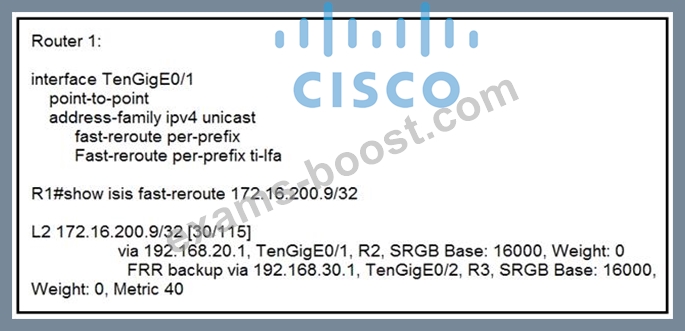
Router 1 is connected to router 2 on interface TenGigE0/1. Which interface provides the alternate path to 172.16.200.9/32 when the link between router 1 and router 2 goes down?
- A. TenGigE0/2 interface provides the alternate path
- B. A primary path must be manually installed
- C. TenGigE0/1 interface provides the alternate path
- D. A backup path must be statically installed
Answer: A
NEW QUESTION # 146
What are three requirements for a static IPv6-in-IPv4 tunnel? (Choose three.)
- A. A static IPv6 address must be configured.
- B. A static IPv4 address must be configured.
- C. Each tunnel endpoint must support IPv4 and IPv6.
- D. A dynamic IPv6 address must be configured.
- E. A dynamic IPv4 address must be configured.
- F. Cisco Express Forwarding must be enabled.
Answer: A,B,C
NEW QUESTION # 147
Refer to the exhibit.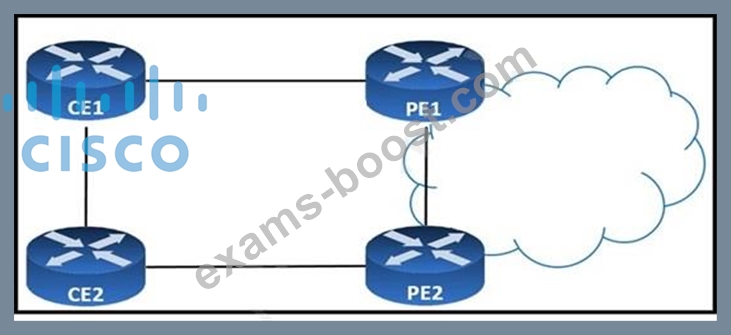
CE1 and CE2 are iBGP neighbors in AS 65516. All traffic that exits AS 65516 must use the link from CE1 to PE1. CE1 is advertising a higher local preference to CE2, but traffic from CE2 still prefers the PE2 link. Which action corrects the problem?
- A. Add the next-hop self command to the CE1 neighbor statement for CE2.
- B. Add the lower local-preference value on PE2 towards CE2.
- C. Configure CE1 to send routes to CE2 with a higher weight.
- D. Configure CE1 to send routes to CE2 with a higher MED.
Answer: A
NEW QUESTION # 148
Refer to the exhibit. A service provider technician is working on a multicast issue for a customer.
While checking the multicast table, the technician notices that no flags are present for the (1.1.1.1, 239.1.1.1) entry, yet flags are present for the (1.1.1.1, 232.1.1.1) entry.
Which factor might explain this issue?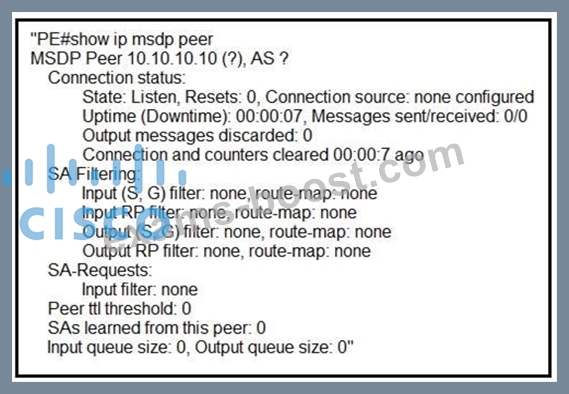
- A. Only the administratively scoped range is permitted
- B. Only GLOP is permitted
- C. Only the default SSM range is permitted
- D. Only ASM is permitted
Answer: C
NEW QUESTION # 149
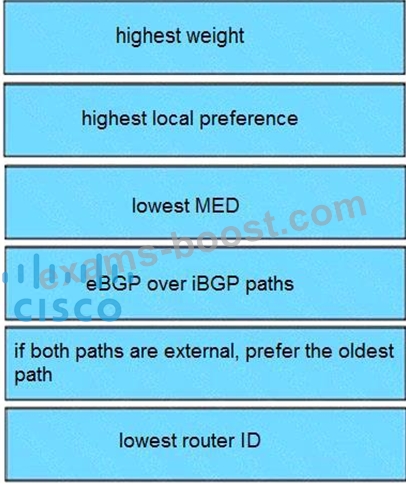
Drag and drop the attributes for the BGP route selection on the left into the correct order on the right. Not all options are used.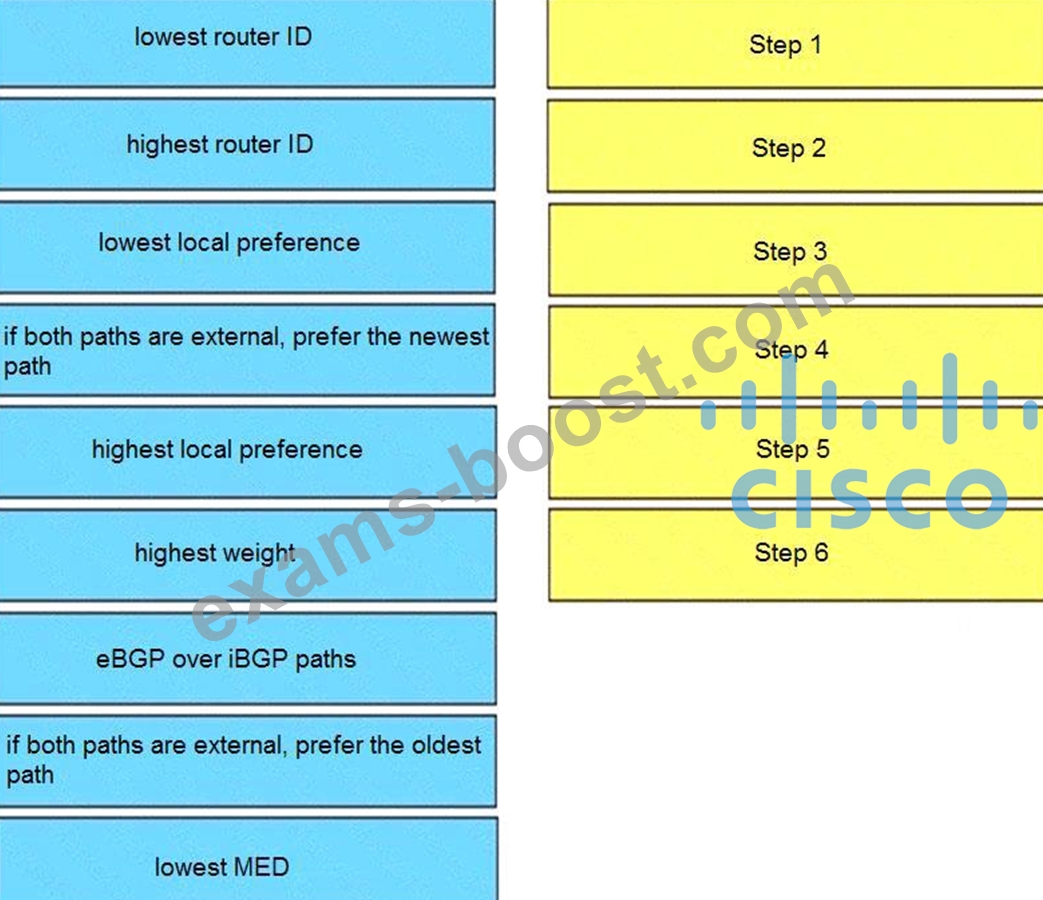
Answer:
Explanation: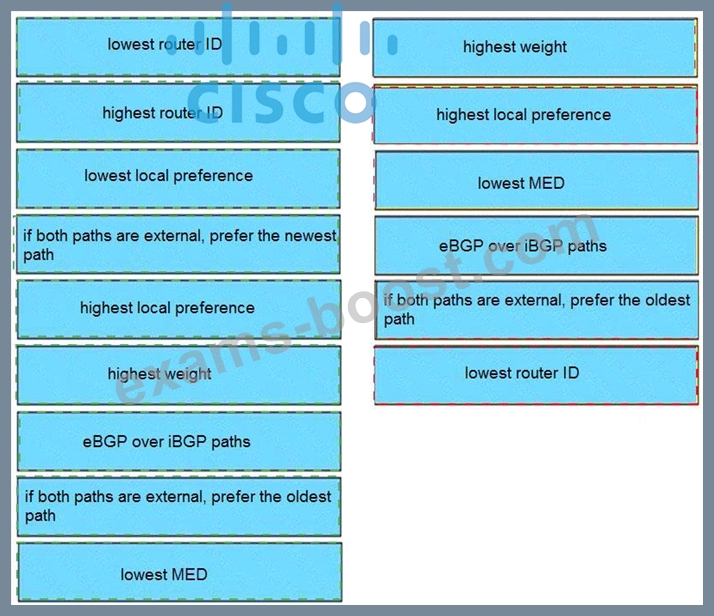
NEW QUESTION # 150
After you change the IP address on an IOS XR router, you cannot ping the new address.
Which step did you forget to complete?
- A. merge the configuration
- B. save the running configuration
- C. roll back the configuration
- D. commit the configuration
Answer: D
NEW QUESTION # 151
Refer to the exhibit.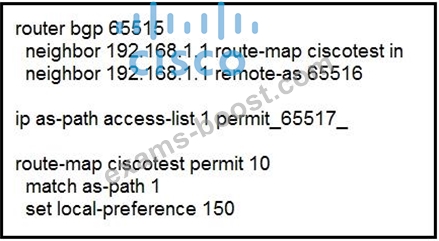
After troubleshooting BGP traffic steering issue, which action did the network operator take to achieve the correct effect of this configuration?
- A. Routes directly attached to AS 65517 have the local preference set to 150.
- B. Routes that have passed through AS 65517 have the local preference set to 150.
- C. Routes that have passed through AS 65517 have the local preference set to 150 and the traffic is denied.
- D. Routes that have originated through AS 65517 have the local preference set to 150.
Answer: B
NEW QUESTION # 152
Refer to the exhibit.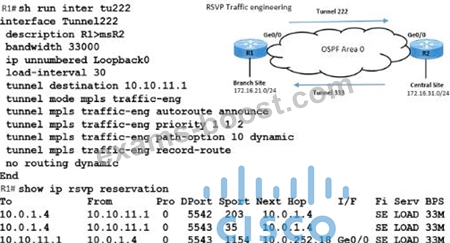
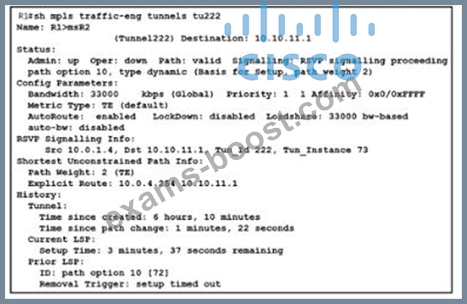
Refer to the exhibit. A network engineer is investigating a report of packet drops between the branch site and the central site.
The two sites are connected via OSPF and RSVP-TE tunnels.
Traffic from the central site to the branch site is passing normally.
Technicians at both sites successfully ping the loopback IP addresses on routers R1 and R2.
Which configuration corrects the packet-drop problem?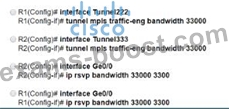
- A. Option A
- B. Option B
- C. Option D
- D. Option C
Answer: C
NEW QUESTION # 153
Refer to the exhibit.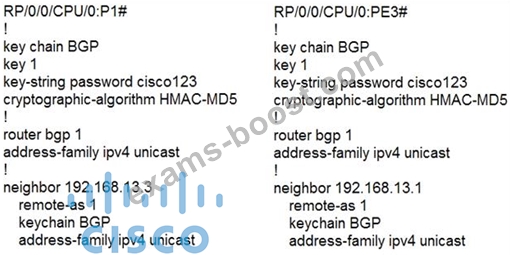
P1 and PE3 Cisco IOS XR routers are directly connected and have this configuration applied. The BGP session is not coming up. Assume that there is no IP reachability problem and both routers can open tcp port 179 to each other. Which action fixes the issue?
- A. Configure the send and accept lifetime under key 1
- B. Change HMAC-MD5 to HMAC-SHA1-12
- C. Change HMAC-MD5 to HMAC-SHA1-20
- D. Change HMAC-MD5 to MD5
Answer: A
NEW QUESTION # 154
Refer to the exhibit.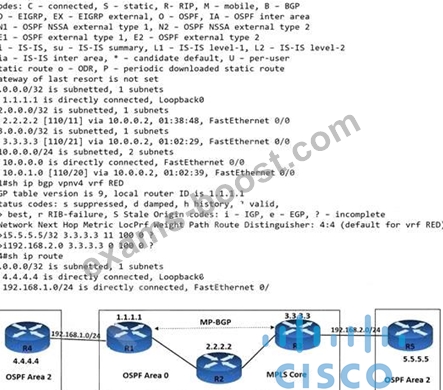
An engineer is troubleshooting connectivity issues on the MPLS core network. A customer connected through R4 cannot reach the OSPF domain on R5. While checking the routing table of R1, the engineer cannot see all the routes from R3 and R5. Which task must the engineer perform so that R4 is able to reach R5?
- A. Enable OSPF peering and configure route redistribution between routers R4 and R1.
- B. Enable OSPF on the Area-0 routers and configure MP-BGP between routers R1 and R3.
- C. Enable MP-BGP peering on routers R1. R3, R4, and R5.
- D. Enable route filtering between routers R1 and R3.
Answer: A
NEW QUESTION # 155
Refer to the exhibit.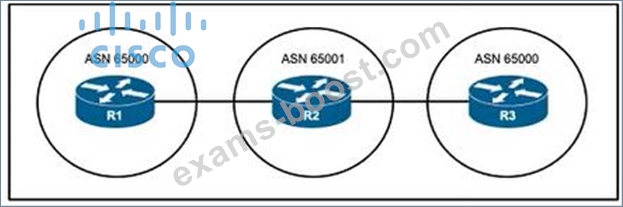
Refer to the exhibit. An engineer is troubleshooting an issue with this network and notices that prefixes from R3 are missing on the R1 routing table Due to repeated ASN when the 10 0 0 0'8 prefix from R3 arrives at R1, BGP automatically rejects it There is no prefix-list on R1 which blocks the traffic from R3 What should the engineer do to fix the problem so that BGP allows that prefix on R1?
- A. Configure identical confederation ASNs on R1 and R2.
- B. Configure the next-hop-self command on R2.
- C. Configure the allowas-in command on R1.
- D. Configure R2 as a route reflector client of R1.
Answer: C
NEW QUESTION # 156
Which command is used to enable BIDIR-PIM under global configuration mode for Cisco IOS XE Sofware?
- A. ipv4 pim bidir-enable
- B. ip multicast-routing
- C. ip pim bidir-enable
- D. ip pim bidir
Answer: C
Explanation:
Reference:
imc_basic_cfg.html
NEW QUESTION # 157
Refer to the exhibit.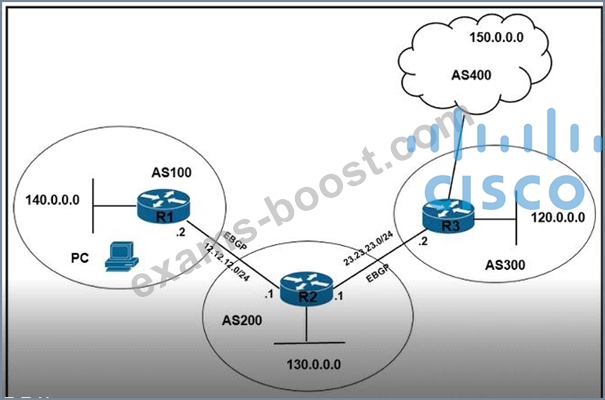
Refer to the exhibit. Excessive routes are flooding from network 150.0.0.0 into AS100. Internet traffic between AS400 and AS300 is working normally. No route controlling mechanism is applied on incoming and outgoing traffic Which configuration resolves the issue?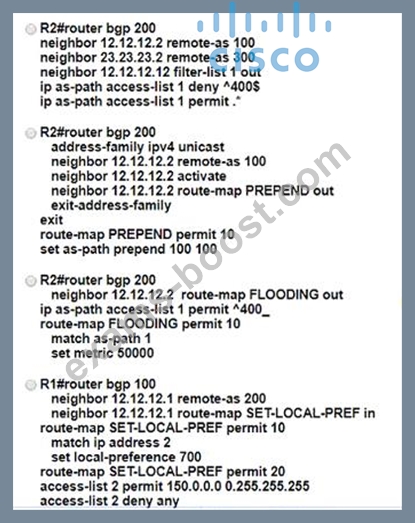
- A. Option B
- B. Option A
- C. Option D
- D. Option C
Answer: B
NEW QUESTION # 158
Which statement about enabling segment routing for IGPs is true?
- A. Segment routing can be enabled only globally
- B. Segment routing can be enabled only under the routing process
- C. Segment routing must first be enabled under then routing process and then globally
- D. Segment routing must first be enabled globally and then under the routing process
Answer: D
Explanation:
Reference:
book/sr-ospfv2-node-sid.html
NEW QUESTION # 159
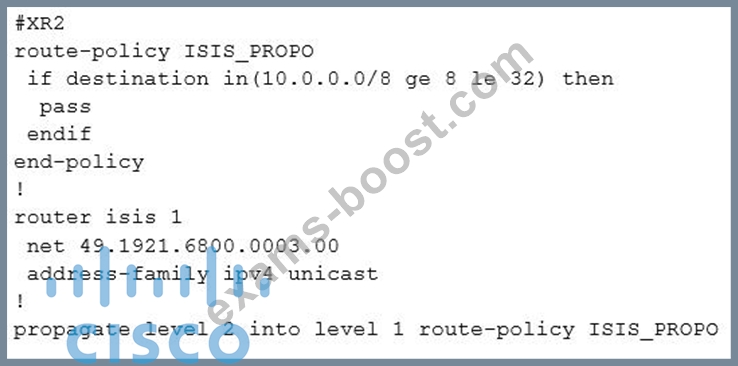
Refer to the exhibit. A network operator must inject a Level 1 route from XR2 (10.16.16.0/24) into the ISIS topology.
Which configuration allows the injection in a way that XR3 and XR1 have a valid and working route for 10.16.16.0/24?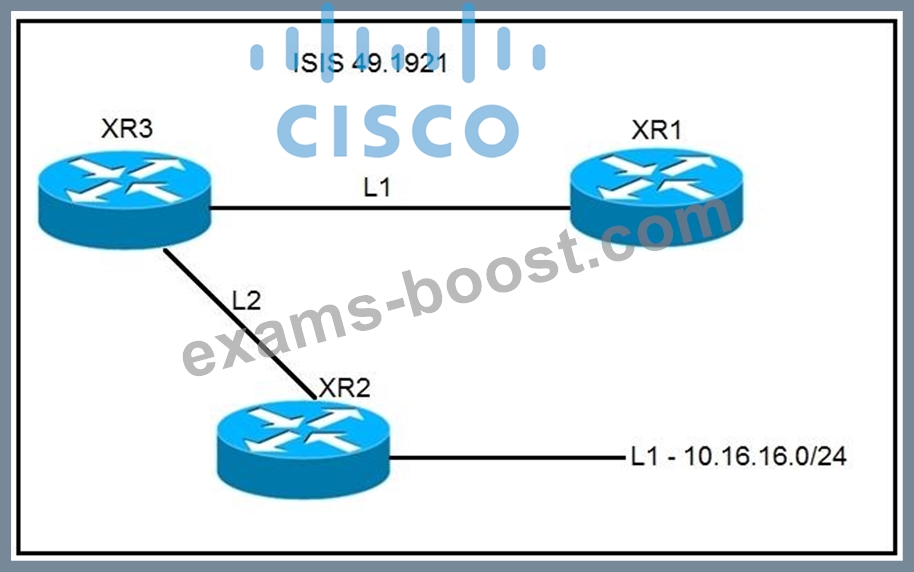
- A.
- B.
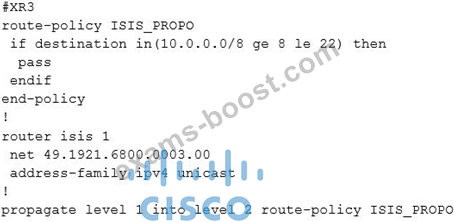
- C.
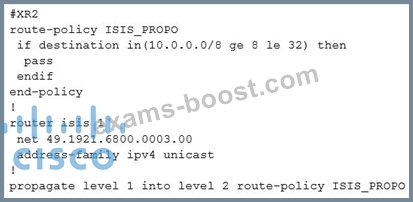
- D.
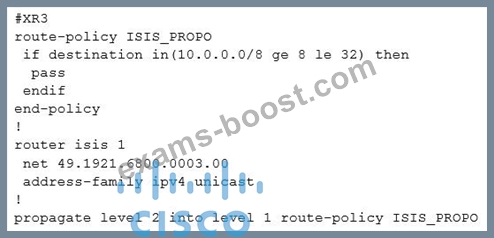
Answer: D
Explanation:
L1 route injected by XR2 won't be advertised to XR1, since L2 routes are NOT leaked to L1 by default. An [L2-L1] route leak policy should be configured on L1/L2 router (XR3).
NEW QUESTION # 160
A network engineer is troubleshooting OSPF multiarea. Which Cisco IOS XR feature should the engineer use in order to streamline OSPF issue?
- A. show lp ospf topology command
- B. routing process enabled by default on all interfaces
- C. DR support for topology management
- D. hierarchical CLI
Answer: D
NEW QUESTION # 161
Refer to the exhibit.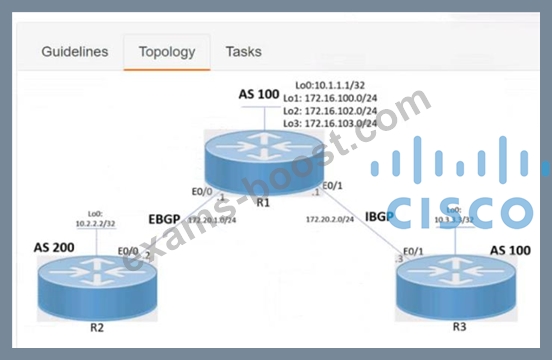
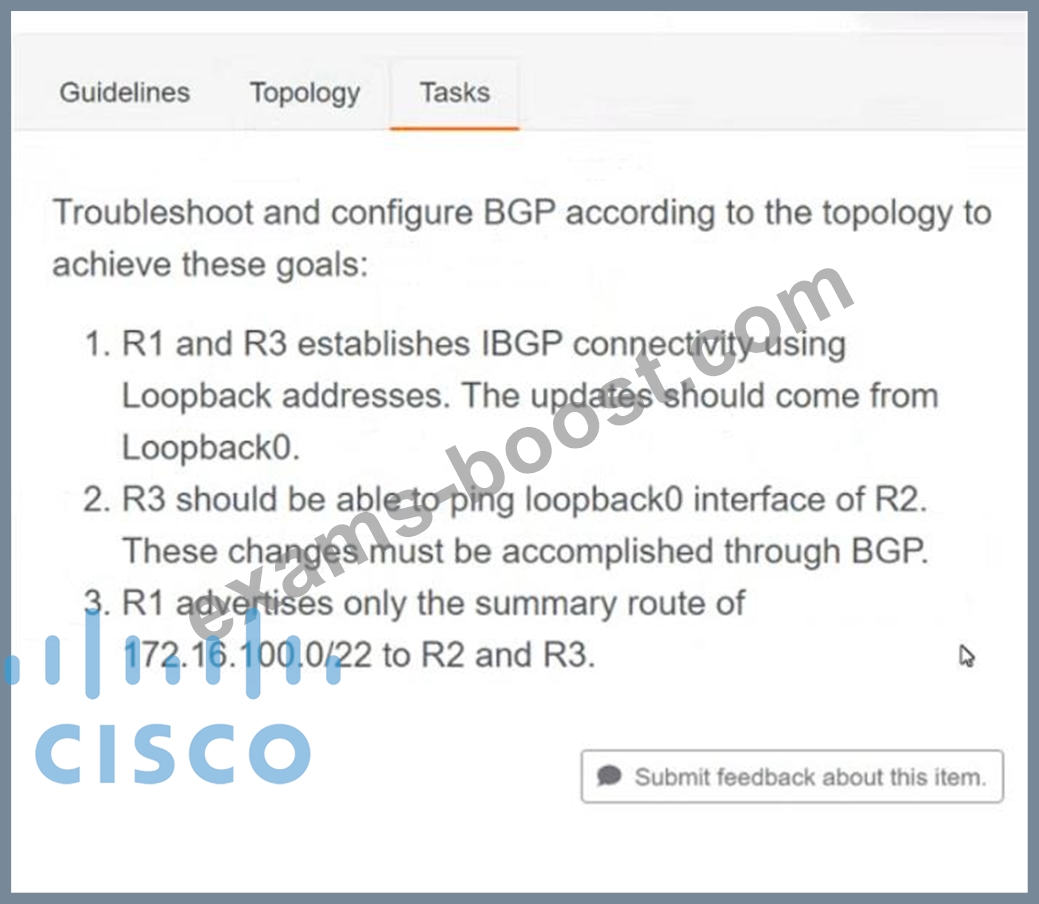
Answer:
Explanation:
Solution :-
R1
Router bgp 100
Neigh 10.3.3.3 remote-as 100
Neigh 10.3.3.3 update-source loopback0
Address-family ipv4
Neigh 10.3.3.3 next-hop-self
Aggregate-address 172.16.100.0 255.255.252.0 summary-only
Copy run start
R3
Router bgp 100
Neigh 10.1.1.1 remote-as 100
Neigh 10.1.1.1 update-source loopback 0
Copy run start
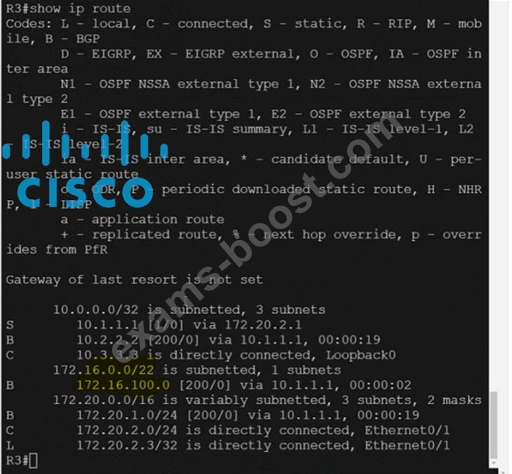
Verification:-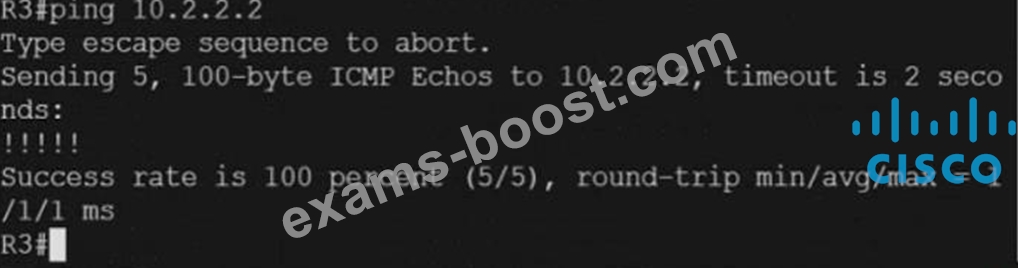
NEW QUESTION # 162 
Refer to the exhibit. XR1 and XR2 are sending the prefix 10.11.11.0/24 to XR3. A configured policy on XR1 is incorrectly prepending AS path 11 11 12 12 onto this prefix. A network operator wants to add a policy onto XR3 that will not allow the falsely prepending prefix from being installed. Which policy configuration applied to the XR3 neighbor configuration for XR1 can accomplish this requirement without impact to other or future received routes?
- A.

- B.

- C.

- D.

Answer: C
Explanation:
Explanation/Reference: https://www.cisco.com/c/en/us/td/docs/routers/crs/software/crs_r4-1/routing/command/reference/ b_routing_cr41crs/b_routing_cr41crs_chapter_01000.html#wp3850885229
NEW QUESTION # 163
Refer to the exhibit.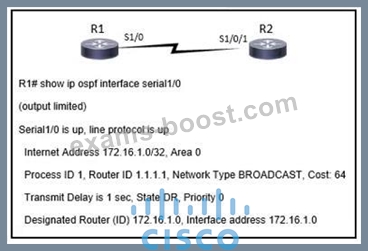
While configuring router 2 with all the default values, a network engineer cannot see any route received in router 1. How should the engineer solve the issue?
- A. Modify the router ID to be the interface IP on the serial.
- B. Set the network type in S1/0 to point-to-point.
- C. Modify the IP address or mask of the interface to a valid one.
- D. Set up a priority different than 0 in the interface.
Answer: C
NEW QUESTION # 164
Refer to the exhibit. All routers in the network are in area 12, with IS-IS running in the default configuration as the IGP. To avoid congestion on the link from R1 to R2, the network architect planned for traffic from R1 to R3 to pass through R4. To meet the requirement, a network engineer set the metric from R1 to R4 to a cost of 15, but the traffic is still travelling through R2.
Which action must the engineer take to resolve the issue?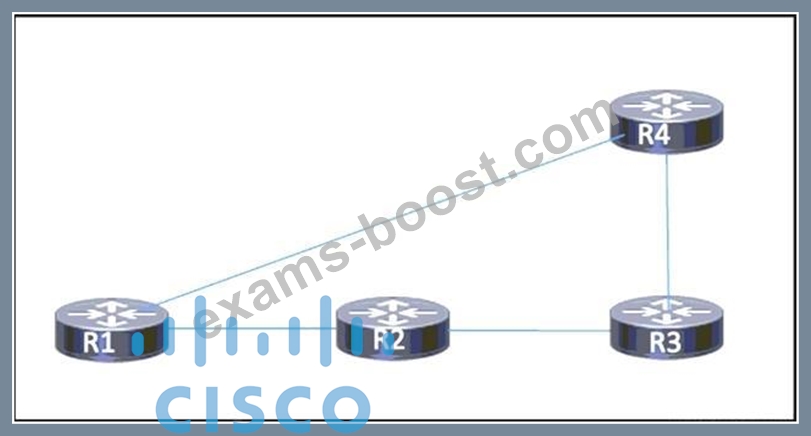
- A. Change the cost on the link from R1 to R2 to 11 and enable narrow metrics.
- B. Change the cost on the link from R1 to R4 to 5.
- C. Change the IS-IS administrative distance to 10.
- D. Change the default metric to 20 on all links and disable wide area metrics.
Answer: A
Explanation:
IS-IS uses default wide metrics to calculate the shortest path, and costs are additive across links.
By default, the IS-IS metric is based on the cost assigned to each link.
The link from R1 to R4 was configured with a metric of 15, but traffic is still passing through R1 - R2 - R3. This indicates that the cost of R1 - R2 - R3 is still lower than the R1 - R4 - R3 path.
Increasing the cost on the link R1 - R2 to 11, which makes it less preferred. Enabling narrow metrics ensures that IS-IS calculates costs using a smaller range of values (1-63), which is often simpler for controlling traffic flows.
NEW QUESTION # 165
......
Cisco 300-510 exam, also known as the Implementing Cisco Service Provider Advanced Routing Solutions exam, is designed for IT professionals who want to validate their expertise in implementing and troubleshooting advanced routing technologies in a service provider network environment. 300-510 exam is one of the requirements for earning the Cisco Certified Specialist - Service Provider Advanced Routing Implementation certification.
We offers you the latest free online 300-510 dumps to practice: https://www.exams-boost.com/300-510-valid-materials.html
Cisco 300-510 Real Exam Questions Guaranteed Updated Dump: https://drive.google.com/open?id=1pujX9wzYh_XQWoYIG_AtYzyZisrJ24KJ