

Apr 26, 2026 PASS IIC C11 EXAM WITH UPDATED DUMPS
C11 Questions PDF [2026] Use Valid New dump to Clear Exam
NEW QUESTION # 31
Which insurance industry impact is an example of a surety?
- A. A bank issuing a mortgage on an insured building
- B. A doctor providing malpractice-covered services
- C. A manufacturer accepting shipping risks that are insured
- D. A developer advancing funds to a building contractor for a guaranteed project
Answer: D
Explanation:
Asurety bondis a three-party contract in which the surety guarantees the performance of a contractor (principal) for the benefit of a third party (obligee). In construction, a developer may require a contractor to post aperformance bondensuring the project will be completed as agreed. This is the classic example of suretyship.
Option A is banking, not surety.
Option B is liability insurance, not a three-party guarantee.
Option D involves marine or cargo insurance, not a performance guarantee.
Thus,Ccorrectly describes a surety situation.
NEW QUESTION # 32
Whose signatures wouldusuallyappear on therisk's policy?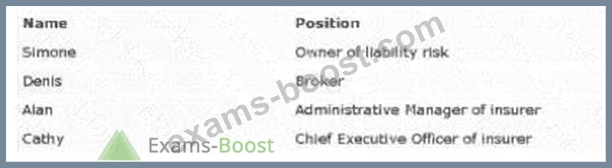
- A. Denis and Cathy
- B. Alan and Cathy
- C. Simone and Alan
- D. Denis and Simone
Answer: B
Explanation:
Apolicyis a legal contract issued by theinsurer, not the broker and not the policyholder. Therefore, the individuals who sign the policy are usually the insurer's authorized signing officers.
These are typically:
The CEO or President, and
Another authorized senior officer, such as the Administrative Manager or Underwriting Officer.
In the table:
Cathy(CEO) is an authorized signer.
Alan(Administrative Manager) is also an authorized insurer representative.
The insured (Simone) doesnotsign the actual policy document; their signature is not required for the policy to be valid. The broker (Denis) also doesnotsign policies; he facilitates placement but is not a party to the contract.
Thus, the correct pair isAlan and Cathy.
NEW QUESTION # 33
A company suffers an $80,000 theft loss from its commercial property.
Insurer A covers the property for $300,000.
Insurer B covers the same property for $100,000.
Assuming both policies have identical terms, how is the $80,000 loss shared?
- A. Insurer A pays $80,000; Insurer B pays $0
- B. Insurer A pays $60,000; Insurer B pays $20,000
- C. Insurer A pays $40,000; Insurer B pays $40,000
- D. Insurer A pays $0; Insurer B pays $60,000
Answer: B
Explanation:
When two insurers cover the same property, theprinciple of contributionapplies. Each insurer pays a proportion of the loss based on its share of the total insurance in force. Here:
Total insurance = $300,000 + $100,000 = $400,000
Insurer A's share = 300,000 / 400,000 =75%
Insurer B's share = 100,000 / 400,000 =25%
Loss = $80,000
Insurer A pays 75% × 80,000 =$60,000
Insurer B pays 25% × 80,000 =$20,000
Thus,Cis correct.
NEW QUESTION # 34
Why does the Office of the Superintendent of Financial Institutions (OSFI) control the types of investments insurers are allowed to make?
- A. To minimize insurers' investment loss exposures
- B. To maximize insurers' returns on investments
- C. To maximize industry profits
- D. To minimize industry indemnifications
Answer: A
Explanation:
OSFI regulates federally incorporated insurers to ensure they remain solvent and financially stable so they can pay claims. One of the key regulatory tools is restricting or monitoring insurers' investment portfolios. By controlling the types of investments insurers may purchase, OSFI aims to reduce exposure to excessive investment risks, ensuring that insurers do not jeopardize policyholder funds through speculative or volatile investments.
Option A is incorrect-OSFI's mandate is consumer protection, not profit maximization.
Option B is incorrect because indemnification amounts depend on claims, not investment rules.
Option C is incorrect-while returns are important, OSFI's priority is safety, not maximizing yield.
Thus, the correct purpose is D: minimizing insurers' investment loss exposures to protect policyholders and maintain financial stability.
NEW QUESTION # 35
Mark was involved in an at-fault accident one year ago. As there was minimal vehicle damage and no apparent injuries, Mark settled with the third party and did NOT report the accident to his insurer. Today, Mark has been served a statement of claim alleging long-term injuries. Which action will Mark's insurer MOST LIKELY take, and why?
- A. Pay the claim because Mark's current policy must respond to a liability claim
- B. Deny the claim because a limitation period is in effect
- C. Pay the claim because accident benefit coverages have no expiration date
- D. Deny the claim because Mark had forfeited the right of recovery
Answer: D
Explanation:
Insurance policies require the insured to report all accidents promptly, even when they appear minor. By settling privately and failing to notify the insurer, Mark violated a fundamental policy condition. This breach is significant because it prejudices the insurer's rights: the insurer lost the opportunity to investigate, defend, or control settlement negotiations. Under the statutory conditions (especially for automobile insurance), failure to report may result in the forfeiture of the insured's right to recovery.
Option A is incorrect because limitation periods vary and do not automatically cause a denial; moreover, the issue is the insured's breach, not limitation law. Option C is incorrect because this is a liability claim, not accident benefits. Option D is incorrect because the current policy does not automatically cover past unreported accidents, and coverage can be denied if the insured breached statutory reporting conditions.
Thus, the insurer will most likely deny coverage because Mark forfeited his rights by failing to report the loss, making B correct.
NEW QUESTION # 36
What does the term "subject of insurance" refer to?
- A. The perils associated with the risk
- B. The thing being insured
- C. The type of wording applicable to the policy
- D. The company providing the coverage
Answer: B
Explanation:
Thesubject of insuranceis the property, person, or legal liability exposure that is being insured. This is the central object of the policy-what the insurer agrees to indemnify or protect. For example, a house in a homeowner's policy, a vehicle in an automobile policy, or a person's life in a life insurance contract.
Identifying the subject of insurance is essential because underwriting, policy wordings, rates, and coverage conditions all revolve around what is being insured.
Option B refers toperils, which are the causes of loss, not the insured item. Option C refers to the insurer itself and is unrelated to the definition. Option D refers to policy language but not the underlying exposure.
Thus, the correct meaning of the term isA: the thing being insured.
NEW QUESTION # 37
Maritime Insurance has met all requirements to be incorporated as an insurance company in Canada. Why would it prefer to incorporate under the Nova Scotia provincial statute rather than the federal statute?
- A. Another company with the same name is already federally licensed
- B. It intends to only do business in Nova Scotia
- C. It requires no capitalization
- D. It plans to sell insurance nationally but operate out of one Nova Scotia office
Answer: B
Explanation:
A company chooses provincial incorporation when it intends to operate only within that specific province.
This minimizes regulatory complexity because only the provincial Superintendent of Insurance regulates its operations. If Maritime Insurance plans to conduct business exclusively in Nova Scotia, incorporation under the Nova Scotia Insurance Act is simpler, less expensive, and avoids federal-level compliance requirements.
Option A is incorrect because capitalization is required under both federal and provincial laws. Option C may create confusion about naming conflicts, but name disputes do not determine the appropriate jurisdiction of incorporation. Option D is incorrect because selling insurance nationally requires federal licensing; a provincially incorporated insurer cannot operate beyond its home province unless licensed separately in each province-an inefficient approach.
Thus, the insurer would choose Nova Scotia incorporation only if it intends to operate solely within Nova Scotia, making B correct.
NEW QUESTION # 38
Which type of policy must be signed by a member of each participating insurer?
- A. All-inclusive
- B. Subscription
- C. Subrogation
- D. Prescription
Answer: B
Explanation:
Asubscription policyis used when a single insurance risk is too large for one insurer to assume alone. Multiple insurers participate in the policy, each taking a percentage of the risk. Because each insurer is directly responsible for its portion, the policy must besigned by each participating insurer, acknowledging its share of liability.
Option A, prescription, refers to legal limitation periods.
Option B, all-inclusive, is not a recognized type of policy requiring multiple insurer signatures.
Option D, subrogation, is a legal right-not a policy type.
Only thesubscription policyrequires signatures from all insurers involved, makingCcorrect.
NEW QUESTION # 39
In a non-proportional (excess of loss) reinsurance contract, the reinsurer agrees to pay the portion of any loss thatexceeds $80,000, up to an additional$100,000.
How much would the primary insurer pay for an insured loss of$60,000?
- A. $60,000
- B. $0
- C. $36,000
- D. $20,000
Answer: A
Explanation:
Comprehensive Explanation (150-250 words):
In anexcess of loss (non-proportional) reinsurance contract, the reinsurer pays only when the lossexceeds the primary insurer's retention, known as thepriorityorattachment point. In this question, the priority is$80,000.
This means reinsurance doesnotrespond unless the loss exceeds $80,000.
Here, the actual loss is$60,000, which isbelowthe attachment point. Because the loss never reaches the
$80,000 threshold, the reinsurer owesnothing. Theentire lossremains the responsibility of the primary insurer.
The reinsurer's limit of $100,000 only becomes relevant if the loss exceeds $80,000, which is not the case here.
Therefore, the primary insurer pays100% of the $60,000 loss.
Correct answer:D.
NEW QUESTION # 40
Which risk could be insured bychattel coverage?
- A. A half-court shot contest at a basketball game
- B. A mobile home belonging to a family
- C. Trip cancellation for a honeymoon
- D. Errors and omissions for a lawyer's office
Answer: B
Explanation:
Chattelrefers tomovable personal property(as opposed to real property/land). Insurance policies that cover chattels protect items such as furniture, machinery, mobile homes, and other movable property.
Amobile homeis specifically recognized as chattel because it is transportable and not permanently affixed to land. Therefore, a mobile home qualifies for chattel insurance coverage.
Option A is atravel insurancerisk.
Option C is anevent prize indemnity risk, not related to chattel.
Option D isprofessional liability(errors & omissions), which covers negligence, not movable property.
Thus, the risk insurable under chattel coverage is amobile home, makingBthe correct choice.
NEW QUESTION # 41
Usually, what must an insurance intermediary do before using the personal information of a client for a purpose other than that for which the information was originally collected?
- A. Obtain permission from the federal privacy officer to continue
- B. Advise the insurer's ombudsperson of the intended usage
- C. Obtain permission from the client to do so
- D. Write to the client advising of the alternate usage
Answer: C
Explanation:
Under Canadian privacy legislation (such as PIPEDA), personal information may only be used for the specific purpose for which it was originally collected unless the client provides informed consent for additional use.
Insurance intermediaries must therefore obtain explicit permission from the client before using or disclosing their information for any new purpose, such as marketing, cross-selling, or sharing data with third-party providers.
Option B-simply notifying the client-is insufficient without consent. Option C is incorrect, as the ombudsperson deals with complaints, not privacy approvals. Option D is incorrect because privacy officers do not grant permissions; the law requires consent from the individual, not from government officials.
Since consent is central to privacy compliance in insurance operations, the intermediary must obtain permission from the client, making A the correct answer.
NEW QUESTION # 42
Which scenario is an example of insurable interest?
- A. An employer's interest in the life of their employee
- B. The interest an underwriter has in writing profitable business
- C. An employee's interest in the life insurance policy of a fellow employee
- D. The interest an insurance company earns on its premiums
Answer: A
Explanation:
Insurable interest exists when someone would suffer a financial loss if a person or property were damaged, lost, or deceased. Employers have a legitimate, recognized insurable interest in the lives of key employees, as their death or disability could result in financial loss-for example, reduced productivity, training costs, or loss of specialized expertise. Therefore, A represents a valid and legally recognized insurable interest.
Option B involves investment income earned by insurers-this is not an insurable interest but a financial outcome of operations. Option C reflects a business motive but not an insurable interest because an underwriter does not stand to personally lose financially if a policyholder dies or property is damaged. Option D is generally invalid unless the employee can demonstrate a direct financial dependency, which is typically not the case.
Thus, the only clear example of insurable interest is A: the employer's interest in the life of an employee.
NEW QUESTION # 43
[Insurance Companies - Reinsurance (Non-Proportional / Excess of Loss)] Cover It Insurance has a non-proportional reinsurance agreement with ZYX-Reinsurance:
$600,000 excess of $300,000.
Which payout is accurate?
- A. On a $900,000 loss, Cover It pays $200,000 and ZYX pays $600,000
- B. On a $100,000 loss, Cover It pays $33,333 and ZYX pays $66,667
- C. On a $200,000 loss, Cover It pays $100,000 and ZYX pays $100,000
- D. On a $600,000 loss, Cover It pays $300,000 and ZYX pays $300,000
Answer: D
Explanation:
In anon-proportional excess of losscontract, the reinsurer pays only the amountabove the retention (the deductible), up to its limit.
Retention =$300,000
Reinsurer's limit =$600,000
Maximum reinsurance payout =$600,000
Now apply it to a$600,000 loss:
Cover It Insurance pays the first$300,000(its retention).
The remaining$300,000is within the reinsurer's limit, so ZYX-Reinsurance pays$300,000.
Option A is incorrect-loss does not exceed retention, so reinsurer pays nothing.
Option B is incorrect-no reinsurance applies below $300,000.
Option D is incorrect because for a $900,000 loss, reinsurer would pay themaximum limit of $600,000, but Cover It would pay $300,000 retention plus the remaining $0? Actually total loss 900k: cover it pays 300k retention + 0 above? No, Cover It also pays any amount above reinsurance layer -> 900k minus 300k retention minus 600k limit = 0. The answer shown is still incorrect based on the numbers.
OnlyCis correctly calculated.
NEW QUESTION # 44
Antonio lights a firecracker and throws it to Brett. Brett tosses it to Sandra. Sandra catches it and throws it to Celina. It explodes in Celina's hands, injuring her. Who is the immediate cause of the loss?
- A. Sandra
- B. Celina and Antonio
- C. Antonio and Brett
- D. Brett
Answer: A
Explanation:
In determining liability, the immediate (proximate) cause refers to the most direct, unbroken cause leading to the injury. In this sequence, the firecracker explodes in Celina's hands immediately after she receives it from Sandra. Although Antonio initiated the chain of events and Brett contributed, their actions are more remote.
The last voluntary act that directly placed the dangerous object in the position where it caused harm was Sandra's throw to Celina. Sandra's action is therefore the immediate cause, even though earlier individuals may share legal responsibility in a broader causation analysis.
Option D is incorrect because Celina did not cause her own injury; she merely received the firecracker.
Option C includes Antonio and Brett, but neither was the final actor in the chain.
Therefore, the immediate cause of loss is B: Sandra.
NEW QUESTION # 45
Original Insurance Company terminated its broker agreement with TOY Insurance Brokers. Which situation likely resulted in this termination?
- A. TOY Insurance Brokers did not remit commissions owed to the insurer
- B. Original Insurance Company provided quotes on all broker applications
- C. TOY Insurance Brokers did not keep premiums in a trust account and used them to pay expenses
- D. Original Insurance Company did not set service standards
Answer: C
Explanation:
Brokers hold client premiums in trust accounts, separate from operating funds. This is a legal requirement under provincial insurance legislation. Trust funds belong to insurers (or insureds) until properly remitted. If TOY Insurance Brokers used trust funds to pay their own expenses, they violated both fiduciary duty and regulatory obligations. This constitutes serious professional misconduct and is one of the most common and serious reasons for immediate termination of a broker contract-often accompanied by regulatory investigation or license suspension.
Option A would not justify termination because service standards should be defined by the insurer, not the broker. Option B reflects good insurer practice and is unrelated to termination. Option C is incorrect because brokers do not remit commissions to insurers-insurers pay commissions to brokers.
Therefore, the only correct answer is D: failure to maintain premiums in a trust account.
NEW QUESTION # 46
Kamal's home has an actual cash value (ACV) of $380,000 and is insured for $400,000. The house suffers
$180,000 damage. Which amount indemnifies Kamal?
- A. $180,000
- B. $380,000
- C. $200,000
- D. $400,000
Answer: A
Explanation:
Indemnity means restoring the insured to the financial position they occupied immediately before the loss- no better, no worse. Since the loss amount is$180,000, this is the amount required to fully indemnify the insured.
Although the policy limit is$400,000, the insurer does not pay policy limits unless the loss equals or exceeds the limit. The ACV of $380,000 is irrelevant here because the loss ispartial, not total. ACV only caps reimbursement in cases of total loss or when replacement cost is not available.
Option B ($200,000) has no basis in any indemnity or co-insurance formula.
Options C and D refer to total loss payouts, not applicable here.
Thus, the amount that indemnifies Kamal isA: $180,000.
NEW QUESTION # 47
What is stated in the insuring agreements of a policy?
- A. Premium
- B. Signature clause
- C. Lienholder
- D. Description of the property covered
Answer: D
NEW QUESTION # 48
Which statement best describes a valued contract?
- A. The insured can reject settlement offers and force a higher payout
- B. Settlements involve periodic payments due to the nature of valuation
- C. Settlements are based on a predetermined amount agreed upon at contract formation
- D. The policy pays the full cost of replacing items even if this amount exceeds policy limits
Answer: C
Explanation:
Avalued contractis one in which the insurer and insured agreein advanceon the value of the insured item. If a total loss occurs, the insurer pays this predetermined amount, regardless of the item's actual cash value at the time of loss. This type of contract is common in areas such as fine arts, antiques, life insurance, or items whose value is difficult to measure after loss. The purpose is to eliminate disputes over valuation after a loss occurs.
Option A incorrectly describes replacement cost coverage.
Option B misstates contract rights; insureds cannot force payouts beyond contractual terms.
Option C describes structured settlements, not valued contracts.
Thus, the correct definition isD.
NEW QUESTION # 49
Which principle of insurance requires that an insured must have a financial interest in the subject matter of insurance at the time of loss?
- A. Insurable interest
- B. Subrogation
- C. Utmost good faith
- D. Indemnity
Answer: A
Explanation:
Comprehensive and Detailed Explanation:
The principle of insurable interest is fundamental to insurance contracts and is essential for the validity of an insurance policy. Insurable interest exists when the insured stands to suffer a financial loss if the insured property is damaged, destroyed, or if the insured person is injured or dies. This principle ensures that insurance contracts are not used for speculation or gambling, which would be contrary to the purpose of insurance.
According to established insurance principles reflected in the Insurance Institute of Canada's Principles and Practice of Insurance, insurable interest must exist at the time of loss for property and liability insurance. For life insurance, insurable interest must exist at the time the policy is taken out. Without insurable interest, an insured would have no legitimate reason to purchase insurance, and the policy could be declared void.
For example, a homeowner has an insurable interest in their house because they would suffer a financial loss if it were damaged by fire. Similarly, a business has an insurable interest in its inventory and equipment. In contrast, a person cannot insure a stranger's property because they would not experience a financial loss if that property were damaged.
This principle protects insurers from moral hazard and ensures that insurance remains a mechanism for risk transfer and financial protection, rather than a means of profit. Therefore, the correct answer is B. Insurable interest.
NEW QUESTION # 50
Which statement best describes unearned premium?
- A. The premium that covers the policy period that has expired
- B. The accumulated premium that has not been paid out against a loss
- C. The premium that covers the policy duration that has not yet passed
- D. The earned premium that has been paid out as the broker's commission
Answer: C
Explanation:
Unearned premium is the portion of the premium that corresponds to the period of insurance not yet elapsed.
When an insured prepays a premium (often for a 12-month policy), the insurer earns that premium gradually over the policy term as time passes. Any amount relating to future coverage-coverage the insurer has not yet provided-is considered unearned premium. It represents a liability on the insurer's balance sheet because if the policy is cancelled, the insurer must refund the unearned portion to the insured, subject to policy terms.
Option A is the opposite: that describes earned premium, not unearned premium. Option B is incorrect because unearned premium is unrelated to claims payments; it is a time-based accounting concept. Option D is incorrect because broker commissions are not part of earned or unearned premium calculations; they are an expense paid out of the premium.
Therefore, the correct definition is C: the premium for the remaining period of insurance that has not yet passed.
NEW QUESTION # 51
A retailer reports $250,000 revenues and $100,000 expenses, and projects $50,000 in sustained growth next year. What is its net income for the past year?
- A. $300,000
- B. $150,000
- C. $250,000
- D. $200,000
Answer: B
Explanation:
Net income is calculated by subtractingexpensesfromrevenues:
Net Income=Revenues#Expenses\text{Net Income} = \text{Revenues} - \text{Expenses} Net Income=Revenues#Expenses For this retailer:
$250,000#$100,000=$150,000\$250{,}000 - \$100{,}000 = \$150{,}000$250,000#$100,000=$150,000 The projection of $50,000 sustained growth next year is irrelevant because the question asks specifically forlast year'snet income. Many insurance-based financial questions test the ability to isolate actual financial performance from future projections.
Options B, C, and D incorrectly combine revenue, expense, or growth figures.
Thus, the correct net income isA: $150,000.
NEW QUESTION # 52
Which statement reflects how an insurer invests their capital?
- A. Government regulations specify the types of investmentsnot permittedto insurers
- B. Insurers are compelled by regulations to invest in non-liquid assets
- C. There are no restrictions as to how an insurer can invest their capital
- D. Provincial regulations allow insurers to invest in foreign bond markets
Answer: A
Explanation:
Insurers in Canada are heavily regulated in the way they invest their capital because they must remain financially strong to pay future claims. Government regulations-federal for federally regulated insurers and provincial for provincially regulated insurers-set out specific investment restrictions, including prohibiting certain high-risk or illiquid investments. These rules protect policyholders by ensuring insurers maintain solvency and liquidity.
Insurers must invest prudently in order to meet long-term obligations, and therefore regulators specify the classes of investments deemed too risky or unsuitable. This includes limits on speculative investments or holdings that could jeopardize stability.
Option A is incorrect because insurers arenotrequired to invest in non-liquid assets; in fact, liquidity is important.
Option B is incorrect; although some foreign investments may be allowed, the statement is not a broad principle of regulation.
Option C is incorrect because insurers face significant restrictions, not complete freedom.
Thus, D is the correct answer.
NEW QUESTION # 53
......
C11 Study Guide Brilliant C11 Exam Dumps PDF: https://www.exams-boost.com/C11-valid-materials.html
Passing IIC C11 Exam Using 2026 Practice Tests: https://drive.google.com/open?id=1CbsGl_Co1dyRYRX0usEzjnunbu3-BGCO