

DP-100 Exam Dumps Pass with Updated 2025 Certified Exam Questions
DP-100 Exam Questions - Real & Updated Questions PDF
Career Opportunities, Roles, and Salary
After obtaining the Microsoft Certified: Azure Data Scientist Associate certification, you become eligible for the data scientist role. Also, with this certification, you can expect to earn a decent remuneration of about $97k on average annually, as stated by PayScale.com. The expected career paths for a data scientist also include senior data scientist with a salary potential of $126,778 and data science manager with a salary potential of $136,781. Another possible path is that of a data science director with a potential pay of $157,095 annually. However, remember that besides, such a certificate work experience also matters.
NEW QUESTION # 115
You create an Azure Machine Learning workspace. The workspace contains a dataset named sample.dataset, a compute instance, and a compute cluster. You must create a two-stage pipeline that will prepare data in the dataset and then train and register a model based on the prepared data. The first stage of the pipeline contains the following code: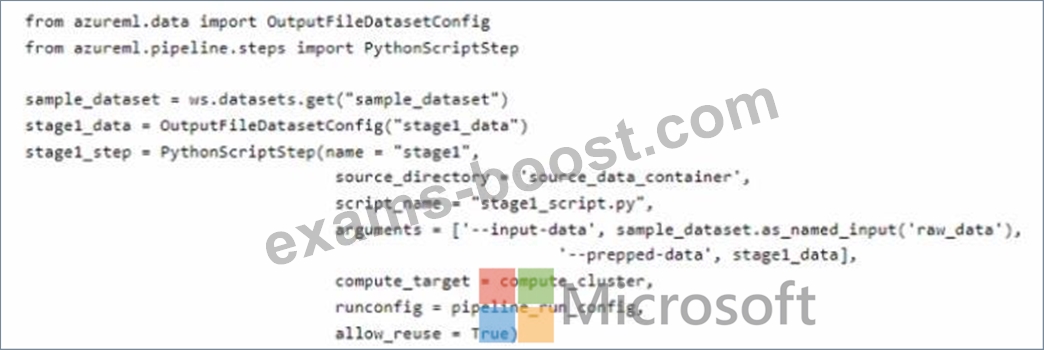
You need to identify the location containing the output of the first stage of the script that you can use as input for the second stage. Which storage location should you use?
- A. workspaceblobstore datastore
- B. compute instance
- C. workspacefi lest ore datastore
Answer: B
NEW QUESTION # 116
You use the Azure Machine Learning SDK in a notebook to run an experiment using a script file in an experiment folder.
The experiment fails.
You need to troubleshoot the failed experiment.
What are two possible ways to achieve this goal? Each correct answer presents a complete solution.
- A. View the logs for the experiment run in Azure Machine Learning studio.
- B. Use the get_output() method of the run object to retrieve the experiment run logs.
- C. Use the get_details_with_logs() method of the run object to display the experiment run logs.
- D. Use the get_metrics() method of the run object to retrieve the experiment run logs.
- E. View the log files for the experiment run in the experiment folder.
Answer: A,C
Explanation:
Use get_details_with_logs() to fetch the run details and logs created by the run.
You can monitor Azure Machine Learning runs and view their logs with the Azure Machine Learning studio.
Incorrect Answers:
A: You can view the metrics of a trained model using run.get_metrics().
E: get_output() gets the output of the step as PipelineData.
Reference:
https://docs.microsoft.com/en-us/python/api/azureml-pipeline-core/azureml.pipeline.core.steprun
https://docs.microsoft.com/en-us/azure/machine-learning/how-to-monitor-view-training-logs
NEW QUESTION # 117
You have an Azure Machine Learning workspace
You plan to use the Azure Machine Learning SDK for Python v1 to submit a job to run a training script.
You need to complete the script to ensure that it will execute the training script.
How should you complete the script? To answer, select the appropriate options in the answer area.
NOTE: Each correct selection is worth one point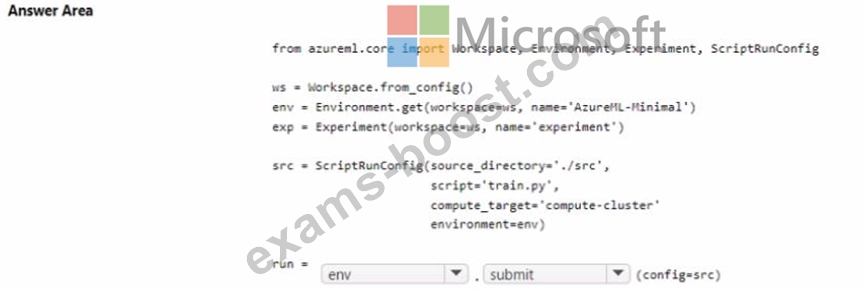
Answer:
Explanation: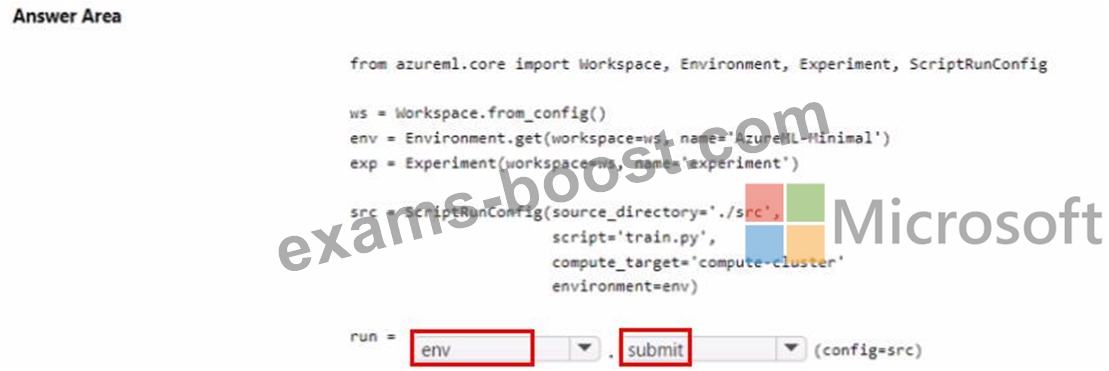
NEW QUESTION # 118
You are moving a large dataset from Azure Machine Learning Studio to a Weka environment.
You need to format the data for the Weka environment.
Which module should you use?
- A. Convert to Dataset
- B. Convert to CSV
- C. Convert to SVMLight
- D. Convert to ARFF
Answer: D
Explanation:
Use the Convert to ARFF module in Azure Machine Learning Studio, to convert datasets and results in Azure Machine Learning to the attribute-relation file format used by the Weka toolset. This format is known as ARFF.
The ARFF data specification for Weka supports multiple machine learning tasks, including data preprocessing, classification, and feature selection. In this format, data is organized by entites and their attributes, and is contained in a single text file.
References:
https://docs.microsoft.com/en-us/azure/machine-learning/studio-module-reference/convert-to-arff Prepare data for modeling Testlet 1 Case study Overview You are a data scientist in a company that provides data science for professional sporting events. Models will use global and local market data to meet the following business goals:
* Understand sentiment of mobile device users at sporting events based on audio from crowd reactions.
* Assess a user's tendency to respond to an advertisement.
* Customize styles of ads served on mobile devices.
* Use video to detect penalty events
Current environment
* Media used for penalty event detection will be provided by consumer devices. Media may include images and videos captured during the sporting event and shared using social media. The images and videos will have varying sizes and formats.
* The data available for model building comprises of seven years of sporting event media. The sporting event media includes; recorded video transcripts or radio commentary, and logs from related social media feeds captured during the sporting events.
* Crowd sentiment will include audio recordings submitted by event attendees in both mono and stereo formats.
Penalty detection and sentiment
* Data scientists must build an intelligent solution by using multiple machine learning models for penalty event detection.
* Data scientists must build notebooks in a local environment using automatic feature engineering and model building in machine learning pipelines.
* Notebooks must be deployed to retrain by using Spark instances with dynamic worker allocation.
* Notebooks must execute with the same code on new Spark instances to recode only the source of the data.
* Global penalty detection models must be trained by using dynamic runtime graph computation during training.
* Local penalty detection models must be written by using BrainScript.
* Experiments for local crowd sentiment models must combine local penalty detection data.
* Crowd sentiment models must identify known sounds such as cheers and known catch phrases. Individual crowd sentiment models will detect similar sounds.
* All shared features for local models are continuous variables.
* Shared features must use double precision. Subsequent layers must have aggregate running mean and standard deviation metrics available.
Advertisements
During the initial weeks in production, the following was observed:
* Ad response rated declined.
* Drops were not consistent across ad styles.
* The distribution of features across training and production data are not consistent Analysis shows that, of the 100 numeric features on user location and behavior, the 47 features that come from location sources are being used as raw features. A suggested experiment to remedy the bias and variance issue is to engineer 10 linearly uncorrelated features.
* Initial data discovery shows a wide range of densities of target states in training data used for crowd sentiment models.
* All penalty detection models show inference phases using a Stochastic Gradient Descent (SGD) are running too slow.
* Audio samples show that the length of a catch phrase varies between 25%-47% depending on region
* The performance of the global penalty detection models shows lower variance but higher bias when comparing training and validation sets. Before implementing any feature changes, you must confirm the bias and variance using all training and validation cases.
* Ad response models must be trained at the beginning of each event and applied during the sporting event.
* Market segmentation models must optimize for similar ad response history.
* Sampling must guarantee mutual and collective exclusively between local and global segmentation models that share the same features.
* Local market segmentation models will be applied before determining a user's propensity to respond to an advertisement.
* Ad response models must support non-linear boundaries of features.
* The ad propensity model uses a cut threshold is 0.45 and retrains occur if weighted Kappa deviated from
0.1 +/- 5%.
* The ad propensity model uses cost factors shown in the following diagram: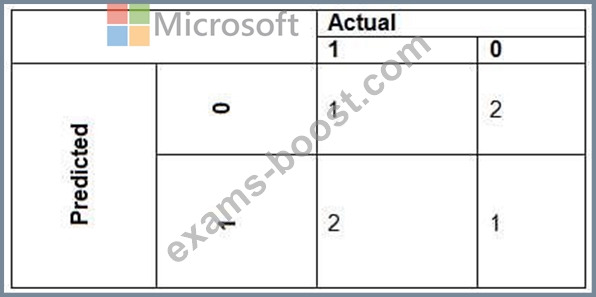
* The ad propensity model uses proposed cost factors shown in the following diagram: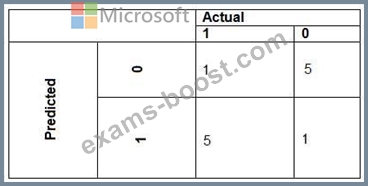
* Performance curves of current and proposed cost factor scenarios are shown in the following diagram: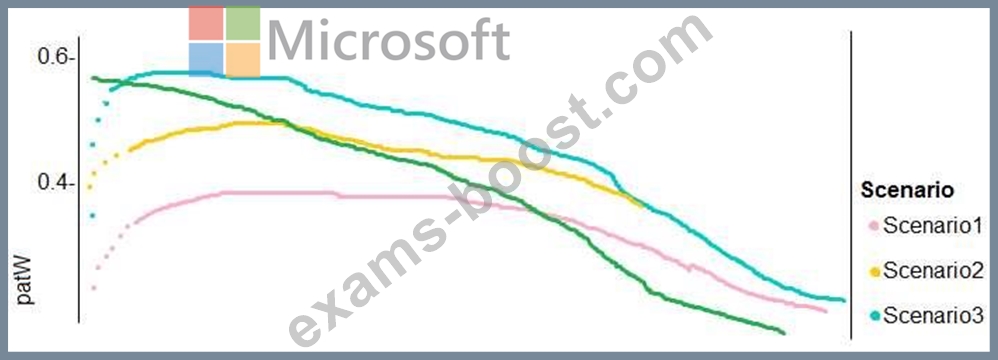
NEW QUESTION # 119
You are using C-Support Vector classification to do a multi-class classification with an unbalanced training dataset. The C-Support Vector classification using Python code shown below:
You need to evaluate the C-Support Vector classification code.
Which evaluation statement should you use? To answer, select the appropriate options in the answer area.
NOTE: Each correct selection is worth one point.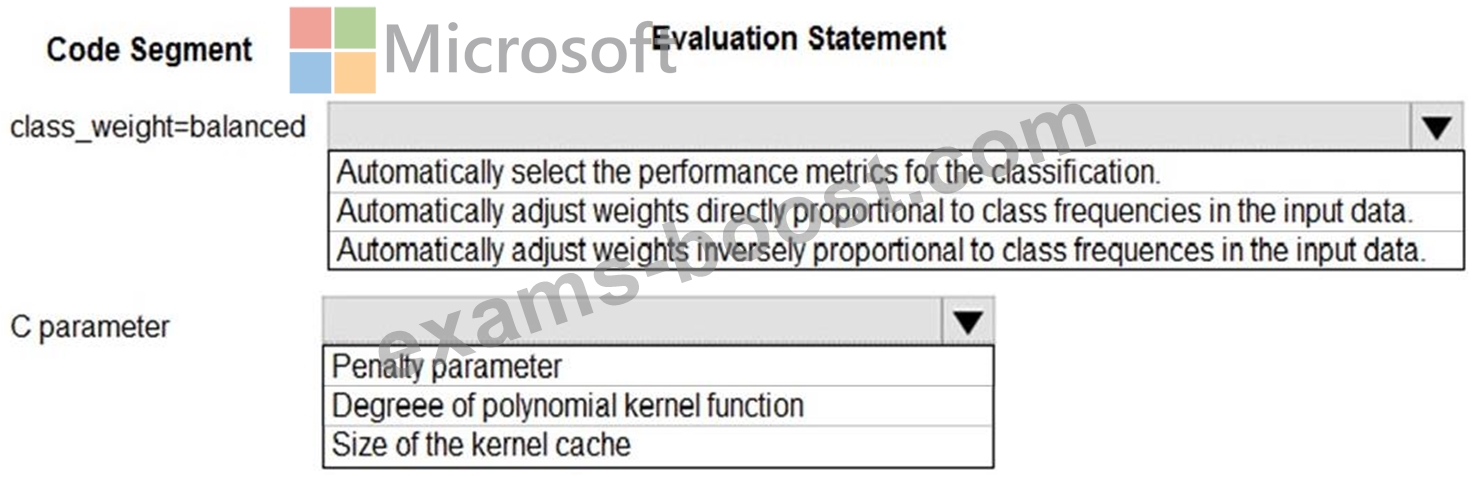
Answer:
Explanation: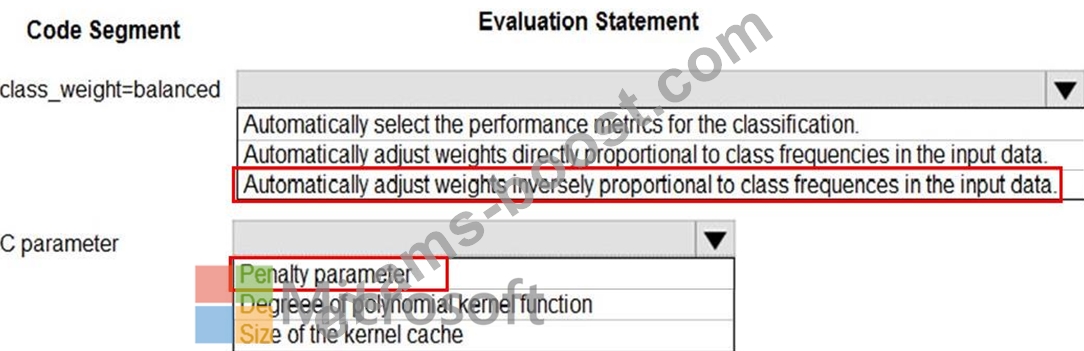
Reference:
https://scikit-learn.org/stable/modules/generated/sklearn.svm.SVC.html
NEW QUESTION # 120
You need to correct the model fit issue.
Which three actions should you perform in sequence? To answer, move the appropriate actions from the list of actions to the answer area and arrange them in the correct order.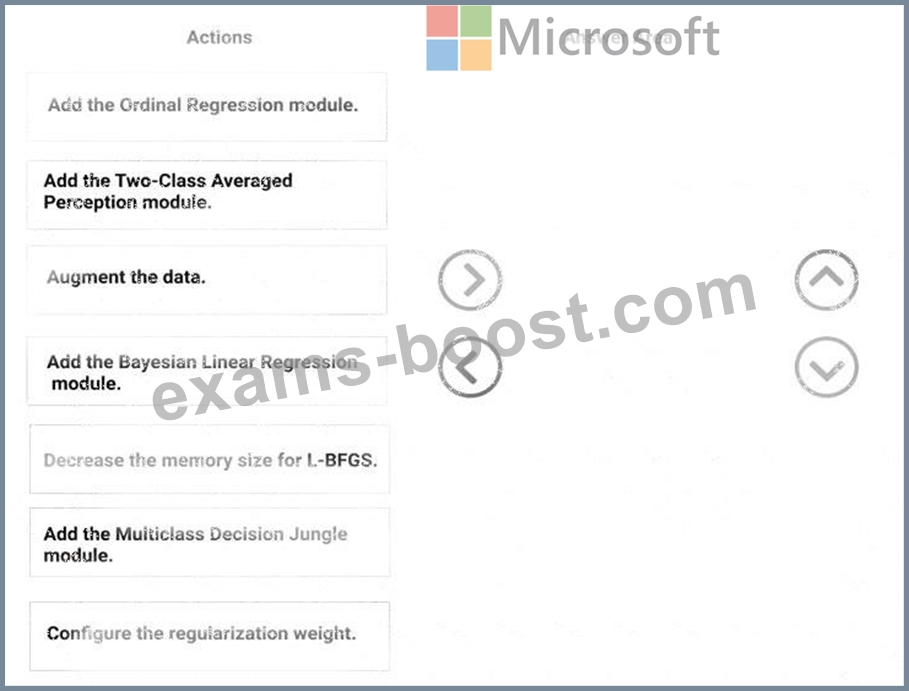
Answer:
Explanation: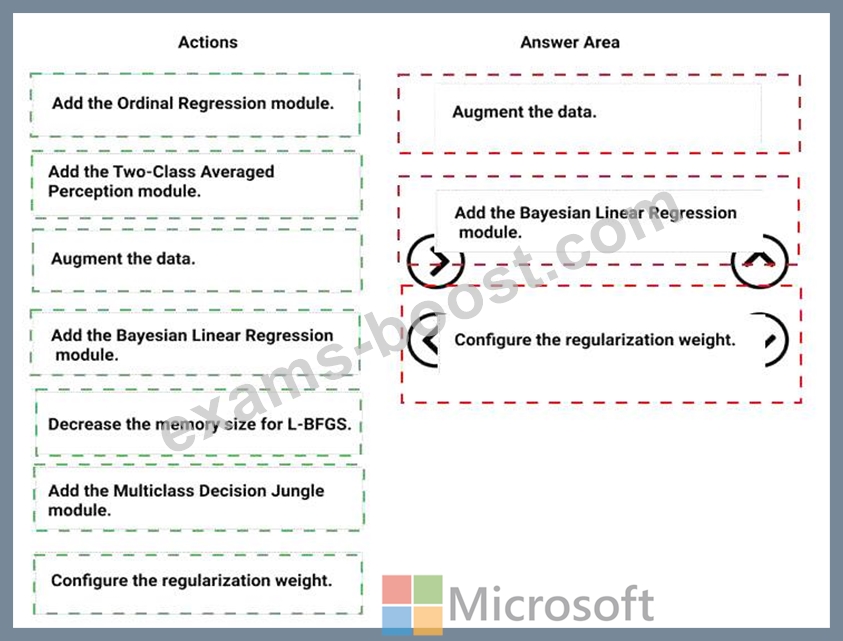
Explanation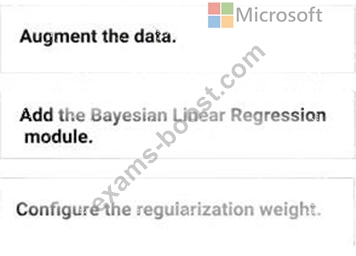
Step 1: Augment the data
Scenario: Columns in each dataset contain missing and null values. The datasets also contain many outliers.
Step 2: Add the Bayesian Linear Regression module.
Scenario: You produce a regression model to predict property prices by using the Linear Regression and Bayesian Linear Regression modules.
Step 3: Configure the regularization weight.
Regularization typically is used to avoid overfitting. For example, in L2 regularization weight, type the value to use as the weight for L2 regularization. We recommend that you use a non-zero value to avoid overfitting.
Scenario:
Model fit: The model shows signs of overfitting. You need to produce a more refined regression model that reduces the overfitting.
NEW QUESTION # 121
You configure a Deep Learning Virtual Machine for Windows.
You need to recommend tools and frameworks to perform the following:
Build deep neural network (DNN) models
Perform interactive data exploration and visualization
Which tools and frameworks should you recommend? To answer, drag the appropriate tools to the correct tasks. Each tool may be used once, more than once, or not at all. You may need to drag the split bar between panes or scroll to view content.
NOTE: Each correct selection is worth one point.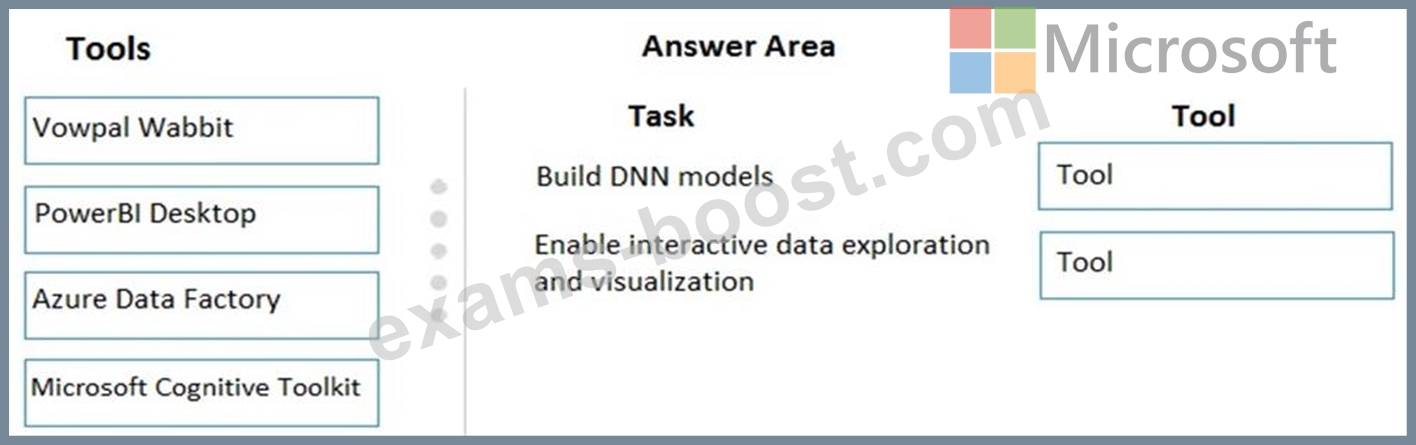
Answer:
Explanation: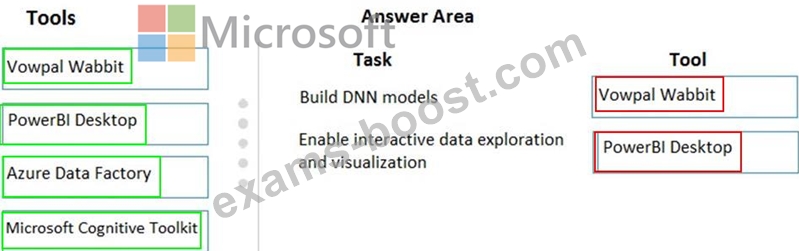
Reference:
https://docs.microsoft.com/en-us/azure/machine-learning/studio-module-reference/train-vowpal-wabbit-version-8-model
https://docs.microsoft.com/en-us/azure/architecture/data-guide/scenarios/interactive-data-exploration
NEW QUESTION # 122
You manage an Azure Machine Learning workspace named workspace1 by using the Python SDK v2.
You must register datastores in workspace1 for Azure Blob and Azure Data Lake Gen2 storage to meet the following requirements:
* Data scientists accessing the datastore must have the same level of access.
* Access must be restricted to specified containers or folders.
You need to configure a security access method used to register the Azure Blob and Azure Data lake Gen? storage in workspace1. Which security access method should you configure? To answer, select the appropriate options in the answers area.
NOTE: Each correct selection is worth one point.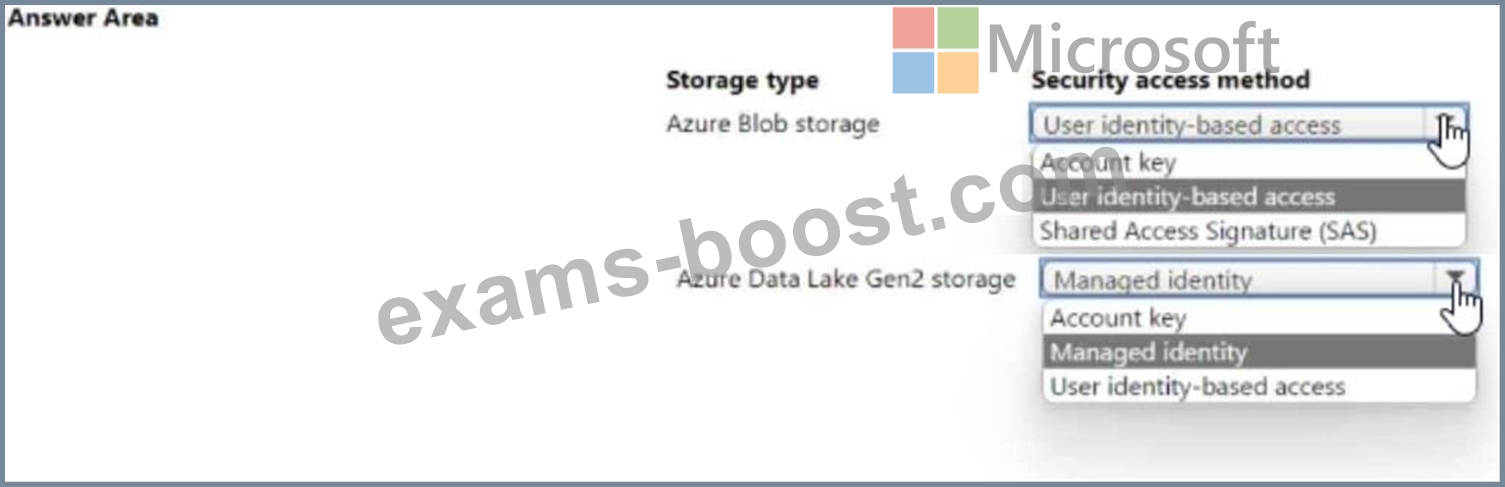
Answer:
Explanation: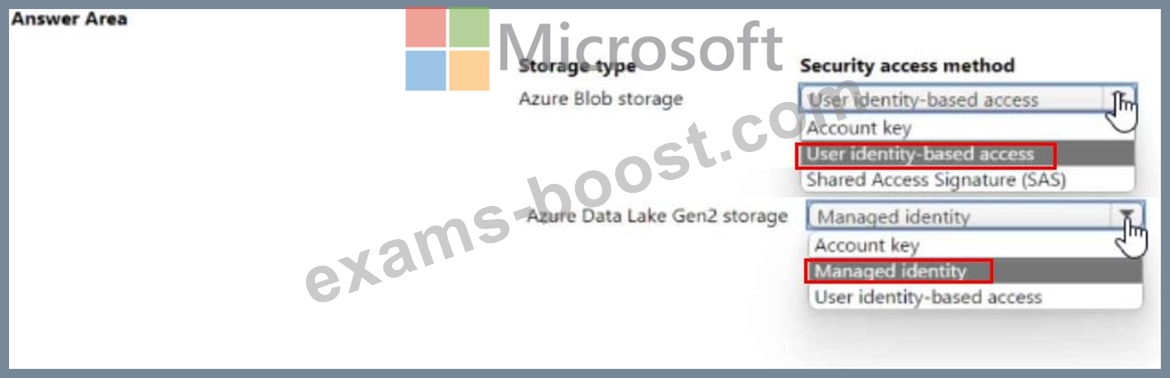
NEW QUESTION # 123
You are tuning a hyperparameter for an algorithm. The following table shows a data set with different hyperparameter, training error, and validation errors.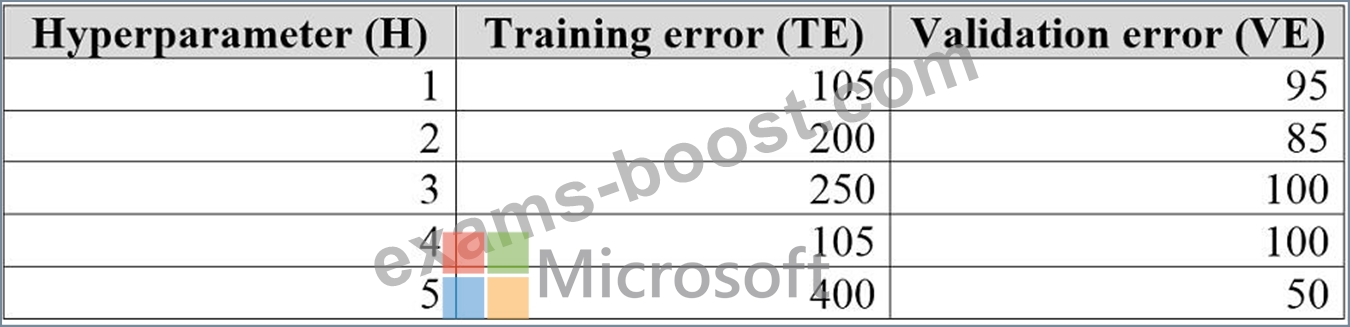
Use the drop-down menus to select the answer choice that answers each question based on the information presented in the graphic.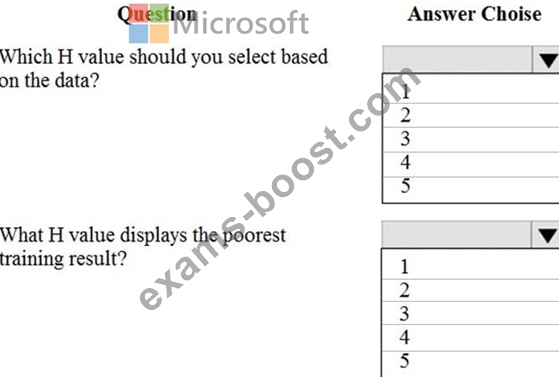
Answer:
Explanation: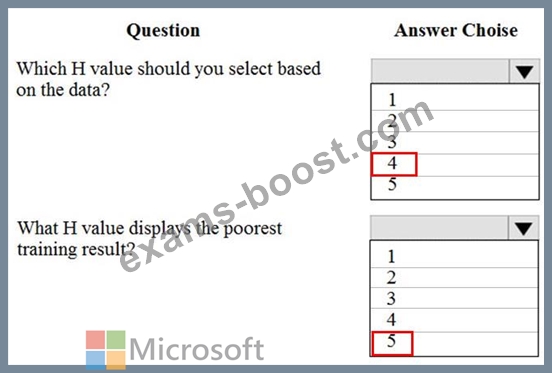
).
Reference:
https://medium.com/comet-ml/organizing-machine-learning-projects-project-management-guidelines-2d2b85651bbd
NEW QUESTION # 124
You are working on a classification task. You have a dataset indicating whether a student would like to play soccer and associated attributes. The dataset includes the following columns: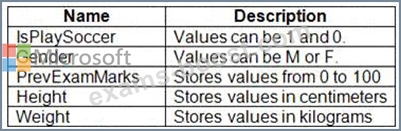
You need to classify variables by type.
Which variable should you add to each category? To answer, select the appropriate options in the answer area.
NOTE: Each correct selection is worth one point.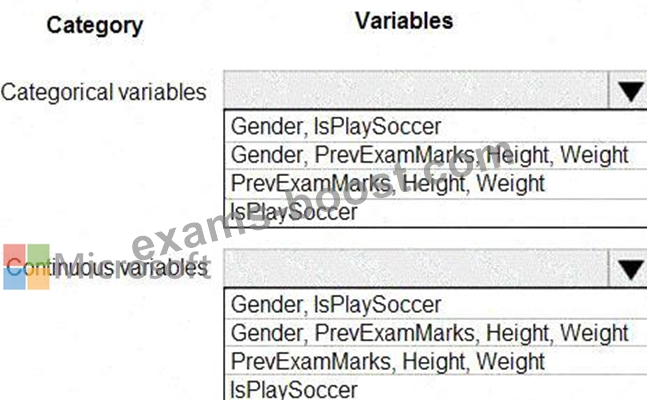
Answer:
Explanation: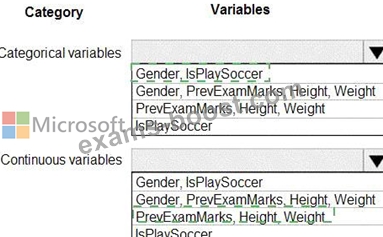
Explanation: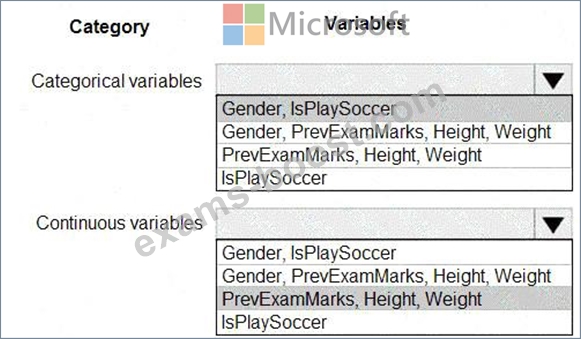
References:
https://www.edureka.co/blog/classification-algorithms/
NEW QUESTION # 125
You create an Azure Machine Learning workspace. You train an MLflow-formatted regression model by using tabular structured data.
You must use a Responsible AI dashboard to assess the model.
You need to use the Azure Machine Learning studio UI to generate the Responsible AI dashboard.
What should you do first?
- A. Create the model explanations.
- B. Register the model with the workspace.
- C. Deploy the model to a managed online endpoint.
- D. Convert the model from the MLflow format to a custom format.
Answer: B
Explanation:
Responsible AI dashboards are linked to your registered models. To view your Responsible AI dashboard, go into your model registry and select the registered model you've generated a Responsible AI dashboard for. Then, select the Responsible AI tab to view a list of generated dashboards.
https://learn.microsoft.com/en-us/azure/machine-learning/how-to-responsible-ai- dashboard?view=azureml-api-2
NEW QUESTION # 126
You have a binary classifier that predicts positive cases of diabetes within two separate age groups.
The classifier exhibits a high degree of disparity between the age groups.
You need to modify the output of the classifier to maximize its degree of fairness across the age groups and meet the following requirements:
* Eliminate the need to retrain the model on which the classifier is based.
* Minimize the disparity between true positive rates and false positive rates across age groups.
Which algorithm and panty constraint should you use? To answer, select the appropriate options in the answer are a. NOTE: Each correct selection is worth one point.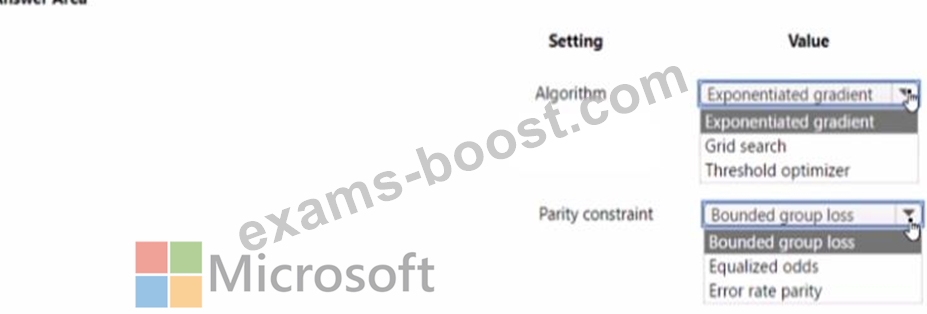
Answer:
Explanation: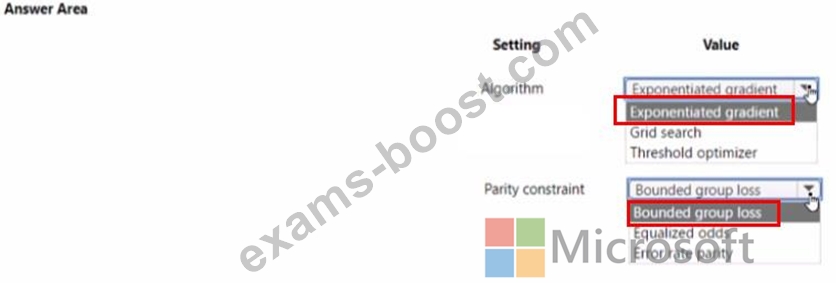
NEW QUESTION # 127
You plan to use automated machine learning to train a regression model. You have data that has features which have missing values, and categorical features with few distinct values.
You need to configure automated machine learning to automatically impute missing values and encode categorical features as part of the training task.
Which parameter and value pair should you use in the AutoMLConfig class?
- A. task = 'classification'
- B. featurization = 'auto'
- C. enable_voting_ensemble = True
- D. enable_tf = True
- E. exclude_nan_labels = True
Answer: B
Explanation:
Featurization str or FeaturizationConfig
Values: 'auto' / 'off' / FeaturizationConfig
Indicator for whether featurization step should be done automatically or not, or whether customized featurization should be used.
Column type is automatically detected. Based on the detected column type preprocessing/featurization is done as follows:
Categorical: Target encoding, one hot encoding, drop high cardinality categories, impute missing values.
Numeric: Impute missing values, cluster distance, weight of evidence.
DateTime: Several features such as day, seconds, minutes, hours etc.
Text: Bag of words, pre-trained Word embedding, text target encoding.
Reference:
https://docs.microsoft.com/en-us/python/api/azureml-train-automl-
client/azureml.train.automl.automlconfig.automlconfig
NEW QUESTION # 128
You use Azure Machine Learning to train and register a model.
You must deploy the model into production as a real-time web service to an inference cluster named service-compute that the IT department has created in the Azure Machine Learning workspace.
Client applications consuming the deployed web service must be authenticated based on their Azure Active Directory service principal.
You need to write a script that uses the Azure Machine Learning SDK to deploy the model. The necessary modules have been imported.
How should you complete the code? To answer, select the appropriate options in the answer area.
NOTE: Each correct selection is worth one point.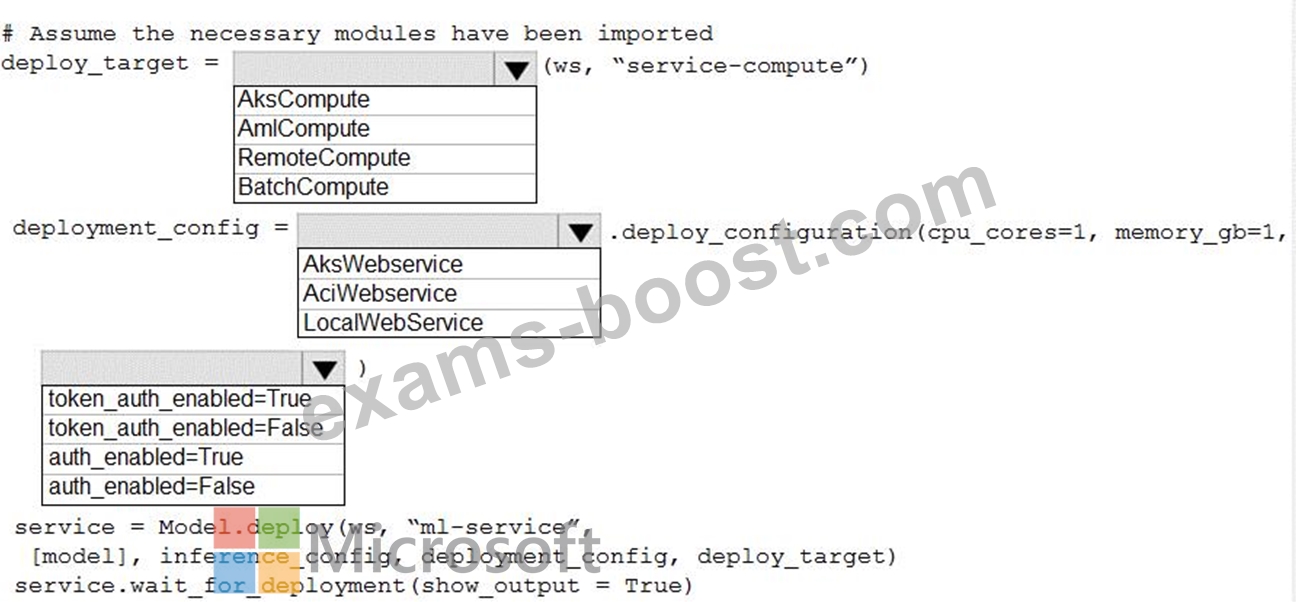
Answer:
Explanation: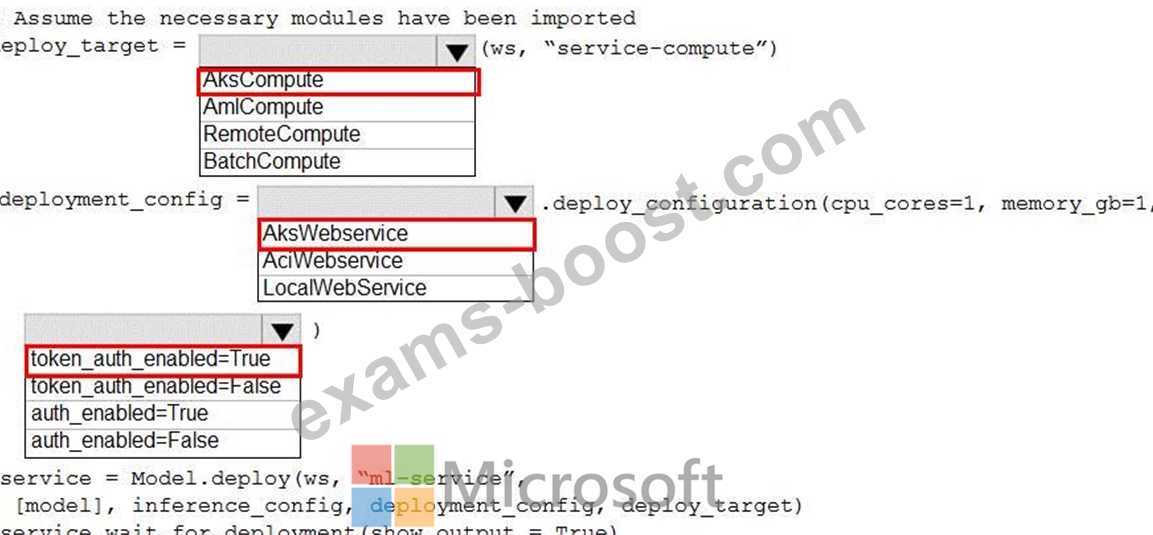
Reference:
https://docs.microsoft.com/en-us/azure/machine-learning/how-to-deploy-azure-kubernetes-service
https://docs.microsoft.com/en-us/azure/databricks/dev-tools/api/latest/aad/service-prin-aad-token
NEW QUESTION # 129
You configure a Deep Learning Virtual Machine for Windows.
You need to recommend tools and frameworks to perform the following:
* Build deep neural network (DNN) models
* Perform interactive data exploration and visualization
Which tools and frameworks should you recommend? To answer, drag the appropriate tools to the correct tasks. Each tool may be used once, more than once, or not at all. You may need to drag the split bar between panes or scroll to view content.
NOTE: Each correct selection is worth one point.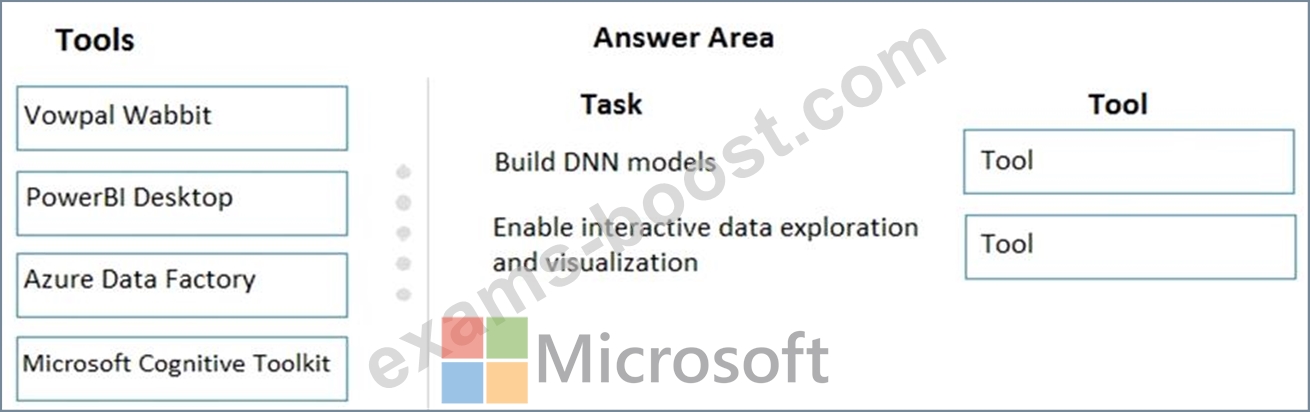
Answer:
Explanation: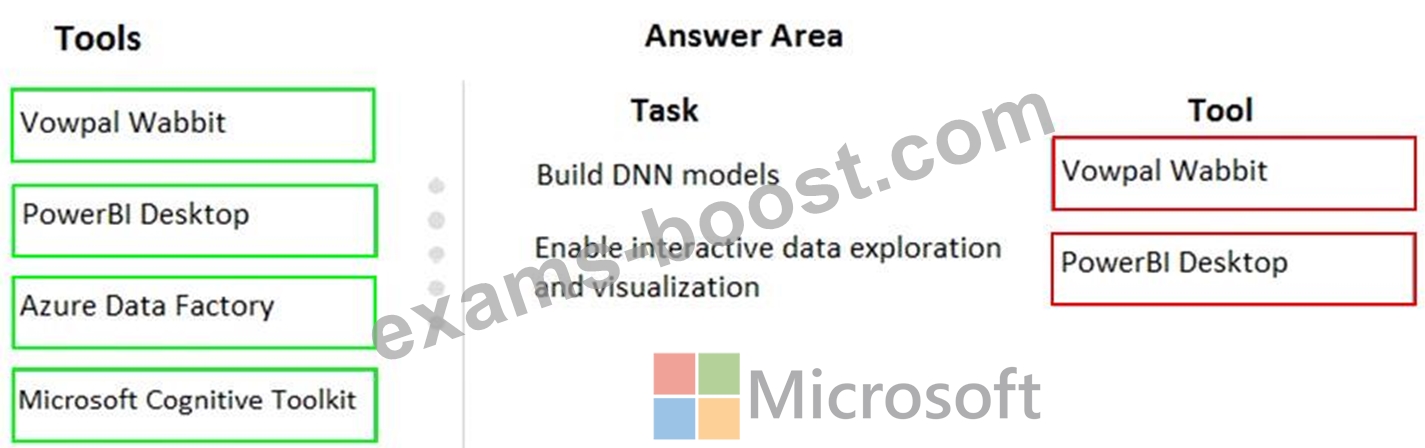
Explanation:
Box 1: Vowpal Wabbit
Use the Train Vowpal Wabbit Version 8 module in Azure Machine Learning Studio (classic), to create a machine learning model by using Vowpal Wabbit.
Box 2: PowerBI Desktop
Power BI Desktop is a powerful visual data exploration and interactive reporting tool BI is a name given to a modern approach to business decision making in which users are empowered to find, explore, and share insights from data across the enterprise.
References:
https://docs.microsoft.com/en-us/azure/machine-learning/studio-module-reference/train-vowpal-wabbit-version-8-model
https://docs.microsoft.com/en-us/azure/architecture/data-guide/scenarios/interactive-data-exploration
NEW QUESTION # 130
You create a datastore named training_data that references a blob container in an Azure Storage account. The blob container contains a folder named csv_files in which multiple comma-separated values (CSV) files are stored.
You have a script named train.py in a local folder named ./script that you plan to run as an experiment using an estimator. The script includes the following code to read data from the csv_files folder: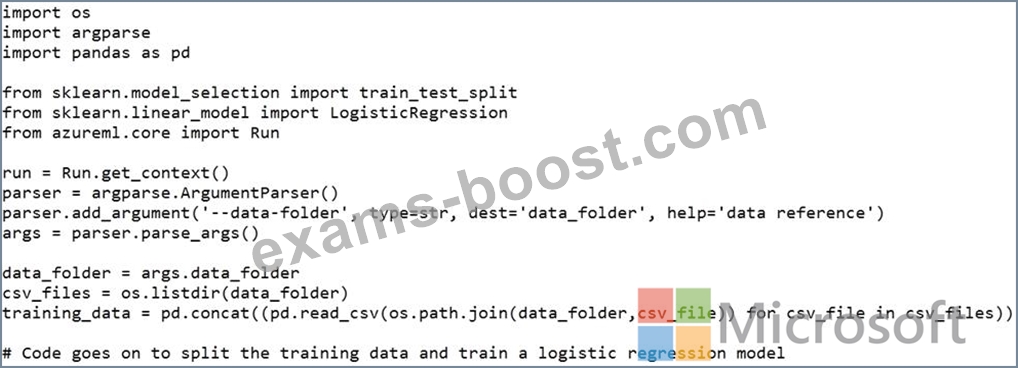
You have the following script.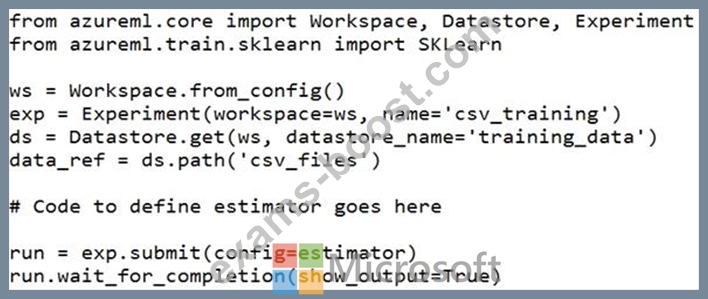
You need to configure the estimator for the experiment so that the script can read the data from a data reference named data_ref that references the csv_files folder in the training_data datastore.
Which code should you use to configure the estimator?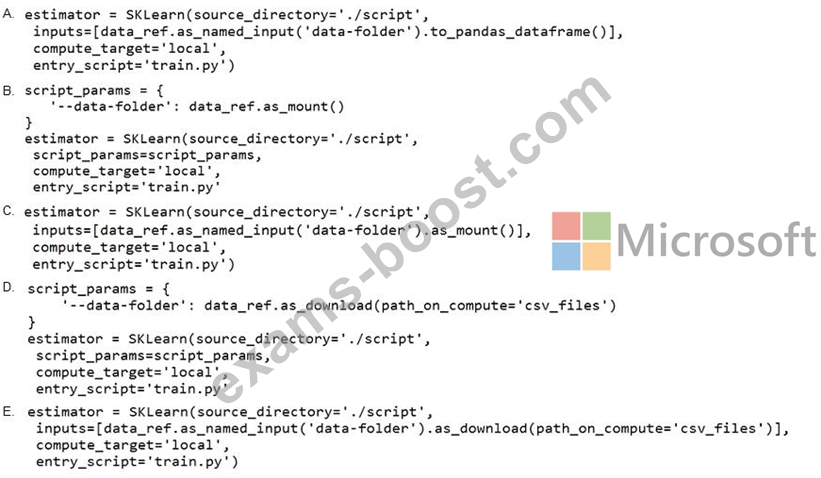
- A. Option D
- B. Option C
- C. Option E
- D. Option B
- E. Option A
Answer: D
Explanation:
Besides passing the dataset through the inputs parameter in the estimator, you can also pass the dataset through script_params and get the data path (mounting point) in your training script via arguments. This way, you can keep your training script independent of azureml-sdk. In other words, you will be able use the same training script for local debugging and remote training on any cloud platform.
Example:
from azureml.train.sklearn import SKLearn
script_params = {
# mount the dataset on the remote compute and pass the mounted path as an argument to the training script
'--data-folder': mnist_ds.as_named_input('mnist').as_mount(),
'--regularization': 0.5
}
est = SKLearn(source_directory=script_folder,
script_params=script_params,
compute_target=compute_target,
environment_definition=env,
entry_script='train_mnist.py')
# Run the experiment
run = experiment.submit(est)
run.wait_for_completion(show_output=True)
Incorrect Answers:
A: Pandas DataFrame not used.
Reference:
https://docs.microsoft.com/es-es/azure/machine-learning/how-to-train-with-datasets
NEW QUESTION # 131
Note: This question is part of a series of questions that present the same scenario. Each question in the series contains a unique solution that might meet the stated goals. Some question sets might have more than one correct solution, while others might not have a correct solution.
After you answer a question in this section, you will NOT be able to return to it. As a result, these questions will not appear in the review screen.
You are using Azure Machine Learning to run an experiment that trains a classification model.
You want to use Hyperdrive to find parameters that optimize the AUC metric for the model. You configure a HyperDriveConfig for the experiment by running the following code: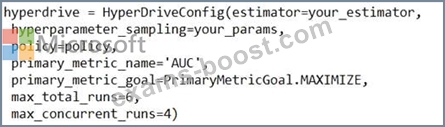
You plan to use this configuration to run a script that trains a random forest model and then tests it with validation data. The label values for the validation data are stored in a variable named y_test variable, and the predicted probabilities from the model are stored in a variable named y_predicted.
You need to add logging to the script to allow Hyperdrive to optimize hyperparameters for the AUC metric.
Solution: Run the following code: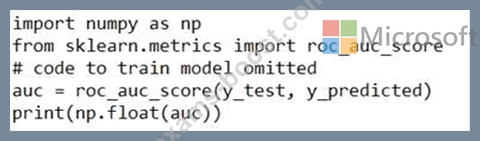
Does the solution meet the goal?
- A. No
- B. Yes
Answer: A
Explanation:
Explanation
Use a solution with logging.info(message) instead.
Note: Python printing/logging example:
logging.info(message)
Destination: Driver logs, Azure Machine Learning designer
Reference:
https://docs.microsoft.com/en-us/azure/machine-learning/how-to-debug-pipelines
NEW QUESTION # 132
You collect data from a nearby weather station. You have a pandas dataframe named weather_df that includes the following data:
The data is collected every 12 hours: noon and midnight.
You plan to use automated machine learning to create a time-series model that predicts temperature over the next seven days. For the initial round of training, you want to train a maximum of 50 different models.
You must use the Azure Machine Learning SDK to run an automated machine learning experiment to train these models.
You need to configure the automated machine learning run.
How should you complete the AutoMLConfig definition? To answer, select the appropriate options in the answer area.
NOTE: Each correct selection is worth one point.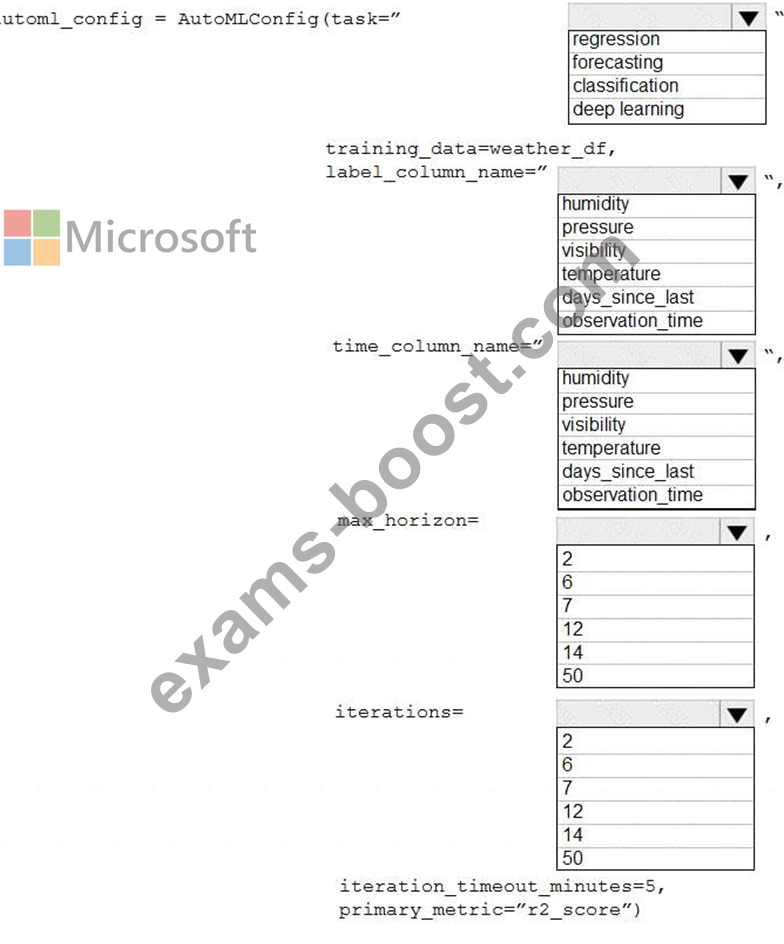
Answer:
Explanation:
Explanation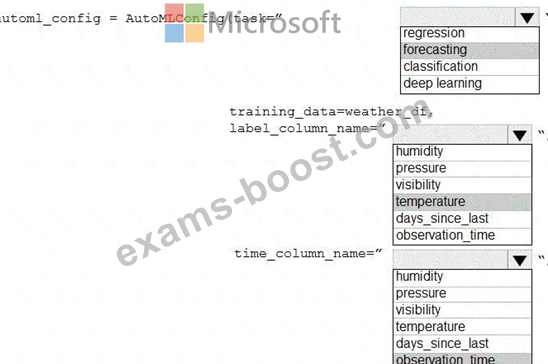
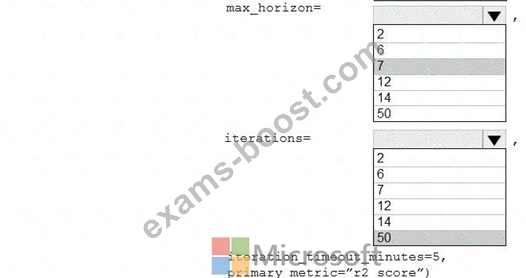
Box 1: forcasting
Task: The type of task to run. Values can be 'classification', 'regression', or 'forecasting' depending on the type of automated ML problem to solve.
Box 2: temperature
The training data to be used within the experiment. It should contain both training features and a label column (optionally a sample weights column).
Box 3: observation_time
time_column_name: The name of the time column. This parameter is required when forecasting to specify the datetime column in the input data used for building the time series and inferring its frequency. This setting is being deprecated. Please use forecasting_parameters instead.
Box 4: 7
"predicts temperature over the next seven days"
max_horizon: The desired maximum forecast horizon in units of time-series frequency. The default value is 1.
Units are based on the time interval of your training data, e.g., monthly, weekly that the forecaster should predict out. When task type is forecasting, this parameter is required.
Box 5: 50
"For the initial round of training, you want to train a maximum of 50 different models." Iterations: The total number of different algorithm and parameter combinations to test during an automated ML experiment.
Reference:
https://docs.microsoft.com/en-us/python/api/azureml-train-automl-client/azureml.train.automl.automlconfig.auto
NEW QUESTION # 133
You use Data Science Virtual Machines (DSVMs) for Windows and Linux in Azure.
You need to access the DSVMs.
Which utilities should you use? To answer, select the appropriate options in the answer area.
NOTE: Each correct selection is worth one point.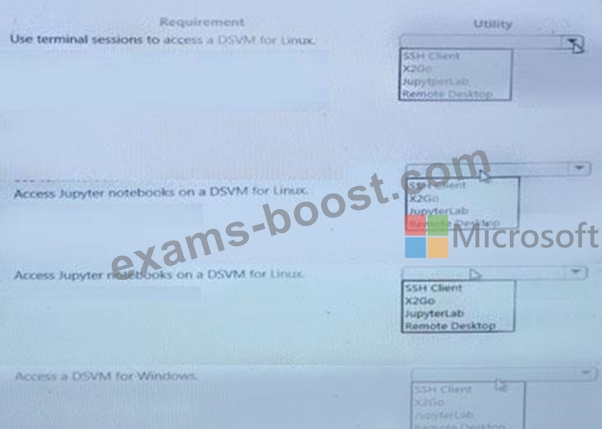
Answer:
Explanation: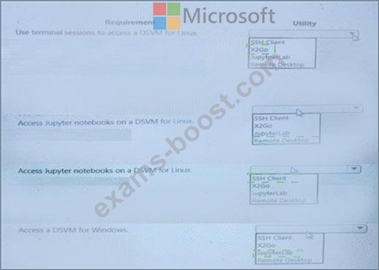
NEW QUESTION # 134
......
Pass Guaranteed Quiz 2025 Realistic Verified Free Microsoft: https://www.exams-boost.com/DP-100-valid-materials.html
Free Microsoft Azure DP-100 Ultimate Study Guide: https://drive.google.com/open?id=19oOFvOCt44nNFdLs54ZRVtzuxTMWD3ST