

DP-420 Dumps PDF 2025 Strategy Your Preparation Efficiently
Latest Verified & Correct Microsoft DP-420 Questions
NEW QUESTION # 23
You have a database named telemetry in an Azure Cosmos DB Core (SQL) API account that stores IoT dat a. The database contains two containers named readings and devices.
Documents in readings have the following structure.
id
deviceid
timestamp
ownerid
measures (array)
- type
- value
- metricid
Documents in devices have the following structure.
id
deviceid
owner
- ownerid
- emailaddress
- name
brand
model
For each of the following statements, select Yes if the statement is true. Otherwise, select No.
NOTE: Each correct selection is worth one point.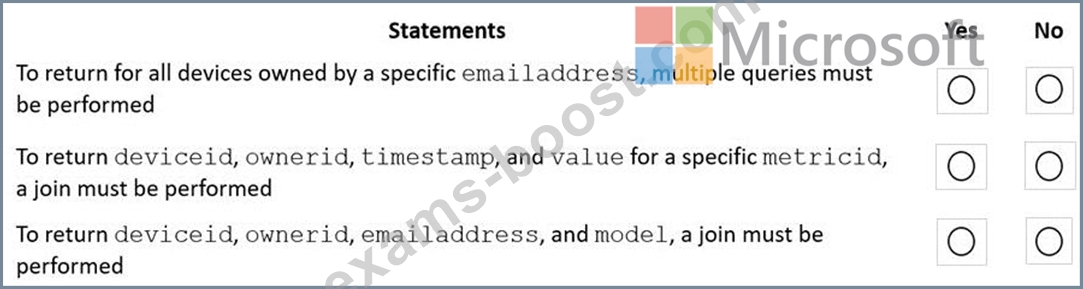
Answer:
Explanation: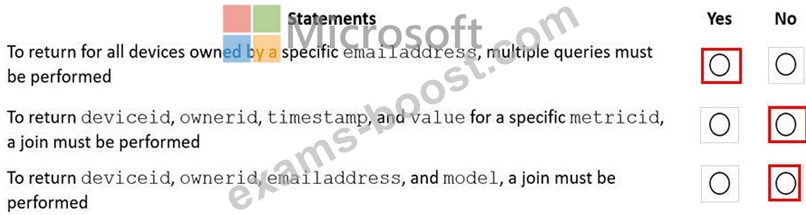
NEW QUESTION # 24
You are creating a database in an Azure Cosmos DB Core (SQL) API account. The database will be used by an application that will provide users with the ability to share online posts. Users will also be able to submit comments on other users' posts.
You need to store the data shown in the following table.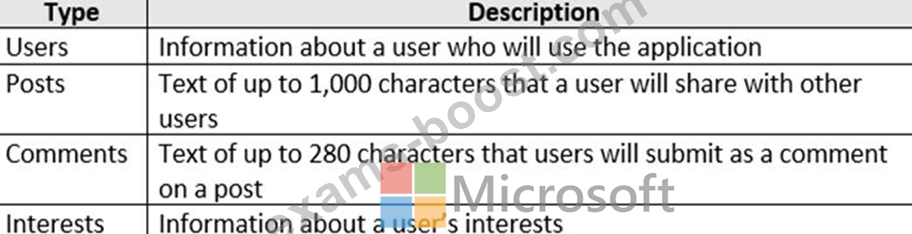
The application has the following characteristics:
Users can submit an unlimited number of posts.
The average number of posts submitted by a user will be more than 1,000.
Posts can have an unlimited number of comments from different users.
The average number of comments per post will be 100, but many posts will exceed 1,000 comments.
Users will be limited to having a maximum of 20 interests.
For each of the following statements, select Yes if the statement is true. Otherwise, select No.
NOTE: Each correct selection is worth one point.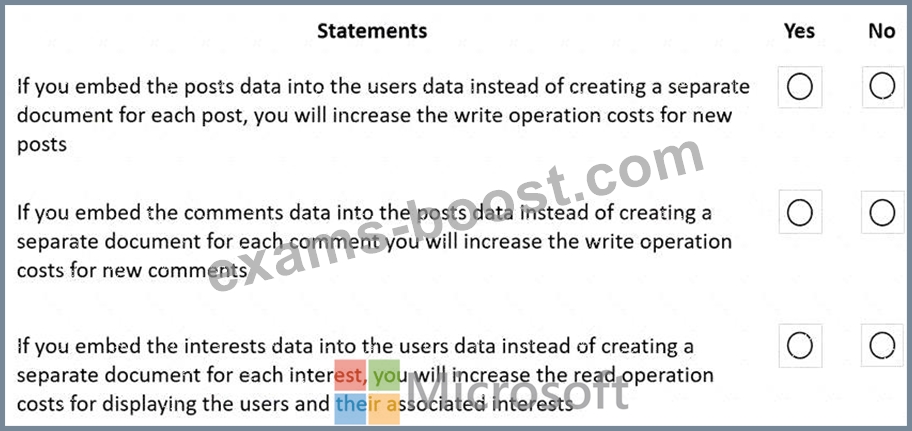
Answer:
Explanation:
Explanation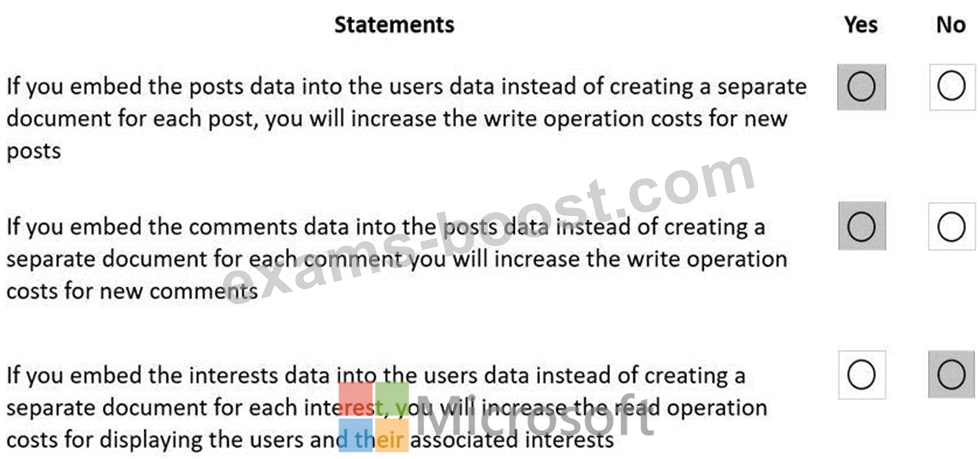
Box 1: Yes
Non-relational data increases write costs, but can decrease read costs.
Box 2: Yes
Non-relational data increases write costs, but can decrease read costs.
Box 3: No
Non-relational data increases write costs, but can decrease read costs.
NEW QUESTION # 25
You have an application that queries an Azure Cosmos 06 for NoSQL account.
You discover that the following two queries run frequently,
You need to minimize the request units (RUs) consumed by reads and writes. What should you create?
- A. a composite index for (name ASC, time stamp ASC)
- B. a composite index for (name ASC time stamp ASC) and a composite index for (name, time stamp disc)
- C. a composite index for (name ASC, time stamp DESC)
- D. a composite index for (name DESC, time stamp ASC)
Answer: A
NEW QUESTION # 26
You plan to create an Azure Cosmos DB for NoSQL account that will have a single write region and three read regions. You need to set the consistency level for the account. The solution must meet the following requirements:
* In the write region, writes must replicate synchronously across at least three replicas.
* In the read regions, reads must see writes in order for transactional batches.
* Throughput for reads and writes must be maximized.
Which consistency level should you select?
- A. Eventual
- B. Consistent Prefix
- C. Bounded Staleness
- D. Strong
Answer: B
NEW QUESTION # 27
You plan to create an Azure Cosmos DB Core (SQL) API account that will use customer-managed keys stored in Azure Key Vault.
You need to configure an access policy in Key Vault to allow Azure Cosmos DB access to the keys.
Which three permissions should you enable in the access policy? Each correct answer presents part of the solution.
NOTE: Each correct selection is worth one point.
- A. Update
- B. Sign
- C. Wrap Key
- D. Verify
- E. Unwrap Key
- F. List
- G. Get
Answer: C,E,G
Explanation:
Reference: https://docs.microsoft.com/en-us/azure/cosmos-db/how-to-setup-cmk
NEW QUESTION # 28
You have a database in an Azure Cosmos DB SQL API Core (SQL) account that is used for development.
The database is modified once per day in a batch process.
You need to ensure that you can restore the database if the last batch process fails. The solution must minimize costs.
How should you configure the backup settings? To answer, select the appropriate options in the answer area.
NOTE: Each correct selection is worth one point.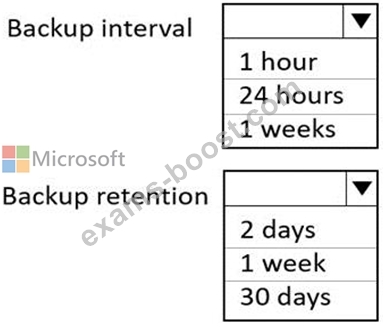
Answer:
Explanation: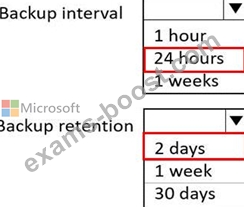
NEW QUESTION # 29
You have an Azure Cosmos DB for NoSQL account1 that is configured for automatic failover. The account1 account has a single read-write region in West US and a and a read region in East US.
You run the following PowerShell command.
What is the effect of running the command?
- A. The account will be configured for multi-region writes.
- B. A manual failover will occur.
- C. The provisioned throughput for account1 will increase.
- D. The account will be unavailable to writes during the change.
Answer: D
Explanation:
You can use the Set-AzCosmosDBAccountRegion cmdlet to update the regions that an Azure Cosmos DB account uses. You can use this cmdlet to add a region or change the region failover order. The cmdlet requires a resource group name, an Azure Cosmos DB account name, and a list of regions in desired failover order1.
For your scenario, based on the PowerShell command, you are using the Set-AzCosmosDBAccountRegion cmdlet to update the regions for an Azure Cosmos DB account named account1 that is configured for automatic failover. The command specifies two regions: West US and East US. The effect of running the command is that the account will be configured for multi-region writes.
Multi-region writes is a feature of Azure Cosmos DB that allows you to write data to any region in your account and have it automatically replicated to all other regions. This feature provides high availability and low latency for write operations across multiple regions. To enable multi-region writes, you need to specify at least two regions in your account and set them as write regions2. In your command, you are setting both West US and East US as write regions by using the -IsZoneRedundant parameter with a value of $true for both regions.
NEW QUESTION # 30
You have an Apache Spark pool in Azure Synapse Analytics that runs the following Python code in a notebook.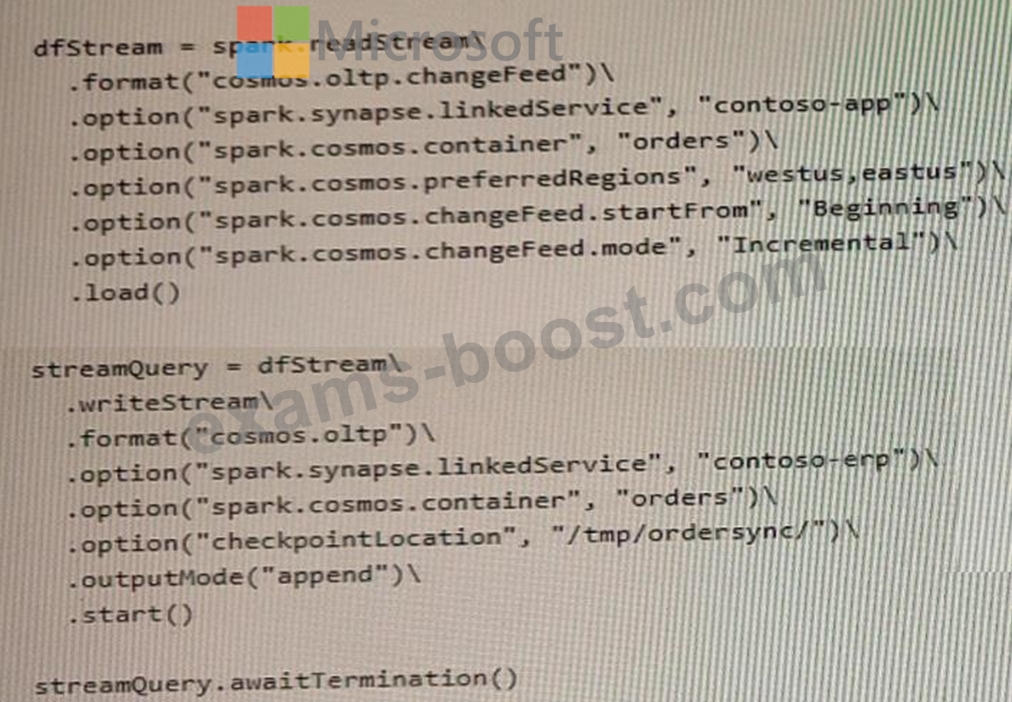
For each of the following statements, select Yes if the statement is true. Otherwise, select No.
NOTE: Each correct selection is worth one point.
Answer:
Explanation:
Explanation:
New and updated orders will be added to contoso-erp.orders: Yes
The code performs bulk data ingestion from contoso-app: No
Both contoso-app and contoso-erp have Analytics store enabled: Yes
The code uses the spark.readStream method to read data from a container named orders in a database named contoso-app. The data is then filtered by a condition and written to another container named orders in a database named contoso-erp using the spark.writeStream method. The write mode is set to"append", which means that new and updated orders will be added to the destination container1.
The code does not perform bulk data ingestion from contoso-app, but rather stream processing. Bulk data ingestion is a process of loading large amounts of data into a data store in batches. Stream processing is a process of continuously processing data as it arrives in real-time2.
Both contoso-app and contoso-erp have Analytics store enabled, because they are both accessed by Spark pools using the spark.cosmos.oltp method. This method requires that the containers have Analytics store enabled, which is a feature that allows Spark pools to query data stored in Azure Cosmos DB containers using SQL APIs3.
NEW QUESTION # 31
You have a container in an Azure Cosmos DB Core (SQL) API account.
You need to use the Azure Cosmos DB SDK to replace a document by using optimistic concurrency.
What should you include in the code? To answer, select the appropriate options in the answer area.
NOTE: Each correct selection is worth one point.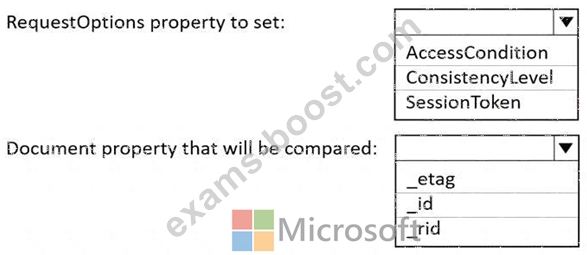
Answer:
Explanation: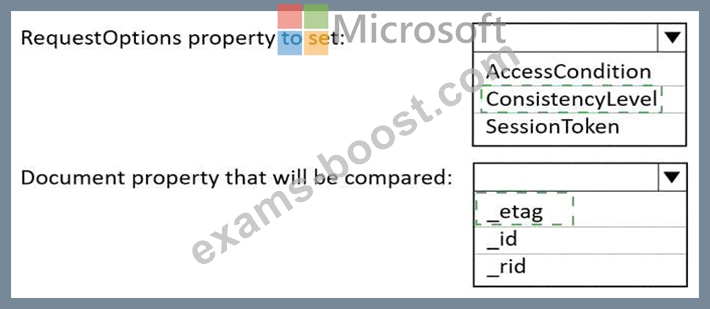
Explanation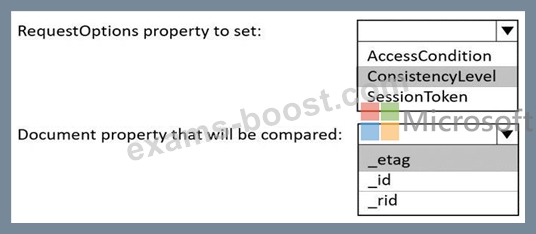
Box 1: ConsistencyLevel
The ItemRequestOptions Class ConsistencyLevel property gets or sets the consistency level required for the request in the Azure Cosmos DB service.
Azure Cosmos DB offers 5 different consistency levels. Strong, Bounded Staleness, Session, Consistent Prefix and Eventual - in order of strongest to weakest consistency.
Box 2: _etag
The ItemRequestOptions class helped us implement optimistic concurrency by specifying that we wanted the SDK to use the If-Match header to allow the server to decide whether a resource should be updated. The If-Match value is the ETag value to be checked against. If the ETag value matches the server ETag value, the resource is updated.
Reference:
https://docs.microsoft.com/en-us/dotnet/api/microsoft.azure.cosmos.itemrequestoptions
https://cosmosdb.github.io/labs/dotnet/labs/10-concurrency-control.html
NEW QUESTION # 32
You have a container named container1 in an Azure Cosmos DB Core (SQL) API account.
The following is a sample of a document in container1.
{
"studentId": "631282",
"firstName": "James",
"lastName": "Smith",
"enrollmentYear": 1990,
"isActivelyEnrolled": true,
"address": {
"street": "",
"city": "",
"stateProvince": "",
"postal": "",
}
}
The container1 container has the following indexing policy.
{
"indexingMode": "consistent",
"includePaths": [
{
"path": "/*"
},
{
"path": "/address/city/?"
}
],
"excludePaths": [
{
"path": "/address/*"
},
{
"path": "/firstName/?"
}
]
}
For each of the following statements, select Yes if the statement is true. Otherwise, select No.
NOTE: Each correct selection is worth one point.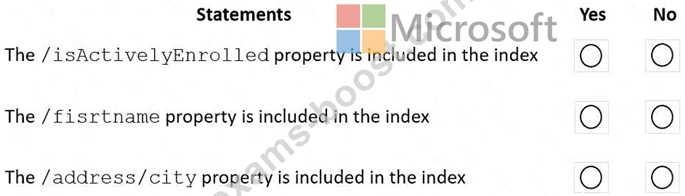
Answer:
Explanation: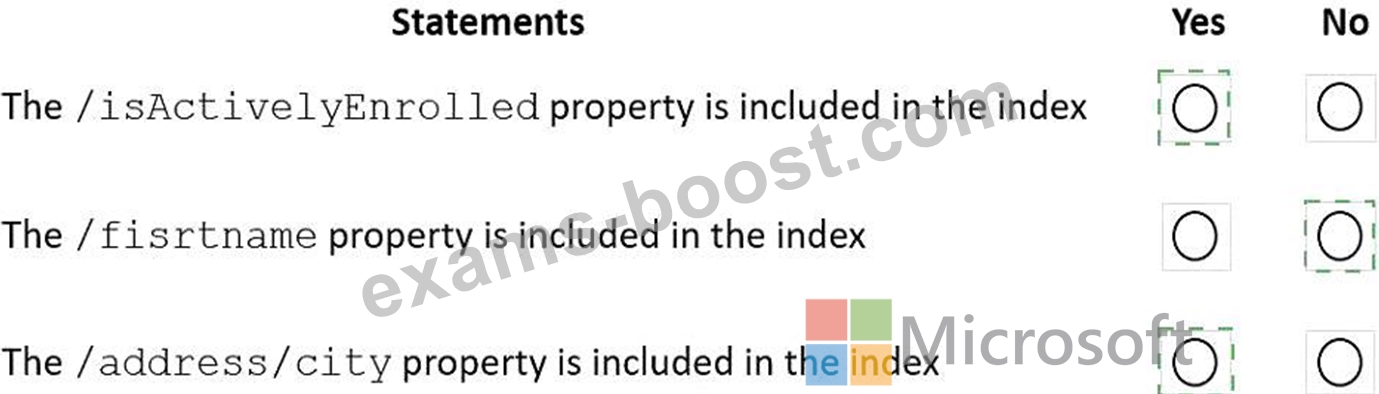
Explanation: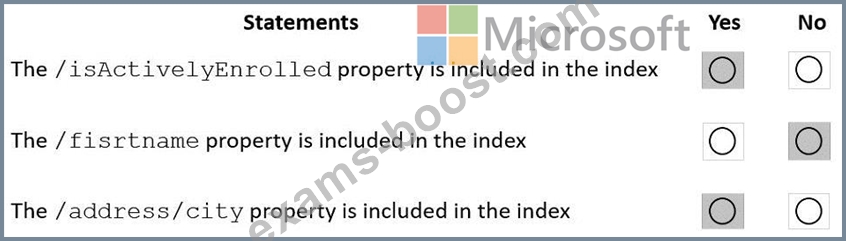
Box 1: Yes
"path": "/*" is in includePaths.
Include the root path to selectively exclude paths that don't need to be indexed. This is the recommended approach as it lets Azure Cosmos DB proactively index any new property that may be added to your model.
Box 2: No
"path": "/firstName/?" is in excludePaths.
Box 3: Yes
"path": "/address/city/?" is in includePaths
Reference: https://docs.microsoft.com/en-us/azure/cosmos-db/index-policy
NEW QUESTION # 33
You plan to use a multi-region Azure Cosmos DB for NoSQL account to store data for a new application suite.
The suite contains the applications shown in the following table.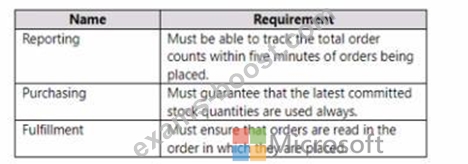
Each application should use the weakest consistency level possible.
Which consistency level should you configure for each application? To answer, select the appropriate options in the answer area. NOTE: Each correct selection is worth one point.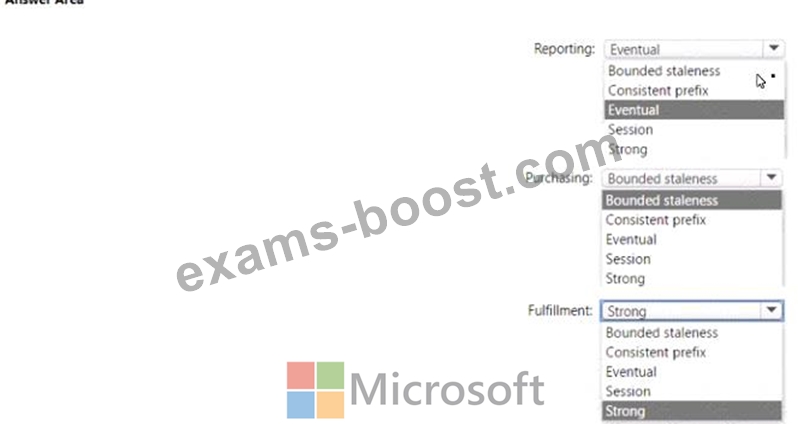
Answer:
Explanation: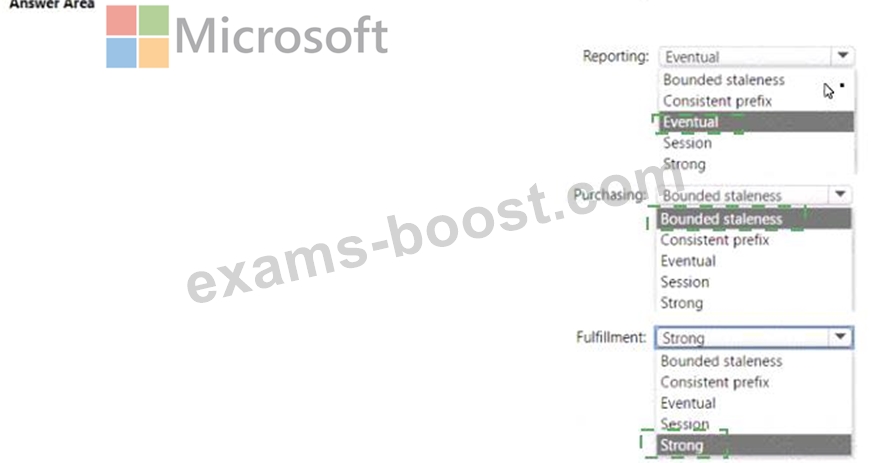
Explanation: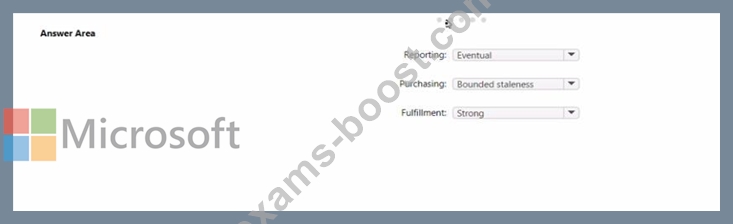
NEW QUESTION # 34
You have a database named db1 in an Azure Cosmos DB for NoSQL
You are designing an application that will use dbl.
In db1, you are creating a new container named coll1 that will store in coll1.
The following is a sample of a document that will be stored in coll1.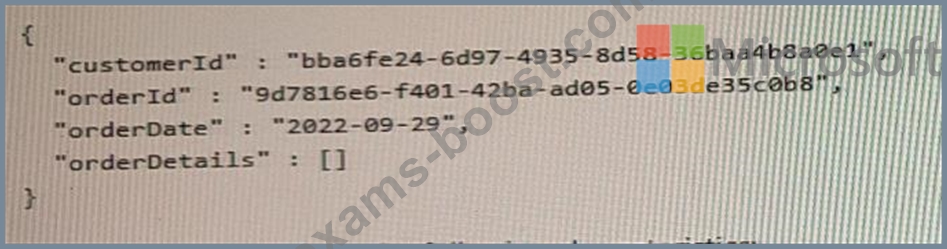
The application will have the following characteristics:
* New orders will be created frequently by different customers.
* Customers will often view their past order history.
You need to select the partition key value for coll1 to support the application. The solution must minimize costs.
To what should you set the partition key?
- A. customerId
- B. orderDate
- C. orderId
- D. id
Answer: A
Explanation:
Explanation
Based on the characteristics of the application and the provided document structure, the most suitable partition key value for coll1 in the given scenario would be the customerId, Option B.
The application frequently creates new orders by different customers and customers often view their past order history. Using customerId as the partition key would ensure that all orders associated with a particular customer are stored in the same partition. This enables efficient querying of past order history for a specific customer and reduces cross-partition queries, resulting in lower costs and improved performance.
a partition key is a JSON property (or path) within your documents that is used by Azure Cosmos DB to distribute data among multiple partitions . A partition key should have a high cardinality, which means it should have many distinct values, such as hundreds or thousands . A partition key should also align with the most common query patterns of your application, so that you can efficiently retrieve data by using the partition key value1.
Based on these criteria, one possible partition key that you could use for coll1 is B. customerId.
This partition key has the following advantages:
It has a high cardinality, as each customer will have a unique ID
It aligns with the query patterns of the application, as customers will often view their past order history3.
It minimizes costs, as it reduces the number of cross-partition queries and optimizes the storage and throughput utilization1.
This partition key also has some limitations, such as:
It may not be optimal for scenarios where orders need to be queried independently from customers or aggregated by date or other criteria It may result in hot partitions or throttling if some customers create orders more frequently than others or have more data than others It may not support transactions across multiple customers, as transactions are scoped to a single logical partition2.
Depending on your specific use case and requirements, you may need to adjust this partition key or choose a different one. For example, you could use a synthetic partition key that concatenates multiple properties of an item2, or you could use a partition key with a random or pre-calculated suffix to distribute the workload more evenly2.
NEW QUESTION # 35
You have an Azure Cosmos DB for NoSQL database named db1.
You run the following code: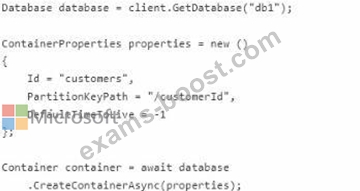
For each of the following statements, select Yes if the statement is true. Otherwise, select No.
NOTE: Each correct selection is worth one point.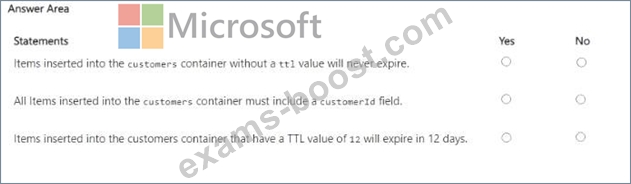
Answer:
Explanation: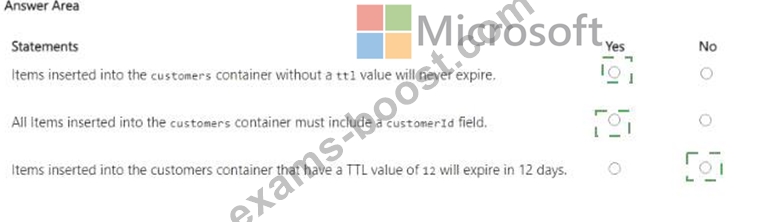
Explanation: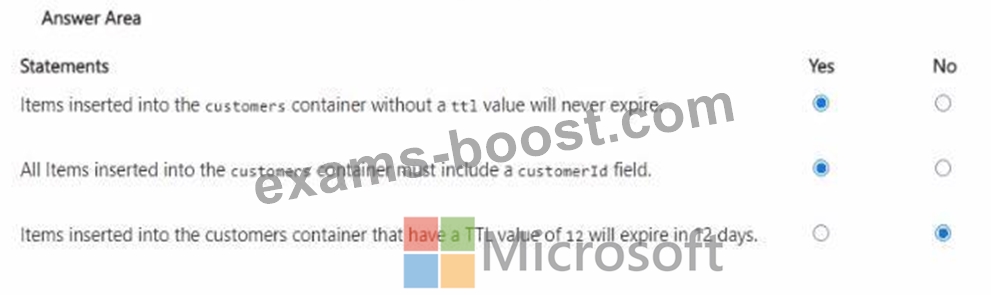
NEW QUESTION # 36
Note: This question is part of a series of questions that present the same scenario. Each question in the series contains a unique solution that might meet the stated goals. Some question sets might have more than one correct solution, while others might not have a correct solution.
After you answer a question in this section, you will NOT be able to return to it. As a result, these questions will not appear in the review screen.
You have a container named container1 in an Azure Cosmos DB Core (SQL) API account.
You need to make the contents of container1 available as reference data for an Azure Stream Analytics job.
Solution: You create an Azure Synapse pipeline that uses Azure Cosmos DB Core (SQL) API as the input and Azure Blob Storage as the output.
Does this meet the goal?
- A. Yes
- B. No
Answer: B
Explanation:
Instead create an Azure function that uses Azure Cosmos DB Core (SQL) API change feed as a trigger and Azure event hub as the output.
The Azure Cosmos DB change feed is a mechanism to get a continuous and incremental feed of records from an Azure Cosmos container as those records are being created or modified. Change feed support works by listening to container for any changes. It then outputs the sorted list of documents that were changed in the order in which they were modified.
The following diagram represents the data flow and components involved in the solution:
Reference: https://docs.microsoft.com/en-us/azure/cosmos-db/sql/changefeed-ecommerce-solution
NEW QUESTION # 37
You have a database named telemetry in an Azure Cosmos DB Core (SQL) API account that stores IoT data.
The database contains two containers named readings and devices.
Documents in readings have the following structure.
id
deviceid
timestamp
ownerid
measures (array)
- type
- value
- metricid
Documents in devices have the following structure.
id
deviceid
owner
- ownerid
- emailaddress
- name
brand
model
For each of the following statements, select Yes if the statement is true. Otherwise, select No.
NOTE: Each correct selection is worth one point.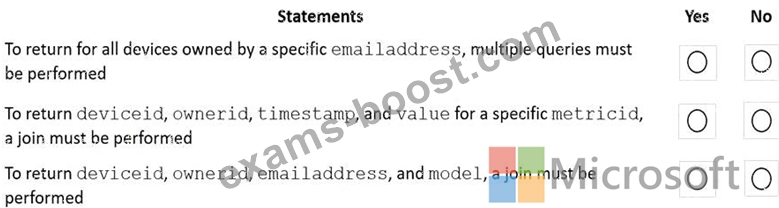
Answer:
Explanation: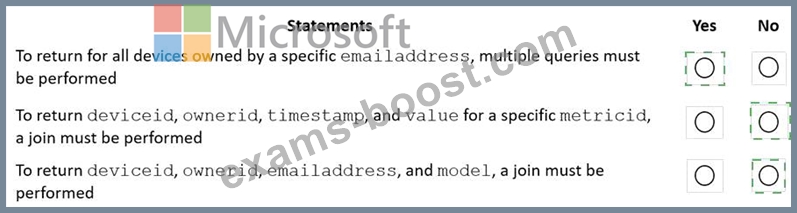
Explanation: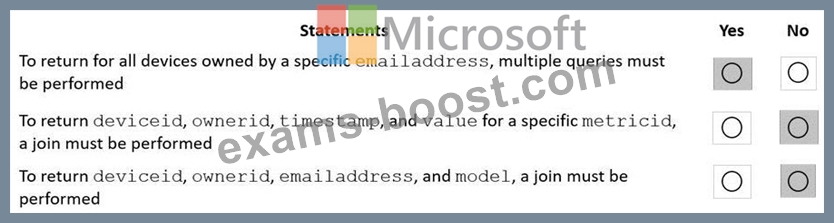
Box 1: Yes
Need to join readings and devices.
Box 2: No
Only readings is required. All required fields are in readings.
Box 3: No
Only devices is required. All required fields are in devices.
NEW QUESTION # 38
You have the Azure Cosmos DB for NoSQL containers shown in the following table.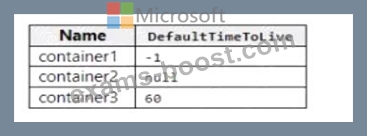
You have the items shown in the following table.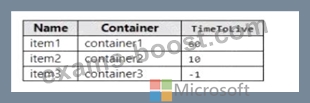
When will each item expire? To answer, select the appropriate options in the answer area.
NOTE: Each correct selection is worth one point.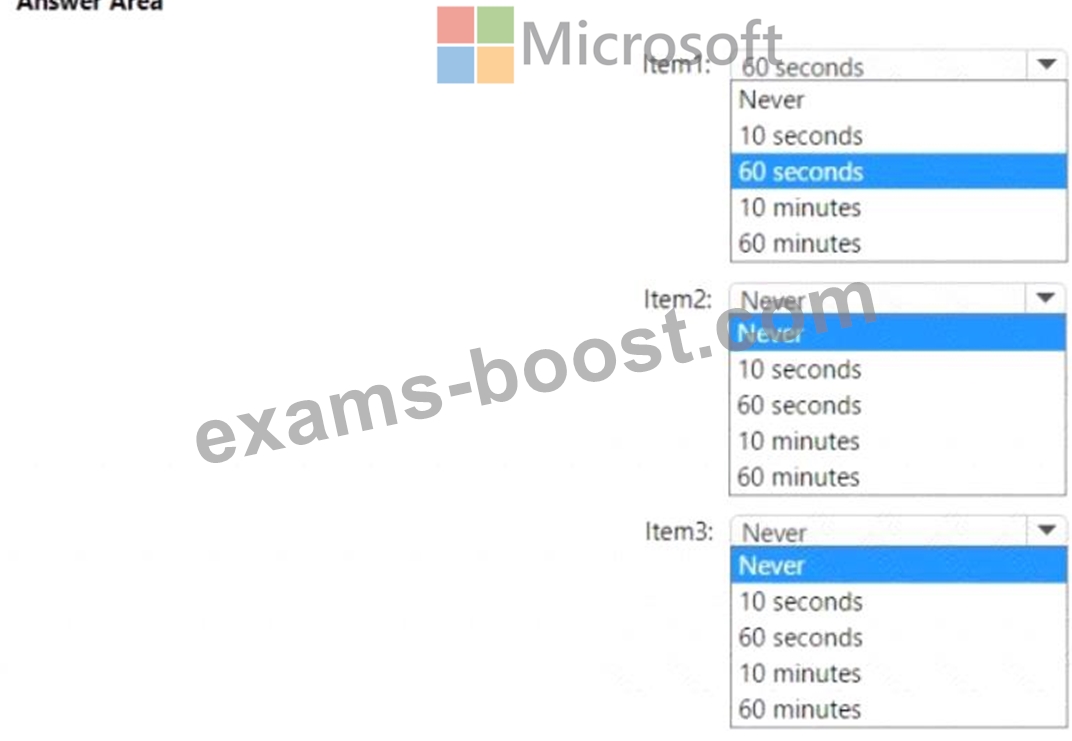
Answer:
Explanation: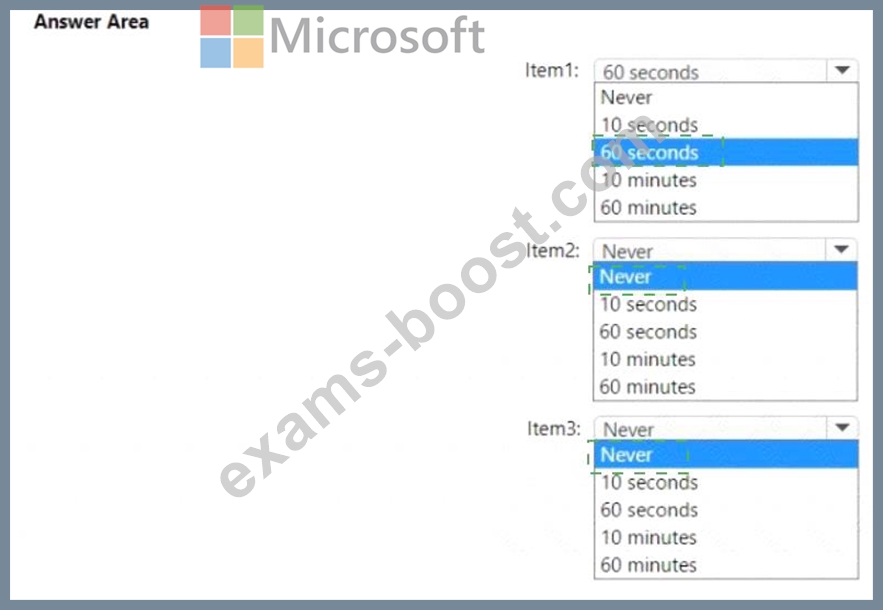
Explanation: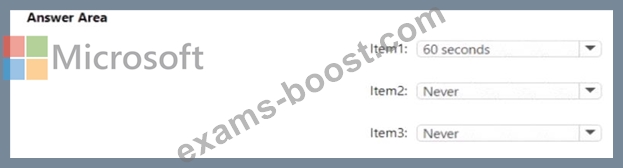
NEW QUESTION # 39
You have an Azure Cosmos DB Core (SQL) API account named storage1 that uses provisioned throughput capacity mode.
The storage1 account contains the databases shown in the following table.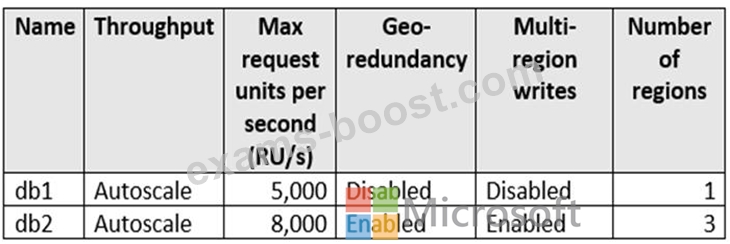
The databases contain the containers shown in the following table.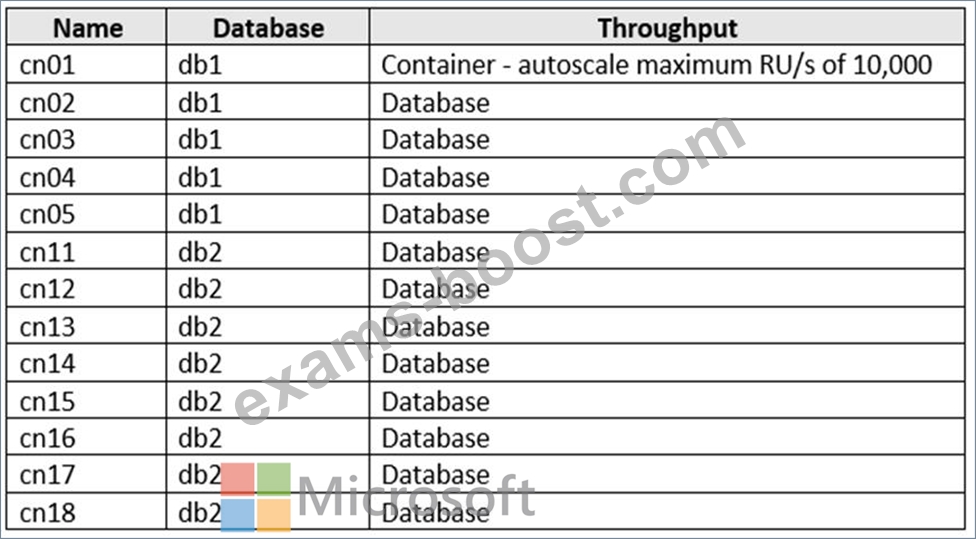
For each of the following statements, select Yes if the statement is true. Otherwise, select No.
NOTE: Each correct selection is worth one point.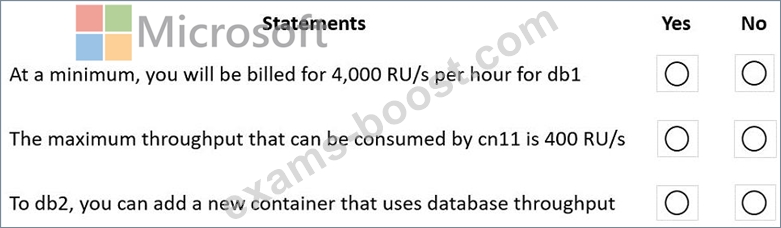
Answer:
Explanation: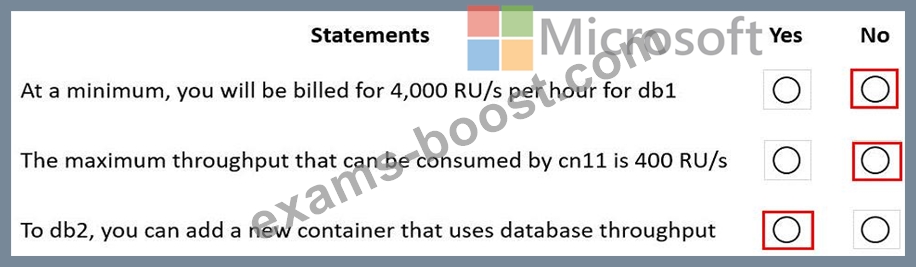
Reference:
https://docs.microsoft.com/en-us/azure/cosmos-db/plan-manage-costs
https://azure.microsoft.com/en-us/pricing/details/cosmos-db/
NEW QUESTION # 40
You need to recommend indexes for con-product and con-productVendor. The solution must meet the product catalog requirements and the business requirements.
Which type of index should you recommend for each container? To answer, select the appropriate options in the answer area.
NOTE: Each correct selection is worth one point.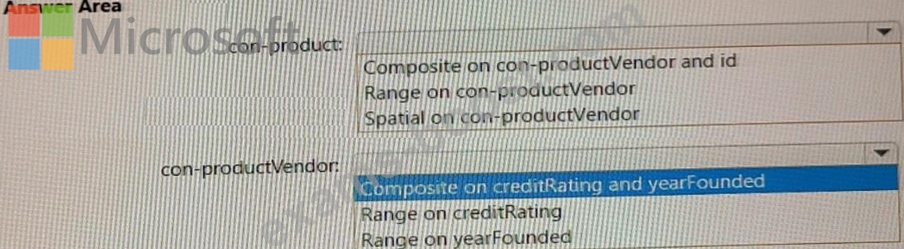
Answer:
Explanation: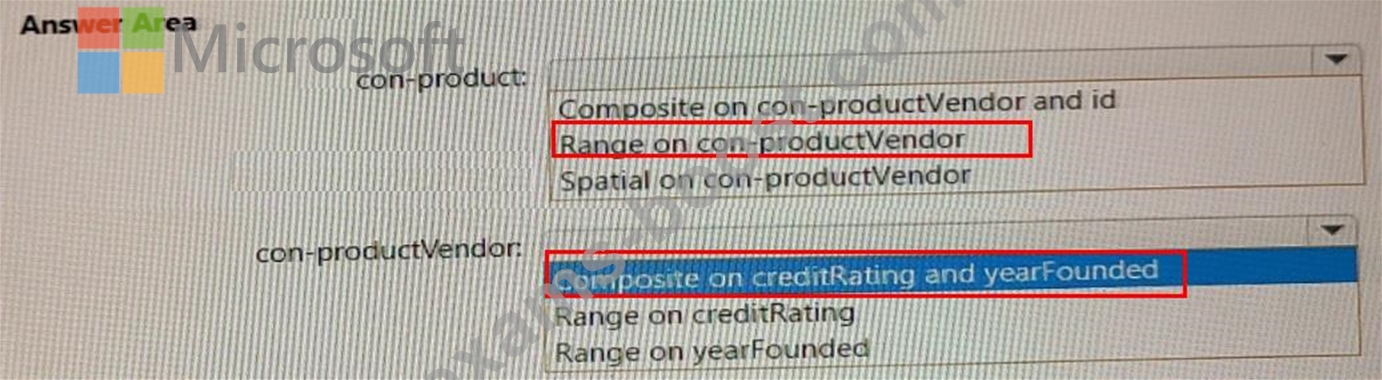
NEW QUESTION # 41
You have an Azure Cosmos DB for NoSQL container named Contacts that is configured as shown in the following exhibit.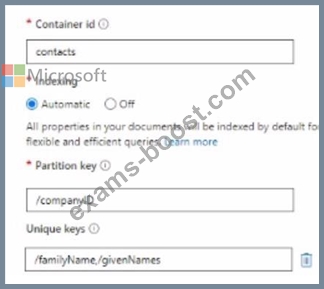
Contacts contains the items shown in the following table.
To Contacts, you plan to insert the items shown in the following table.
For each of the following statements select Yes if the statement is true. Otherwise, select No.
NOTE: Each correct selection is worth one point.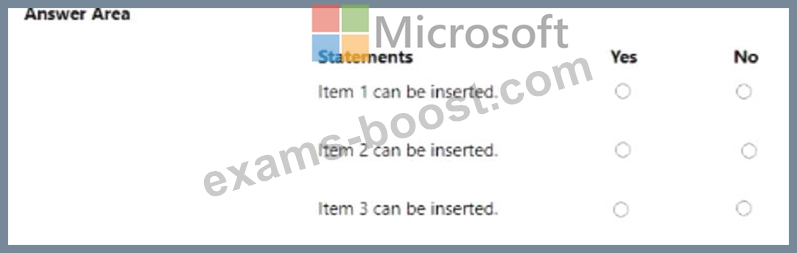
Answer:
Explanation: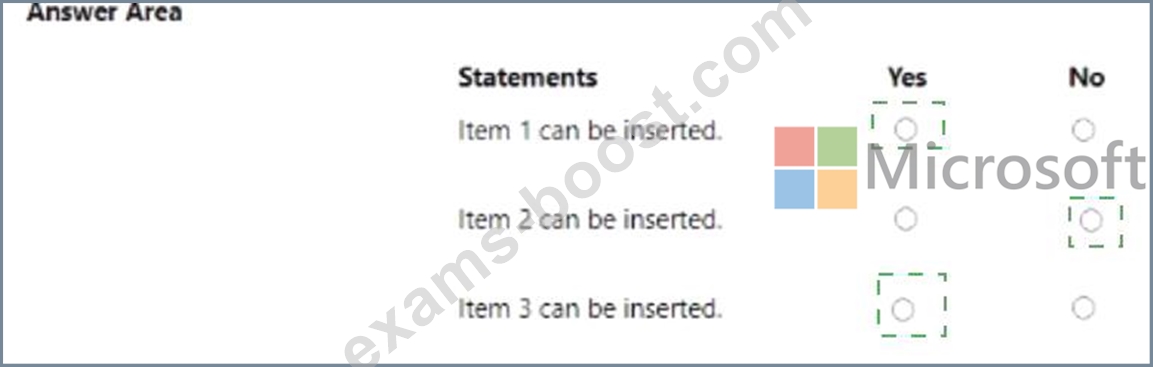
Explanation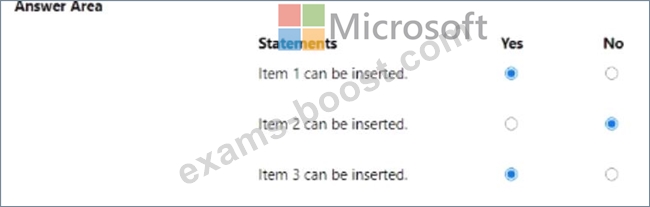
NEW QUESTION # 42
You plan to create an Azure Cosmos DB database named db1 that will contain two containers. One of the containers will contain blog posts, and the other will contain users. Each item in the blog post container will include:
* A single blog post
* All the comments associated to the blog post
* The names of the users who created the blog post and added the comments.
You need to design a solution to update usernames m the user container without causing data integrity issues.
The solution must minimize administrative and development effort. What should you include in the solution?
To answer, select the appropriate options in the answer area.
NOTE: Each correct selection is worth one point.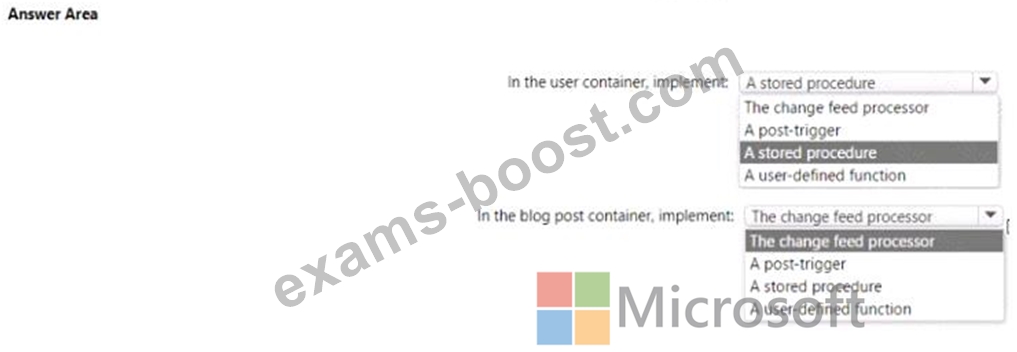
Answer:
Explanation: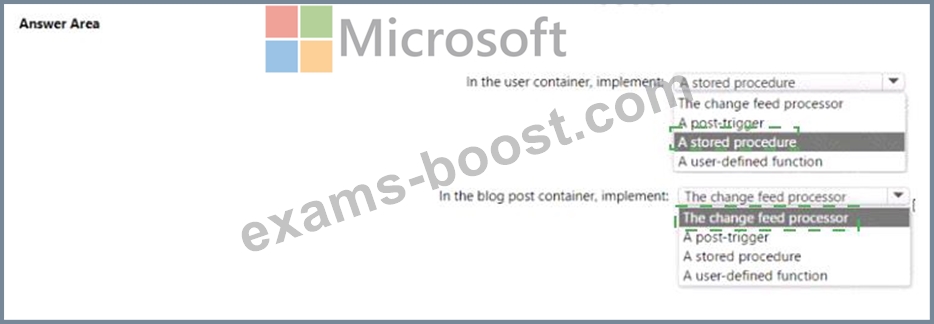
Explanation: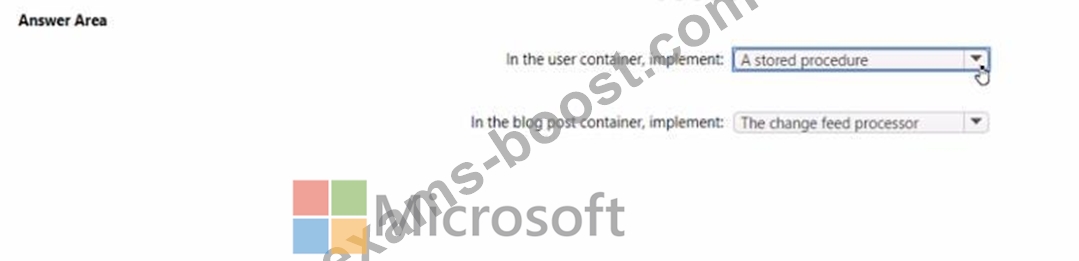
NEW QUESTION # 43
You are designing a data model for an Azure Cosmos DB for NoSQL account.
What are the partition limits for request units per second (RU/s) and storage? To answer, select the appropriate options in the answer area.
NOTE: Each correct selection is worth one point.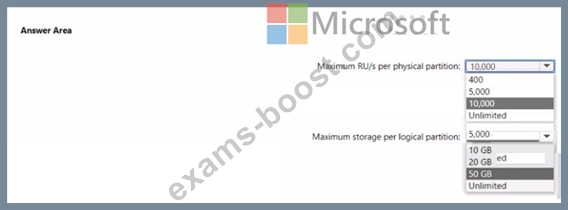
Answer:
Explanation: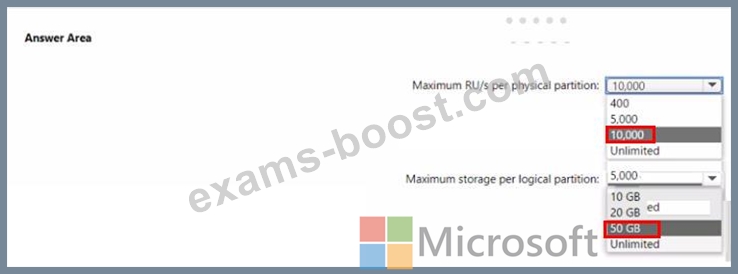
NEW QUESTION # 44
The following is a sample of a document in orders.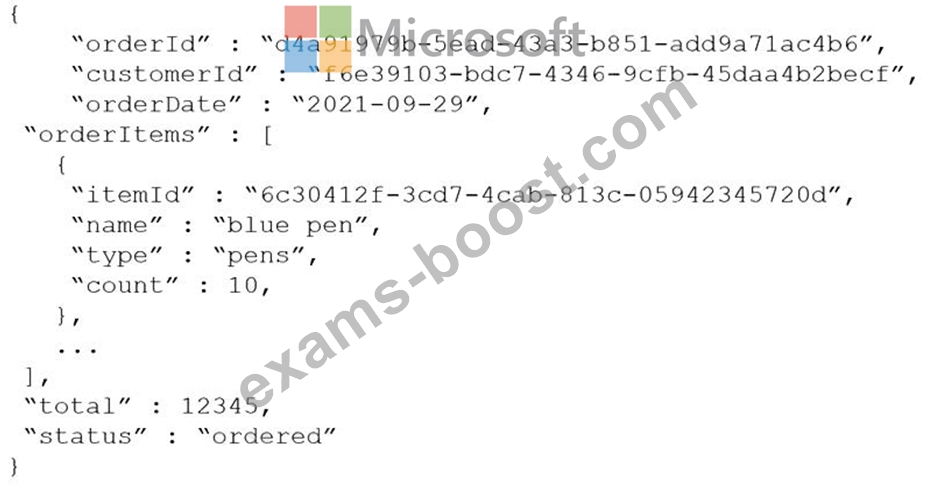
The orders container uses customer as the partition key.
You need to provide a report of the total items ordered per month by item type. The solution must meet the following requirements:
Ensure that the report can run as quickly as possible.
Minimize the consumption of request units (RUs).
What should you do?
- A. Configure the report to query orders by using a SQL query through a dedicated gateway.
- B. Configure the report to query a new aggregate container. Populate the aggregates by using the change feed.
- C. Configure the report to query a new aggregate container. Populate the aggregates by using SQL queries that run daily.
- D. Configure the report to query orders by using a SQL query.
Answer: C
Explanation:
Explanation
You can facilitate aggregate data by using Change Feed and Azure Functions, and then use it for reporting.
Reference: https://docs.microsoft.com/en-us/azure/cosmos-db/change-feed
NEW QUESTION # 45
You have the following query.
SELECT * FROM
WHERE c.sensor = "TEMP1"
AND c.value < 22
AND c.timestamp >= 1619146031231
You need to recommend a composite index strategy that will minimize the request units (RUs) consumed by the query.
What should you recommend?
- A. a composite index for (value ASC, sensor ASC) and a composite index for (timestamp ASC, sensor ASC)
- B. a composite index for (sensor ASC, value ASC) and a composite index for (sensor ASC, timestamp ASC)
- C. a composite index for (sensor ASC, value ASC, timestamp ASC) and a composite index for (sensor DESC, value DESC, timestamp DESC)
- D. a composite index for (sensor ASC, value ASC, timestamp ASC)
Answer: B
Explanation:
If a query has a filter with two or more properties, adding a composite index will improve performance.
Consider the following query:
SELECT * FROM c WHERE c.name = "Tim" and c.age > 18
In the absence of a composite index on (name ASC, and age ASC), we will utilize a range index for this query. We can improve the efficiency of this query by creating a composite index for name and age.
Queries with multiple equality filters and a maximum of one range filter (such as >,<, <=, >=, !=) will utilize the composite index.
NEW QUESTION # 46
You have a container in an Azure Cosmos DB for NoSQL account. The database that has a manual throughput of 30,000 request units per second (RU/s). The current consumption details are shewn in the following chart.
Normalized RU Consumption (%) By PartitionKeyRangeID

Use the drop-down menus to select the answer choice that answers each question based on the information presented in the graphic. NOTE: Each correct selection is worth one point.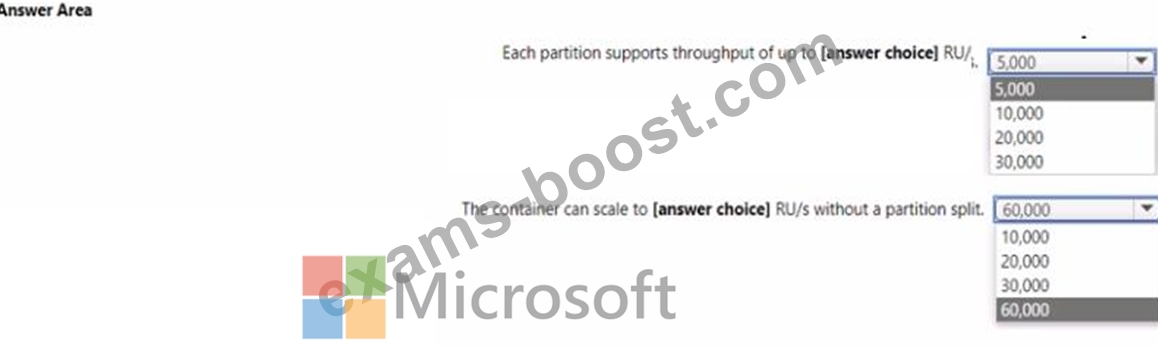
Answer:
Explanation: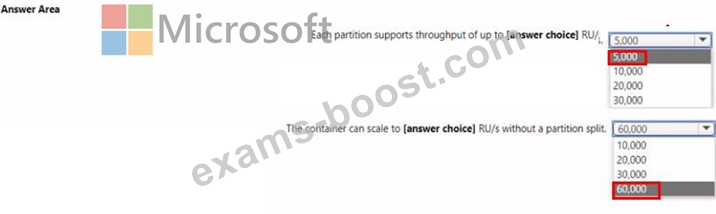
NEW QUESTION # 47
You have an Azure Cosmos DB account named account1 that has a default consistency level of session.
You have an app named App1.
You need to ensure that the read operations of App1 can request either bounded staleness or consistent prefix consistency.
What should you modify for each consistency level? To answer, select the appropriate options in the answer area.
NOTE: Each correct selection is worth one point.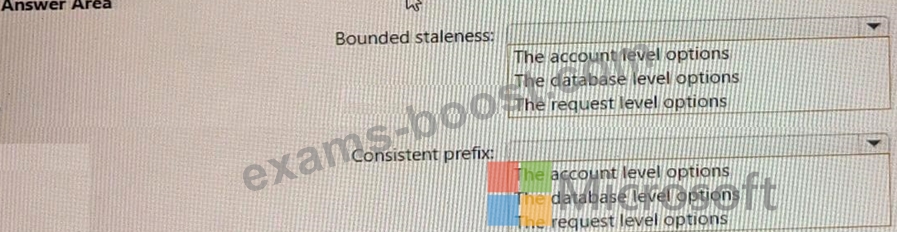
Answer:
Explanation: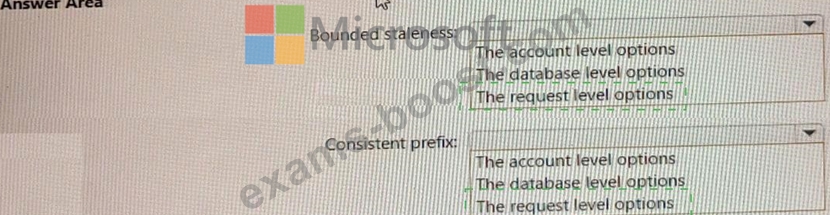
Explanation:
Box 1 =The request level options
Azure Cosmos DB offers five well-defined consistency levels: strong, bounded staleness, session, consistent prefix and eventual. You can configure the default consistency level on your Azure Cosmos DB account at any time2. The default consistency level appliesto all databases and containers under that account1. You can also override the default consistency level for a specific request by using the request options2.
Box 2 =The request level options
To modify the consistency level of a read operation in Azure Cosmos DB, you can use request-level options to override the account's default consistency setting. Therefore, to ensure that the read operations of App1 can request either consistent prefix or session consistency, you need to modify the request-level options for each operation.Reference: -https://docs.microsoft.com/en-us/azure/cosmos-db/consistency-levels
NEW QUESTION # 48
......
DP-420 PDF Dumps Are Helpful To produce Your Dreams Correct QA's: https://www.exams-boost.com/DP-420-valid-materials.html
100% Pass Guaranteed Download Azure Cosmos DB Developer Specialty Exam PDF Q&A: https://drive.google.com/open?id=1w-D5w5zhCq17RD31Sxp4FbufrMZKFY4W