

Feb 24, 2026 PASS Microsoft DP-300 EXAM WITH UPDATED DUMPS
DP-300 Questions PDF [2026] Use Valid New dump to Clear Exam
To prepare for the Microsoft DP-300 exam, candidates are advised to have a strong understanding of database administration concepts and practices, as well as familiarity with the Microsoft Azure cloud platform. Microsoft offers a range of training courses and study materials to help candidates prepare for the exam, including instructor-led training, online courses, and study guides. Additionally, candidates can take advantage of practice exams and other resources to ensure that they are fully prepared for the exam.
NEW QUESTION # 158
Hotspot Question
You plan to deploy an instance of SQL Server on Linux Azure Virtual Machines. The instance will run Microsoft SQL Server 2022 and use the SQL Server IaaS Agent extension for Linux.
Which Linux operating system should you deploy, and which benefit will the SQL Server IaaS Agent extension provide? To answer, select the appropriate options in the answer area.
NOTE: Each correct selection is worth one point.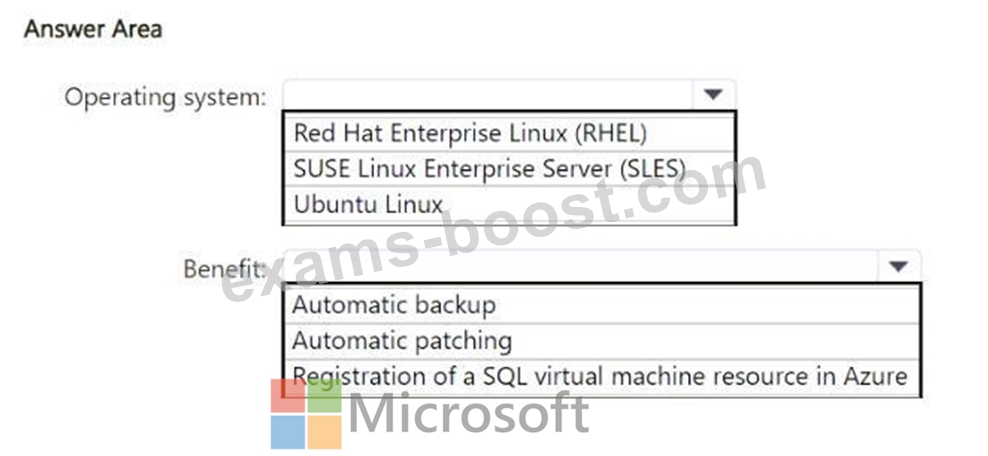
Answer:
Explanation: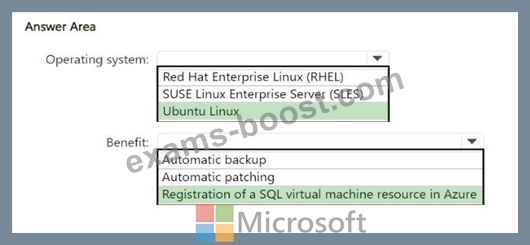
Explanation:
Operating System: Ubuntu Linux
https://learn.microsoft.com/en-us/azure/azure-sql/virtual-machines/linux/sql-server-iaas-agent- extension-linux?view=azuresql&tabs=azure-powershell#limitations Limitations: The Linux SQL IaaS Agent extension has the following limitations:
Only SQL Server VMs running on the Ubuntu Linux operating system are supported. Other Linux distributions are not currently supported.
Benefit: Registration of a SQL virtual machine resource in Azure
In below link, automated backups and patching are NOT present in the Benefits list for Linux:
https://learn.microsoft.com/en-us/azure/azure-sql/virtual-machines/linux/sql-server-iaas-agent- extension-linux?view=azuresql&tabs=azure-powershell
NEW QUESTION # 159
A data engineer creates a table to store employee information for a new application. All employee names are in
the US English alphabet. All addresses are locations in the United States. The data engineer uses the following
statement to create the table.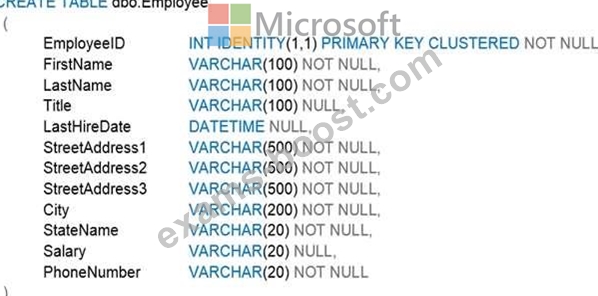
You need to recommend changes to the data types to reduce storage and improve performance.
Which two actions should you recommend? Each correct answer presents part of the solution.
NOTE: Each correct selection is worth one point.
- A. Change LastHireDateto the datedata type.
- B. Change Salaryto the moneydata type.
- C. Change PhoneNumberto the bigintdata type.
- D. Change PhoneNumberto the floatdata type.
- E. Change LastHireDate to the datetime2(7)data type.
Answer: A,B
Explanation:
Section: [none]
NEW QUESTION # 160
You plan to migrate on-premises Microsoft SQL Server databases to Azure.
You need to identify which deployment and resiliency options meet the following requirements:
* Support user-initiated backups.
* Support multiple automatically replicated instances across Azure regions.
* Minimize administrative effort to implement and maintain business continuity.
What should you identify? To answer, select the appropriate options in the answer area.
NOTE: Each correct selection is worth one point.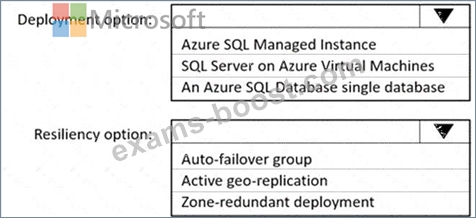
Answer:
Explanation: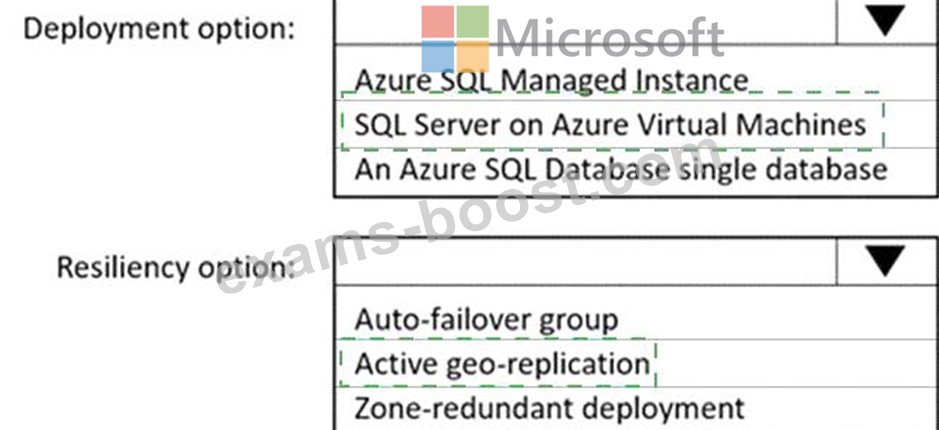
Explanation:
Box 1: SQL Server on Azure VMs
SQL Server on Azure Virtual Machines can take advantage of Automated Backup, which regularly creates backups of your database to blob storage. You can also manually use this technique.
Box 2: Active geo-replication
Geo-replication for services such as Azure SQL Database and Cosmos DB will create secondary replicas of your data across multiple regions. While both services will automatically replicate data within the same region, geo-replication protects you against a regional outage by enabling you to fail over to a secondary region.
Reference:
https://docs.microsoft.com/en-us/azure/azure-sql/virtual-machines/windows/sql-server-on-azure-vm-iaas-what-is
https://docs.microsoft.com/en-us/dotnet/architecture/cloud-native/infrastructure-resiliency-azure
NEW QUESTION # 161
What should you implement to meet the disaster recovery requirements for the PaaS solution?
- A. Availability Zones
- B. geo-replication
- C. Always On availability groups
- D. failover groups
Answer: D
Explanation:
Section: [none]
Explanation:
Scenario: In the event of an Azure regional outage, ensure that the customers can access the PaaS solution
with minimal downtime. The solution must provide automatic failover.
The auto-failover groups feature allows you to manage the replication and failover of a group of databases on a
server or all databases in a managed instance to another region. It is a declarative abstraction on top of the
existing active geo-replication feature, designed to simplify deployment and management of geo-replicated
databases at scale. You can initiate failover manually or you can delegate it to the Azure service based on a
user-defined policy.
The latter option allows you to automatically recover multiple related databases in a secondary region after a
catastrophic failure or other unplanned event that results in full or partial loss of the SQL Database or SQL
Managed Instance availability in the primary region.
Reference:
https://docs.microsoft.com/en-us/azure/azure-sql/database/auto-failover-group-overview
Question Set 3
NEW QUESTION # 162
You create a new Azure SQL managed instance named SQL1 and enable Database Mail extended stored procedures.
You need to ensure that SOL Server Agent jobs running on SQL 1 can notify administrators when a failure occurs.
Which three actions should you perform in sequence? To answer, move the appropriate actions from the list of actions to the answer area and arrange them in the correct order.
Answer:
Explanation:
Explanation
NEW QUESTION # 163
You have two Azure virtual machines named VM1 and VM2 that run Windows Server 2019. VM1 and VM2 each host a default Microsoft SQL Server 2019 instance. VM1 contains a database named DB1 that is backed up to a file named D:\DB1.bak.
You plan to deploy an Always On availability group that will have the following configurations:
* VM1 will host the primary replica of DB1.
* VM2 will host a secondary replica of DB1.
You need to prepare the secondary database on VM2 for the availability group.
How should you complete the Transact-SQL statement? To answer, select the appropriate options in the answer area.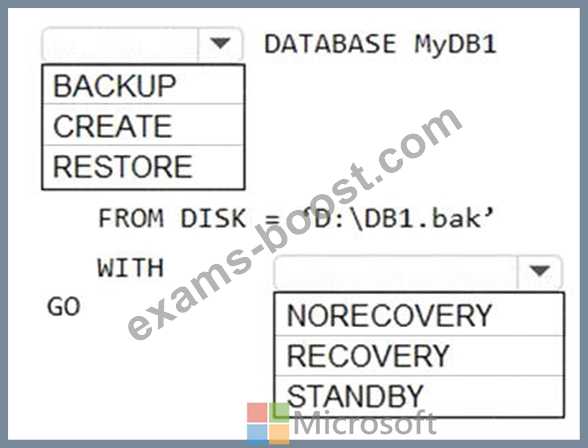
Answer:
Explanation: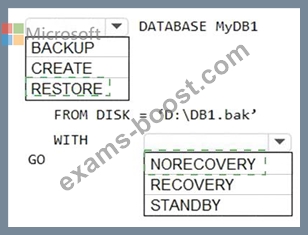
Explanation
Graphical user interface, text, application, chat or text message Description automatically generated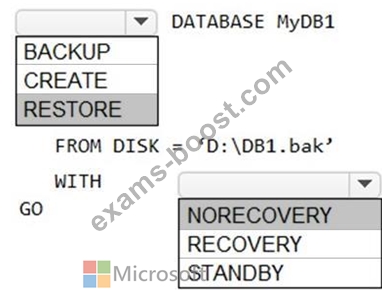
Reference:
https://docs.microsoft.com/en-us/sql/database-engine/availability-groups/windows/manually-prepare-a-secondary
NEW QUESTION # 164
You plan to create a table in an Azure Synapse Analytics dedicated SQL pool.
Data in the table will be retained for five years. Once a year, data that is older than five years will be deleted.
You need to ensure that the data is distributed evenly across partitions. The solutions must minimize the amount of time required to delete old data.
How should you complete the Transact-SQL statement? To answer, drag the appropriate values to the correct targets. Each value may be used once, more than once, or not at all.
You may need to drag the split bar between panes or scroll to view content.
NOTE: Each correct selection is worth one point.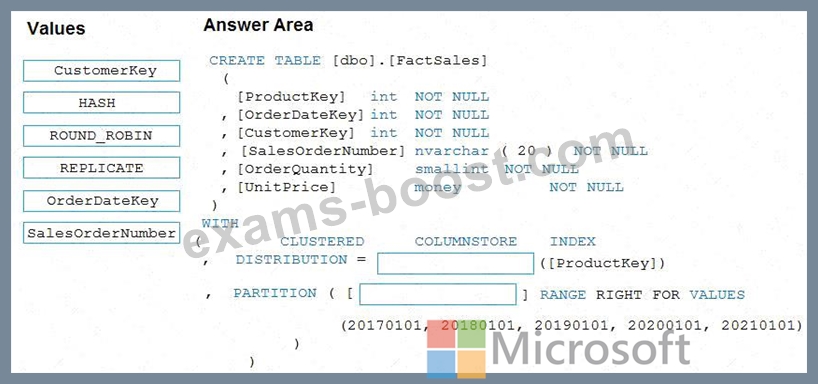
Answer:
Explanation: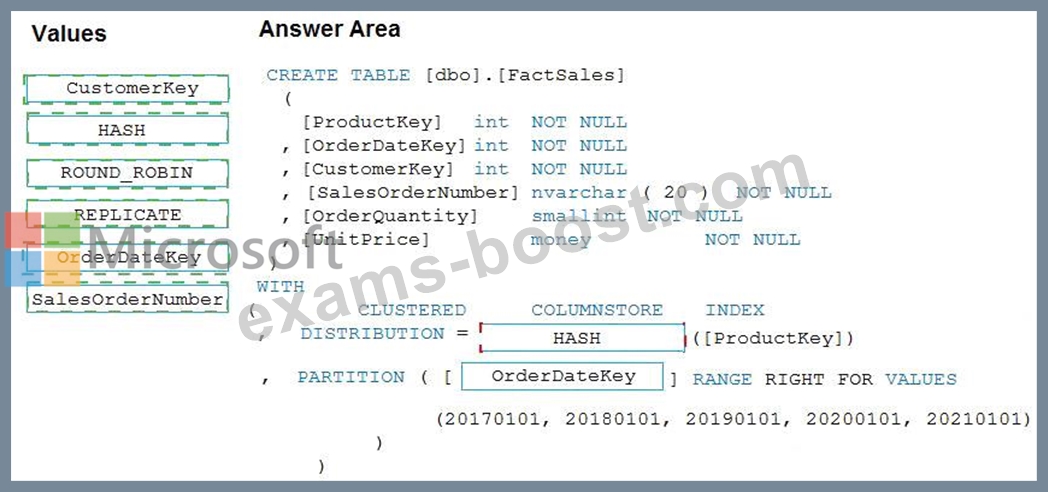
Explanation: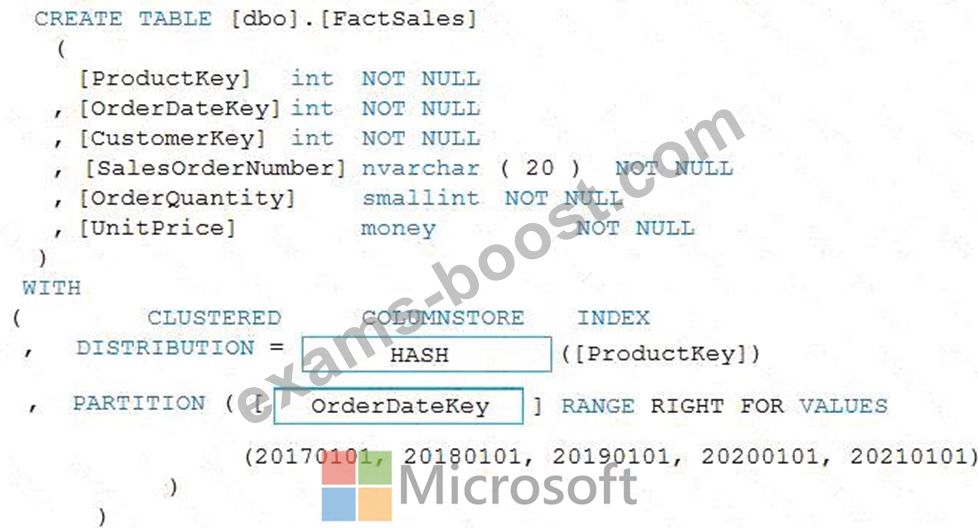
Box 1: HASH
Box 2: OrderDateKey
In most cases, table partitions are created on a date column.
A way to eliminate rollbacks is to use Metadata Only operations like partition switching for data management.
For example, rather than execute a DELETE statement to delete all rows in a table where the order_date was in October of 2001, you could partition your data early. Then you can switch out the partition with data for an empty partition from another table.
Reference:
https://docs.microsoft.com/en-us/sql/t-sql/statements/create-table-azure-sql-data-warehouse
https://docs.microsoft.com/en-us/azure/synapse-analytics/sql/best-practices-dedicated-sql-pool
NEW QUESTION # 165
You need to recommend the appropriate purchasing model and deployment option for the 30 new databases. The solution must meet the technical requirements and the business requirements.
What should you recommend? To answer, select the appropriate options in the answer area.
NOTE: Each correct selection is worth one point.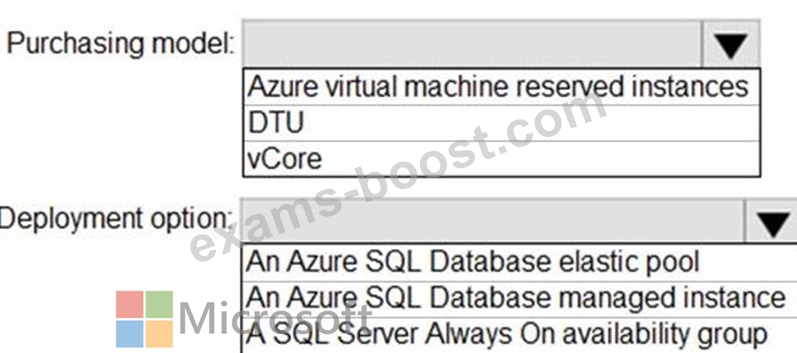
Answer:
Explanation: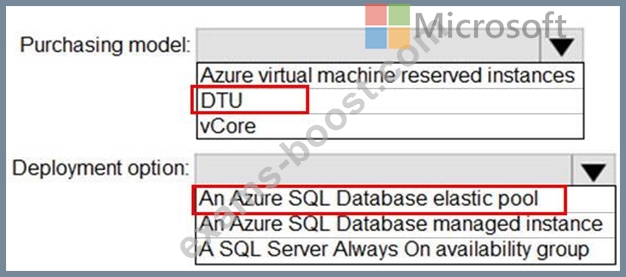
Reference:
https://docs.microsoft.com/en-us/azure/azure-sql/database/elastic-pool-overview
https://docs.microsoft.com/en-us/azure/azure-sql/database/reserved-capacity-overview
NEW QUESTION # 166
You have an Azure SQL database named db1 on a server named server1.
You use Query Performance Insight to monitor db1.
You need to modify the Query Store configuration to ensure that performance monitoring data is available as soon as possible.
Which configuration setting should you modify and which value should you configure? To answer, select the appropriate options in the answer area.
NOTE: Each correct selection is worth one point.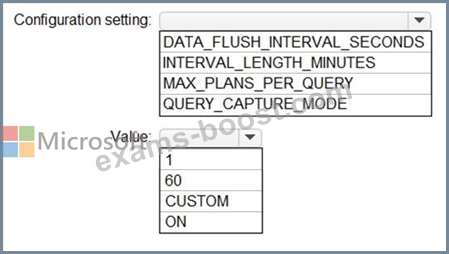
Answer:
Explanation: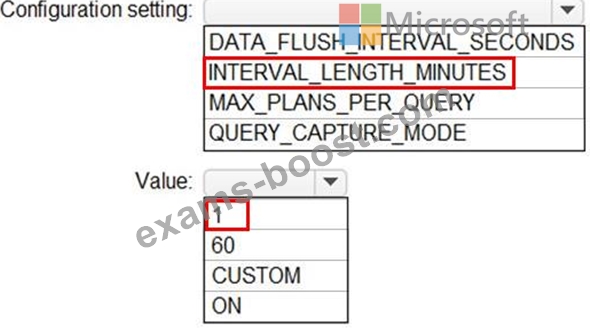
NEW QUESTION # 167
You have an Azure SQL database that contains a table named Employees. Employees contains a column named Salary.
You need to encrypt the Salary column. The solution must prevent database administrators from reading the data in the Salary column and must provide the most secure encryption.
Which three actions should you perform in sequence? To answer, move the appropriate actions from the list of actions to the answer area and arrange them in the correct order.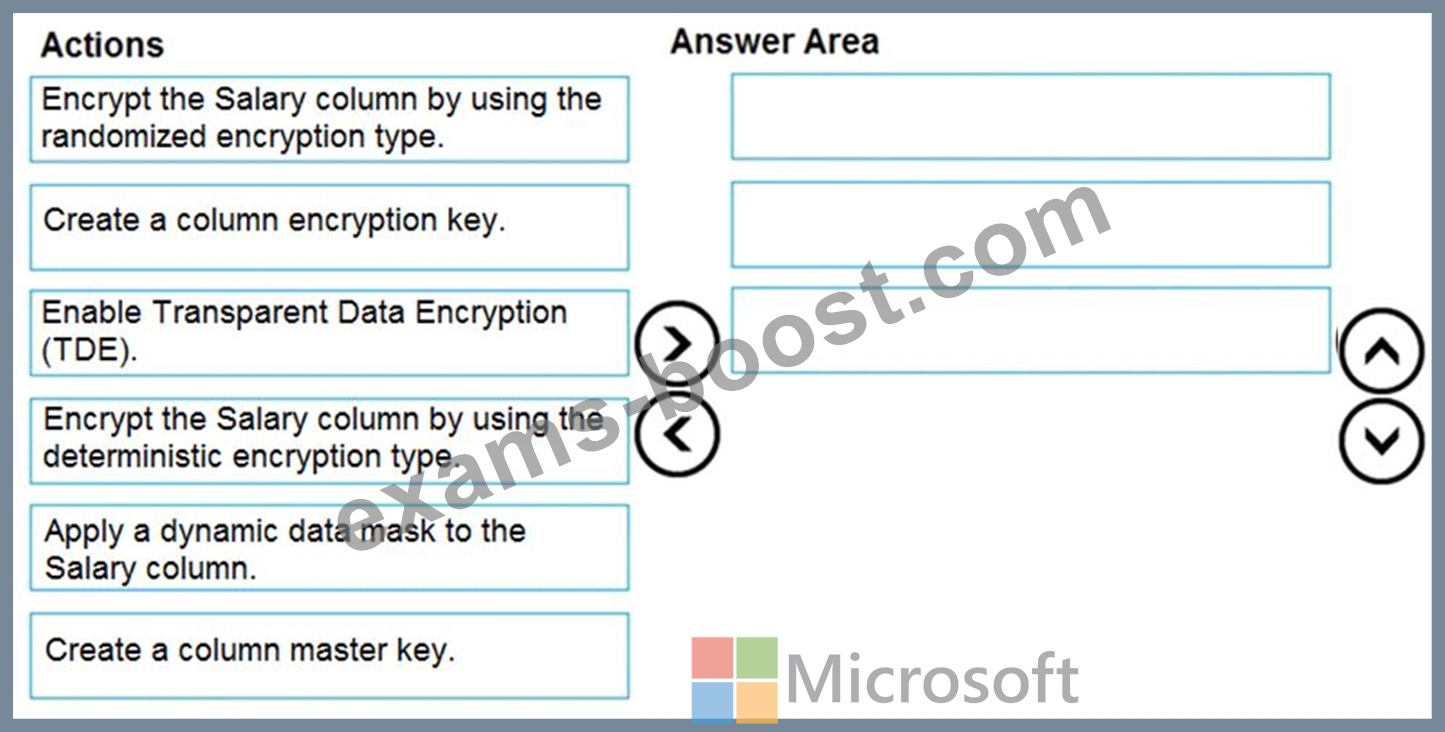
Answer:
Explanation: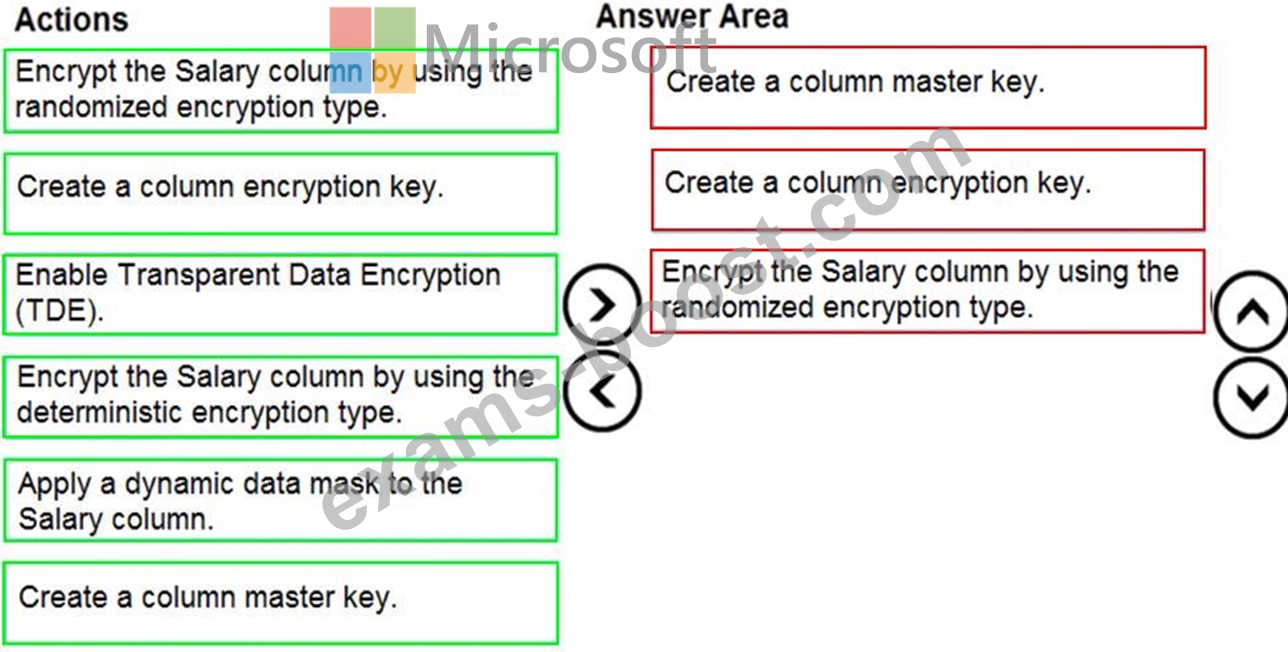
Explanation:
Step 1: Create a column master key
Create a column master key metadata entry before you create a column encryption key metadata entry in the database and before any column in the database can be encrypted using Always Encrypted.
Step 2: Create a column encryption key.
Step 3: Encrypt the Salary column by using the randomized encryption type.
Randomized encryption uses a method that encrypts data in a less predictable manner. Randomized encryption is more secure, but prevents searching, grouping, indexing, and joining on encrypted columns.
Note: A column encryption key metadata object contains one or two encrypted values of a column encryption key that is used to encrypt data in a column. Each value is encrypted using a column master key.
Incorrect Answers:
Deterministic encryption.
Deterministic encryption always generates the same encrypted value for any given plain text value. Using deterministic encryption allows point lookups, equality joins, grouping and indexing on encrypted columns. However, it may also allow unauthorized users to guess information about encrypted values by examining patterns in the encrypted column, especially if there's a small set of possible encrypted values, such as True/False, or North/South/East/West region.
Reference:
https://docs.microsoft.com/en-us/sql/relational-databases/security/encryption/always-encrypted-database-engine
NEW QUESTION # 168
You have an Azure subscription.
You plan to deploy a new Azure virtual machine that will host a Microsoft SQL Server instance.
You need to configure the disks on the virtual machine. The solution must meet the following requirements:
* Minimize latency for transaction logs.
* Minimize the impact on IO Of the virtual machine.
Which type of disk should you use for each workload? To answer. drag the appropriate disk types to the correct workloads. Each disk type may be used once, at all. You may need to drag the split bar between panes or scroll to view content.
NOTE: Each correct selection is worth one point.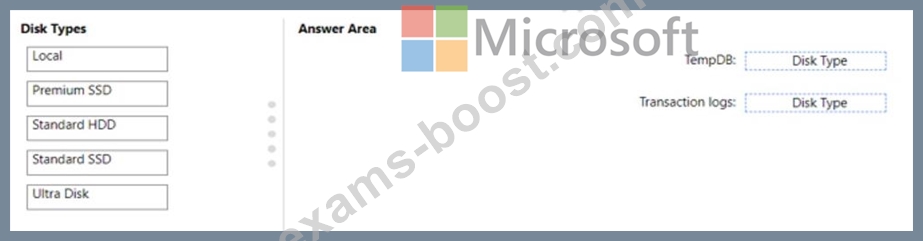
Answer:
Explanation: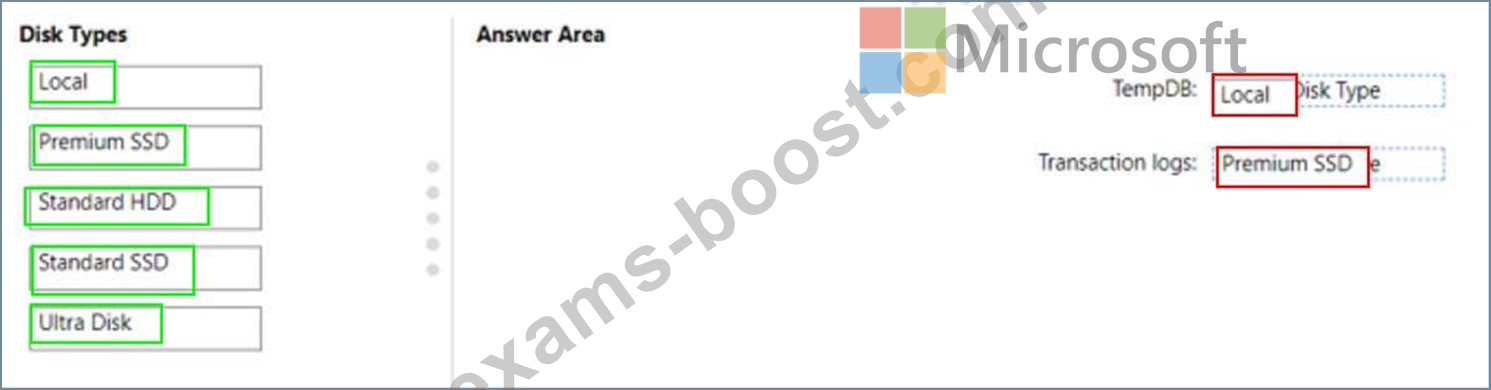
NEW QUESTION # 169
You have an Azure SQL database that contains a table named Employees. Employees contains a column named Salary.
You need to encrypt the Salary column. The solution must prevent database administrators from reading the data in the Salary column and must provide the most secure encryption.
Which three actions should you perform in sequence? To answer, move the appropriate actions from the list of actions to the answer area and arrange them in the correct order.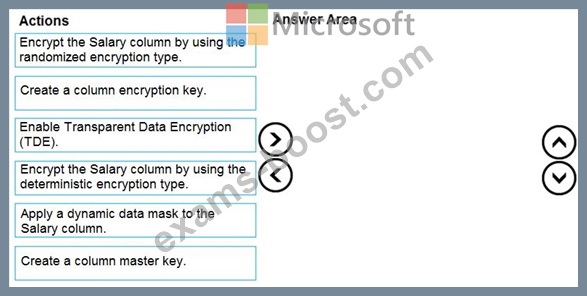
Answer:
Explanation: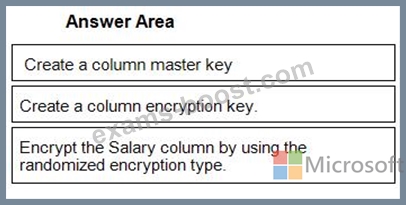
1 - Create a column master key
2 - Create a column encryption key.
3 - Encrypt the Salary column by using the randomized encryption type.
Reference:
https://docs.microsoft.com/en-us/sql/relational-databases/security/encryption/always-encrypted-database-engine
NEW QUESTION # 170
You have an Azure SQL database.
You run the following PowerShell script.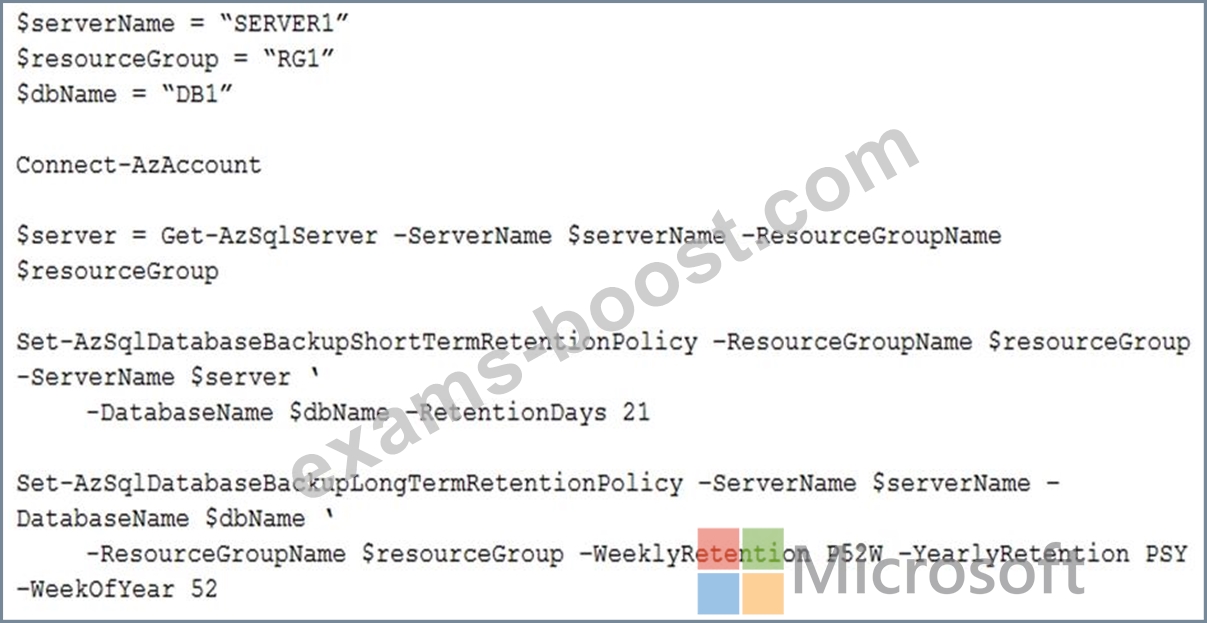
For each of the following statements, select Yes if the statement is true. Otherwise, select No.
NOTE: Each correct selection is worth one point.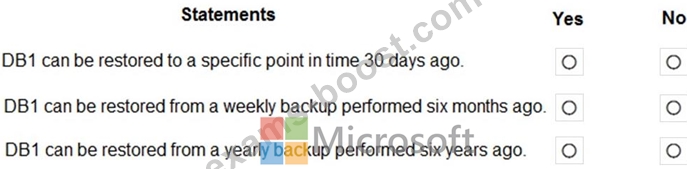
Answer:
Explanation: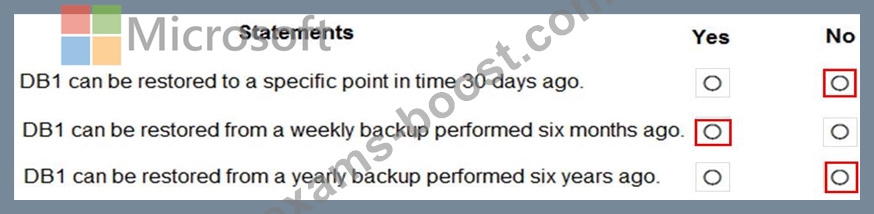
Reference:
https://docs.microsoft.com/en-us/powershell/module/az.sql/set-azsqldatabasebackupshorttermretentionpolicy?view=azps-7.2.0
https://docs.microsoft.com/en-us/powershell/module/az.sql/set-azsqldatabasebackuplongtermretentionpolicy?view=azps-7.2.0
NEW QUESTION # 171
You have several Azure SQL databases on the same Azure SQL Database server in a resource group named ResourceGroup1.
You must be alerted when CPU usage exceeds 80 percent for any database. The solution must apply to any additional databases that are created on the Azure SQL server.
Which resource type should you use to create the alert?
- A. Resource Groups
- B. SQL Servers
- C. SQL Databases
- D. SQL Virtual Machines
Answer: C
Explanation:
There are resource types related to application code, compute infrastructure, networking, storage
+ databases.
You can deploy up to 800 instances of a resource type in each resource group.
Some resources can exist outside of a resource group. These resources are deployed to the subscription, management group, or tenant. Only specific resource types are supported at these scopes.
Reference:
https://docs.microsoft.com/en-us/azure/azure-resource-manager/management/resource-providers-and-types
NEW QUESTION # 172
SIMULATION
You need to generate an email alert for db1 if the average CPU percentage utilization is greater than 50 percent for five minutes sampled at one-minute intervals. The alert must be sent to [email protected].
You may need to use SQL Server Management Studio and the Azure portal.
Answer:
Explanation:
To create an email alert for high CPU percentage utilization in an Azure database within the Azure portal, you'll first need to navigate to your database resource, then to the "Alerts" section.
From there, you'll create a new alert rule, define the CPU percentage threshold, configure an action group for email notifications, and finally, create the alert rule.
Create alerts for Azure SQL Database and Azure Synapse Analytics using the Azure portal Step 1: In the Azure portal, locate the resource you are interested in monitoring and select it.
[Select db1]
Step 2: In the resource menu under Monitoring, select Alerts. The text and icon might vary slightly for different resources.
Step 3: Select the + Create button, then Alert rule.
Step 4: On the Create an alert rule page, the Scope is automatically configured to the individual resource.
Capture activity peaks or sustained resource stress with alerts on the Metrics signal category.
Step 5: On the Condition tab, select See all signals and Select a signal from the list of Metrics.
Step 6: Select the desired metric, for example CPU percentage. Select Apply. [Select CPU percentage] Step 7: After you select a signal, the Alert logic options appear. A preview of recent activity in this resource for that signal is also displayed.
Step 8: Configure a Threshold type to determine when the alert will take action. Choose Aggregation type, Operator, and Threshold value as desired. A typical threshold is: Static, Maximum, Greater than, 80%.
Threshold: [Select 50%]
Operator: [Select Greater than]
Aggregation granularity: [Select 5 minutes]
Select the interval that's used to group the data points by using the aggregation type function.
Choose an Aggregation granularity (period) that's greater than the Frequency of evaluation to reduce the likelihood of missing the first evaluation period of an added time series.
Frequency of evaluation: [Select one minute]
Select how often the alert rule is to be run. Select a frequency that's smaller than the aggregation granularity to generate a sliding window for the evaluation.
Step 9: Under When to evaluate, determine the desired frequency of evaluation. Use the Check every and Lookback period dropdown lists.
Step 10: Optionally, you can add multiple conditions for this alert, choose the Add condition alert if desired.
Step 11: Select Next: Actions >.
Create the new alert rule
Step 12: Use the Use quick actions feature to create a new action group and provide an email or Azure mobile app notification target.
Reference:
https://learn.microsoft.com/en-us/azure/azure-sql/database/alerts-create?
NEW QUESTION # 173
......
DP-300 Study Guide Brilliant DP-300 Exam Dumps PDF: https://www.exams-boost.com/DP-300-valid-materials.html
Passing Microsoft DP-300 Exam Using 2026 Practice Tests: https://drive.google.com/open?id=12oIXK_EPF6uwM6a89vRl_DRisNEAqTMs