

PECB ISO-45001-Lead-Auditor Dumps - 100% Cover Real Exam Questions (Updated 77 Questions)
Real ISO-45001-Lead-Auditor dumps - Real PECB dumps PDF
PECB ISO-45001-Lead-Auditor Exam Syllabus Topics:
| Topic | Details |
|---|---|
| Topic 1 |
|
| Topic 2 |
|
| Topic 3 |
|
| Topic 4 |
|
NEW QUESTION # 46
In the ISO 45001 health and safety management system, what is 'documented information'? Select the ONE best answer.
- A. Any paperwork generated when the system is in operation
- B. The master copies of the documents used to operate the system, held in any format
- C. Any information about the system, or generated by it, held in any format
- D. Paperwork such as Permits to work and risk assessments
Answer: C
Explanation:
ISO 45001 defines "documented information" as information required to be controlled and maintained by an organization. This can include policies, procedures, records, or other relevant data in any format (Clause
3.19). It encompasses all information used to establish, operate, and demonstrate the effectiveness of the OH&S management system.
Analysis of Options:
* A. Any paperwork generated when the system is in operation:Incorrect. This is too narrow and excludes digital or other formats.
* B. Any information about the system, or generated by it, held in any format:Correct. This aligns with the ISO 45001 definition in Clause 3.19.
* C. Paperwork such as Permits to Work and risk assessments:Incorrect. These are examples of documented information but do not encompass the full scope of the term.
* D. The master copies of the documents used to operate the system, held in any format:Incorrect.
This definition is limited to master copies, while documented information includes records as well.
ISO References:
* Clause 3.19: Definition of documented information.
* Clause 7.5: Control of documented information.
NEW QUESTION # 47
Which three of the following statements about closing meetings are true?
- A. The audit team leader cannot instruct audit team members of their roll at the closing meeting.
- B. A closing meeting should be held in all instances, irrespective of whether the audit conducted was first-, second- or third-party.
- C. The closing meeting represents a final opportunity for the auditee to have the audit report findings changed if they are unhappy.
- D. The audit team must meet formally immediately after the closing meeting to consider recommendations for the report.
- E. A closing meeting for a first-party audit is likely to be less formal than the closing meeting for a third- party audit.
- F. The first- and second-party closing meeting must always be documented.
- G. The audit team leader can instruct members of the audit team to attend the closing meeting virtually.
- H. Closing meetings should be chaired by the audit client or their designated representative.
Answer: E,G
NEW QUESTION # 48
You will lead a second-party audit of an organization that manufactures car batteries. When you are checking the audit plan with the auditee's Safety Manager, she asks you to reduce the production line audit from two hours to one hour and to extend the audit to the warehouse from two hours to three hours. She argues that in the last four internal audits, she did not raise any nonconformities in Production while more than 10 were raised in the warehouse.
Which of the following would be your best answer?
- A. OK. I will change the plan accordingly.
- B. OK. I will change the plan. If necessary, I will use the lunchtime to stay longer in the warehouse.
- C. I will not change the plan, but I will consider your comments during the audit.
- D. OK. I will reduce the time in Production to one hour and will review with you (the Safety Manager) the corrective action process in detail during the second hour.
Answer: C
NEW QUESTION # 49
Like many other quality management systems, ISO 45001 uses what is known as a 'PDCA' circle. What do those initials stand for?
- A. Prepare, Deliver, Control, Assess
- B. Plan, Do, Check, Ask
- C. Plan, Do, Check, Act
- D. Plan, Deliver, Control, Achieve
Answer: C
Explanation:
The PDCA (Plan-Do-Check-Act) model is a continuous improvement framework used in ISO 45001 and other management systems.
* Plan: Establish objectives and processes to deliver results in line with the OH&S policy.
* Do: Implement the processes.
* Check: Monitor and measure processes against the policy, objectives, and requirements.
* Act: Take actions to continually improve the system's performance.
Analysis of Options:
* A. Plan, Do, Check, Act:Correct. This is the standard PDCA cycle.
* B. Plan, Do, Check, Ask:Incorrect. "Ask" is not part of the cycle.
* C. Plan, Deliver, Control, Achieve:Incorrect. This is not the PDCA cycle.
* D. Prepare, Deliver, Control, Assess:Incorrect. This deviates from the PDCA framework.
ISO Reference:
* Clause 0.3: PDCA model.
NEW QUESTION # 50
During a second-party audit at a sawmill, you find that the OHSMS Manager conducted the hazard identification process. In the risk assessment report, hazards were listed as physical hazards, chemical hazards, biological hazards and psychosocial hazards, with the hazards categories as low medium and high to be addressed. The OHSMS Manager did not have an action plan for low and medium risks, saying that they ignored those He stated that they brought in a health and safety consultant to advise on treatment for the high risks.
When interviewing the OHSMS Manager, the auditor presents a nonconformity relating to potential hazards In the factory If the dust extraction system broke down. The OHSMS Manager said that. If that happened, the agreed planned action is that workers would put masks on.
Select one of the options for how the auditor should respond to this statement.
- A. Ask the OH5MS Manager to confirm that this action meets regulatory requirements for air purity.
- B. Seek evidence that the response action is both Implemented and effective.
- C. Suggest that they should increase their maintenance checks.
- D. Advise that the factory should cease its operations It the dust extraction equipment malfunctioned.
Answer: B
Explanation:
The auditor should assess whether the organization's planned action (using masks in case of dust extraction failure) is both implemented and effective. This aligns with ISO 45001 requirements to ensure that control measures are functional and meet the intended objectives.
* Clause 8.1.2 (Hierarchy of Controls):The use of PPE, such as masks, is considered a last resort in the hierarchy of controls. The organization must demonstrate that the measure is:
* Implemented (e.g., PPE is available and workers are trained to use it).
* Effective (e.g., masks provide adequate protection against dust).
* Analysis of Options:
* A. Advise that the factory should cease operations if the dust extraction equipment malfunctioned.While ceasing operations may be a necessary control in extreme situations, it is not a practical or realistic recommendation unless a high-risk scenario cannot be otherwise managed.
* B. Ask the OHSMS Manager to confirm regulatory compliance.Regulatory compliance is important but does not fully address the requirement to ensure the action is effective.
* C. Seek evidence that the response action is both implemented and effective.This is the most appropriate response. The auditor must verify implementation and effectiveness to determine conformity.
* D. Suggest increasing maintenance checks.Maintenance is important for preventing equipment breakdowns, but this option does not address the immediate audit finding about the adequacy of response actions.
ISO References:
* Clause 8.1.2: Emphasizes applying the hierarchy of controls effectively.
* Clause 9.1.1: Requires monitoring and measuring controls to ensure effectiveness.
NEW QUESTION # 51
You are conducting an ISO 45001 audit of Widgets Inc.., an organization manufacturing machine parts for the aerospace industry, You find a short entry in the incident report file connecting a machine operator who suffered minor injury to his face four weeks ago when a small ribbon of metal hit him while operating his machine.
The subsequent investigation found that he was not wearing the required protective Personal Protective Equipment (PPE). He was subject to disciplinary action and warned that he would lose his job if it happened again.
Select two option of points of investigation which you would consider in order to determine conformity or nonconformity with clause 10.2 of ISO 45001.
- A. Find out when the operator's machine was last subject to a maintenance programme.
- B. Interview the operator to check if the was wearing the correct PPE.
- C. Check whether any corrective actions were taken to eliminate or reduce the risk of recurrence of the Incident.
- D. Determine whether the Health and Safety Authority was notified of the incident
- E. Establish whether the Incident Investigation determined the root cause of the Incident
- F. find out whether the operator was sent to the hospital.
Answer: C,E
Explanation:
Clause 10.2 of ISO 45001 requires organizations to investigate incidents, determine root causes, and implement corrective actions to prevent recurrence.
Analysis of Options:
A . Check whether corrective actions were taken.
This directly relates to the requirement to implement corrective actions to address the identified risks and hazards. Failure to do so would indicate nonconformity.
B . Determine whether the Health and Safety Authority was notified.
Notification is a legal requirement in certain jurisdictions, but it is not explicitly required under ISO 45001 unless the legal context demands it.
C . Establish whether the root cause was determined.
Root cause analysis is fundamental for effective corrective action. Without this, corrective measures may not address the underlying problem.
D . Find out when the operator's machine was last subject to maintenance.
While maintenance is important, it does not directly address the incident's nonconformity.
E . Find out whether the operator was sent to the hospital.
Sending the operator to the hospital is a reactive step and not relevant to compliance with Clause 10.2.
F . Interview the operator about PPE usage.
This is relevant but insufficient for determining compliance with Clause 10.2.
ISO Reference:
Clause 10.2: Investigation of incidents, determination of causes, and implementation of corrective actions.
Clause 8.1.2: Hierarchy of controls and risk reduction.
NEW QUESTION # 52
An adventure park has the following and safety policy document displayed in the reception area:
This organization is committed to providing safe experiences, In accordance with health and safety regulations for their delivery. The organisation will strive to increase the health and safety awareness of its personal, contracts and customers. Continual health and safety improvement is a permanent objective of the organisation. This policy shall be communicated to all interested parties.
Referring to the policy statement, select three options for which the organization is meeting ISO 45001 requirements.
- A. The management Is committed to health and safety Improvement.
- B. The organisation uses contractors committed to health and safety.
- C. The organization intends to communicate its policy to external parties.
- D. The organisation is committed to continual health and safety improvement.
- E. The organization has a good reputation for safe experiences.
- F. The organisation satisfies Its customers' health and safety requirement.
- G. The organisation meets oil statutory requirements.
- H. The organisation's processes deliver the Intended Improvement to health and safety.
- I. The management is committed to health and safety improvement.
Answer: A,C,D
Explanation:
Comprehensive Detailed Explanation along with All ISO 45001 Audit References Clause 5.2 of ISO 45001:2018 outlines requirements for the OH&S policy, emphasizing commitment to continual improvement, compliance with legal requirements, and communication of the policy to interested parties.
Analysis of Options:
* A. The management is committed to health and safety improvement:Correct. The policy explicitly states the organization's commitment to improvement, meeting Clause 5.2 requirements.
* C. The organization has a good reputation for safe experiences:Not relevant to ISO 45001 requirements; reputation is not a policy criterion.
* D. The organization intends to communicate its policy to external parties:Correct. Clause 5.2 requires the policy to be communicated to interested parties.
* E. The organization is committed to continual health and safety improvement:Correct. This directly aligns with Clause 5.2, which mandates continual improvement.
* F. The organization meets all statutory requirements:The policy does not explicitly state compliance with legal requirements, even though this is implied.
* G. The organization satisfies its customers' health and safety requirements:The policy does not specifically address customer requirements.
* H. The organization uses contractors committed to health and safety:Not stated in the policy.
* I. The organization's processes deliver the intended improvement to health and safety:This is not evident from the policy statement.
ISO References:
* Clause 5.2: OH&S policy.
NEW QUESTION # 53
Select three options that would provide evidence of conformance with clause 9.1.1 of ISO 45001.
- A. Competency of centre staff.
- B. Reports showing that elevators have passed the annual inspection.
- C. An OH&S objective to reduce the number of reported incidents.
- D. A procedure on how to determine trends when analysing OHS data.
- E. Signage that alerts visitors to hazards in the centre.
- F. An increase in the visitors using the website.
- G. Reports of accidents to staff members.
- H. Periodic analysis of the results of improvement actions.
Answer: D,G,H
NEW QUESTION # 54
Which three of the following ISO 45001 activities require the organisation to emphasise non-managerial workers' participation?
- A. Determining how to fulfil legal requirements
- B. Determining what needs to be communicated
- C. Establishing OHS objectives
- D. Establishing the OHS policy
- E. Determining actions to eliminate hazards
- F. Determining competence requirements
- G. Managing the internal audit programme
- H. Determining controls on outsourced processes
Answer: C,D,E
Explanation:
ISO 45001 emphasizes the importance of worker participation, particularly non-managerial workers, in developing and improving the OH&S management system. Clause 5.4 outlines specific areas where their involvement is crucial.
Analysis of Options:
* A. Determining competence requirements:Incorrect. Competence requirements are primarily determined by management but may involve feedback from workers.
* B. Determining how to fulfil legal requirements:Incorrect. Management typically handles compliance with legal requirements.
* C. Determining controls on outsourced processes:Incorrect. This is a management responsibility.
* D. Managing the internal audit programme:Incorrect. Workers participate in audits, but managing the program is a management task.
* E. Determining what needs to be communicated:Incorrect. Communication strategies are usually set by management.
* F. Determining actions to eliminate hazards:Correct. Non-managerial workers' input is vital in identifying and eliminating workplace hazards (Clause 8.1.2).
* G. Establishing the OHS policy:Correct. Workers' participation in policy development ensures it is relevant and inclusive (Clause 5.2).
* H. Establishing OHS objectives:Correct. Workers' participation ensures that objectives are practical and aligned with workplace realities (Clause 6.2).
NEW QUESTION # 55
An audit team leader arrives at a fabrication organisation that manufactures stairways to ..certification audit.
At a meeting with the OHSMS Manager the audit finds that the responsibility for worker consultation and participation lies with the managerial team. Select from the options four actions by the managerial team that encourage worker consultation and participation.
- A. Implementing methods tor engaging workers
- B. Conducting toolbox talks on health and safety
- C. threatening reprisals to whistleblowers
- D. Appointing worker's representatives
- E. Implementing a payment scheme to reward worker's OHS performance
- F. Promoting collaborating workers to higher positions
- G. Giving ownership of health and safety matters
- H. Ignoring worker's suggestions
Answer: A,B,D,G
NEW QUESTION # 56
What is the definition of the term 'audit' as per clause 3.32 of ISO 45001:2018?
- A. An evaluation of the effectiveness of health and safety measures
- B. A document that outlines safety procedures and guidelines
- C. A systematic process to assess the risks in a workplace
- D. A legal requirement to comply with health and safety standards
Answer: A
Explanation:
According to Clause 3.32 of ISO 45001:2018, an audit is defined as a systematic, independent, and documented process for obtaining objective evidence and evaluating it to determine the extent to which audit criteria are fulfilled.
This involves assessing the effectiveness of health and safety measures implemented in the organization's OH&S management system.
Analysis of Options:
A . A systematic process to assess the risks in a workplace:
Incorrect. While audits may include risk assessments, the purpose is broader and involves evaluating the entire OH&S management system.
B . An evaluation of the effectiveness of health and safety measures:
Correct. This aligns with the definition of an audit as per ISO 45001:2018.
C . A legal requirement to comply with health and safety standards:
Incorrect. An audit is not necessarily a legal requirement but a process to assess conformity.
D . A document that outlines safety procedures and guidelines:
Incorrect. An audit is a process, not a document.
ISO Reference:
Clause 3.32: Audit definition.
NEW QUESTION # 57
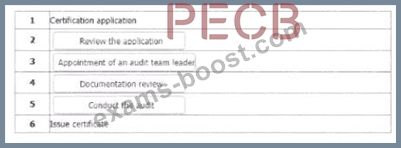
The following options show key actions involved in a third-party audit. They are not in order. Order the stages in the table to show the sequence in which the actions should take place.
To complete the sequence click on the blank section you want to complete so it is highlighted in red and then click on the applicable stage from the options below. Alternatively, drag and drop the options to the appropriate blank section.
These stages take place after a certification application.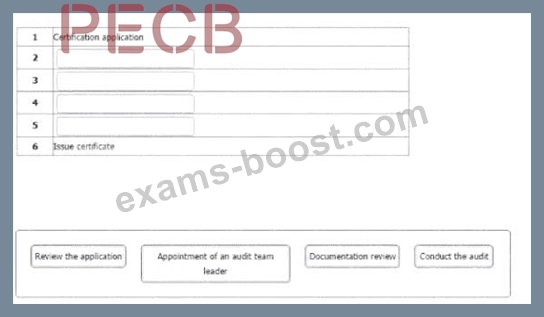
Answer:
Explanation: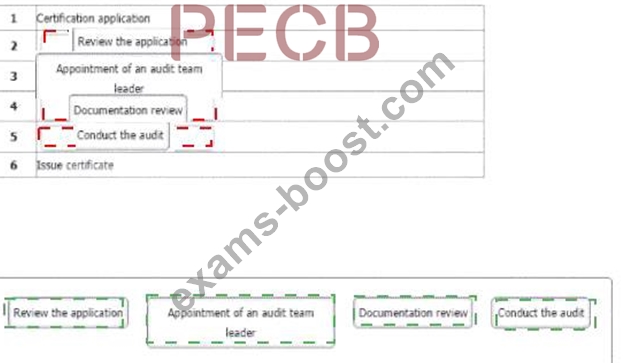
NEW QUESTION # 58
What is the definition of the term 'audit' as per clause 3.32 of ISO 45001:2018?
- A. An evaluation of the effectiveness of health and safety measures
- B. A document that outlines safety procedures and guidelines
- C. A systematic process to assess the risks in a workplace
- D. A legal requirement to comply with health and safety standards
Answer: A
Explanation:
According to Clause 3.32 of ISO 45001:2018, an audit is defined as a systematic, independent, and documented process for obtaining objective evidence and evaluating it to determine the extent to which audit criteria are fulfilled.
This involves assessing the effectiveness of health and safety measures implemented in the organization's OH&S management system.
Analysis of Options:
* A. A systematic process to assess the risks in a workplace:Incorrect. While audits may include risk assessments, the purpose is broader and involves evaluating the entire OH&S management system.
* B. An evaluation of the effectiveness of health and safety measures:Correct. This aligns with the definition of an audit as per ISO 45001:2018.
* C. A legal requirement to comply with health and safety standards:Incorrect. An audit is not necessarily a legal requirement but a process to assess conformity.
* D. A document that outlines safety procedures and guidelines:Incorrect. An audit is a process, not a document.
ISO Reference:
* Clause 3.32: Audit definition.
NEW QUESTION # 59
What does ISO 45001 say are the hazards that have to be considered when planning a health and safety management system? Select the ONE best answer.
- A. Work activities where there is the possibility of danger
- B. Work activities, workplace design, and human factors such as hours of work and bullying and harassment
- C. Work hazards and environmental factors such as bad weather
- D. Hot-work, working at height, enclosed space entry, and work on electrical equipment
Answer: B
Explanation:
ISO 45001:2018 requires a holistic approach to occupational health and safety. This means considering all aspects that could impact worker well-being, not just obvious physical hazards. The correct answer encompasses work activities (the tasks themselves), workplace design (the physical environment), and human factors (psychological and social aspects like working hours and harassment). It's the most comprehensive and aligned with the standard's philosophy ISO 45001:2018, Clause 6.1.2, outlines requirements for hazard identification. Hazards to consider include work activities, workplace design, human factors, and social factors that may impact OH&S. These go beyond traditional physical risks and include psychosocial and organizational hazards.
Analysis of Options:
A . Work activities, workplace design, and human factors such as hours of work and bullying and harassment:
Correct. This comprehensively addresses hazard categories outlined in ISO 45001, Clause 6.1.2.
B . Work activities where there is the possibility of danger:
Too general. ISO 45001 includes broader categories of hazards, including those related to organizational and social factors.
C . Hot-work, working at height, enclosed space entry, and work on electrical equipment:
Too narrow. These are specific hazards but do not encompass the full range outlined in ISO 45001.
D . Work hazards and environmental factors such as bad weather:
Incomplete. While environmental factors are relevant, ISO 45001 also includes workplace design, human factors, and psychosocial hazards.
ISO Reference:
Clause 6.1.2.1: Hazard identification.
Annex A.6.1.2: Examples of hazard categories, including workplace design and human factors.
NEW QUESTION # 60
An audit team leader prepares the audit plan for an initial Stage 2 certification audit. Which two of the following statements are false?
- A. The audit team leader should plan to interview each employee.
- B. The organisation should cancel at staff leave during the audit.
- C. The plan does not need to include the names of the senior managers.
- D. The audit team leader should present the plan to the auditee before the Stage 2 audit.
- E. The organisation should review the audit plan for agreement.
- F. The audit team leader does not select the OHS audit team members.
Answer: A,F
Explanation:
Comprehensive Detailed Explanation along with All ISO 45001 Audit Reference Analysis of Each Option:
A . The organisation should review the audit plan for agreement.
True.
According to ISO 45001 guidelines and ISO 19011 (Guidelines for Auditing Management Systems), it is standard practice for the auditee organization to review and agree to the audit plan to ensure clarity on scope, objectives, and processes.
Reference: ISO 19011:2018, Clause 6.3.2.
B . The audit team leader does not select the OHS audit team members.
False.
The audit team leader is responsible for selecting competent team members with the requisite expertise to evaluate the auditee's Occupational Health & Safety Management System (OHSMS). Selection is based on criteria such as knowledge of ISO 45001, auditing skills, and understanding of the industry.
Reference: ISO 19011:2018, Clause 5.4.2 and 6.3.1.
C . The audit team leader should plan to interview each employee.
False.
While employee interviews are an essential part of gathering evidence during an ISO 45001 audit, interviewing every employee is impractical and unnecessary. A representative sampling strategy is used to assess compliance across various levels and departments.
Reference: ISO 19011:2018, Clause 6.4.6.
D . The audit team leader should present the plan to the auditee before the Stage 2 audit.
True.
Presenting the audit plan to the auditee before the audit is essential to ensure all parties are informed and prepared for the audit. This practice is emphasized in ISO 19011 and supports transparency and effective audit execution.
Reference: ISO 19011:2018, Clause 6.3.3.
E . The organisation should cancel staff leave during the audit.
False.
ISO 45001 and related audit guidelines do not mandate the cancellation of staff leave during audits. While key personnel should be available, the audit team collaborates with the organization to plan around leave schedules to minimize disruption.
Reference: Not explicitly covered in ISO 45001 or ISO 19011; falls under planning discretion.
F . The plan does not need to include the names of the senior managers.
True.
While the audit plan should outline the scope, objectives, and methods, it does not specifically require the inclusion of senior managers' names unless they are directly involved in the audit.
Reference: ISO 19011:2018, Clause 6.3.2.
Key ISO Reference:
ISO 45001:2018, Clause 9.2 (Internal Audit Requirements).
ISO 19011:2018, Clauses 5.4.2, 6.3.1, 6.3.2, and 6.4.6.
NEW QUESTION # 61
An audit team leader arrives at a steel fabrication organisation that manufactures stairways to carry out a Stage2 certification audit. At a meeting with the OHSMS Manager, she is told that they have won their biggest contact from a construction organization to manufacture and install stairways.
During the audit, a team member found that several employees had suffered hand injuries over several months due to handrail welds not being property polished. The OHSMS Manager blames the new employees they had to take on because of the big contract. The auditor raises a nonconformance against clause 10.2 erf ISO 45001.
In relation to the nonconformity raised by the auditor and in line with the policy of the certification body, the audit team raise improvement opportunities in the audit report.
Which three of the options would represent acceptance opportunities for improvement in the report?
- A. A first aid station could be located next to the handrail polishing operation.
- B. Additional internal audits of the OHS management system may reduce production problems.
- C. All workers should be given competence test.
- D. A quality control programme could involve non-destructive testing of the welded handrails
- E. The molding polishers should be disciplined for Incompetency.
- F. Operational planning activities may benefit from an improved risk based approach based on international standards tor risk management.
- G. The requirement for wearing protective gloves could be extended to shop floor workers across all operations.
- H. The induction programme for new employees could include an awareness training video in health and safety.
Answer: F,G,H
Explanation:
Comprehensive Detailed Explanation along with All ISO 45001 Audit References Opportunities for improvement (OFIs) are suggestions provided during audits that do not indicate nonconformities but are aimed at enhancing the system's performance.
Analysis of Options:
* A. A quality control program could involve non-destructive testing of the welded handrails:While beneficial, this focuses on product quality rather than OH&S improvements.
* B. Operational planning activities may benefit from an improved risk-based approach based on international standards for risk management:Correct. Enhancing risk-based thinking aligns with Clause 6.1.1.
* C. A first aid station could be located next to the handrail polishing operation:While useful, first aid station placement is an operational matter, not directly related to OH&S management system improvement.
* D. Additional internal audits of the OHS management system may reduce production problems:
Internal audits should address system performance, not production problems.
* F. The induction program for new employees could include an awareness training video on health and safety:Correct. Enhanced training for new employees addresses Clause 7.2 (competence).
* G. The requirement for wearing protective gloves could be extended to shop floor workers across all operations:Correct. This improves hazard control in line with Clause 8.1.2.
* H. The molding polishers should be disciplined for incompetency:Disciplinary actions are outside the scope of system improvement.
ISO References:
* Clause 6.1.1: Risk management.
* Clause 7.2: Competence.
* Clause 8.1.2: Hierarchy of controls.
NEW QUESTION # 62
......
Realistic Exams-boost ISO-45001-Lead-Auditor Dumps PDF - 100% Passing Guarantee: https://www.exams-boost.com/ISO-45001-Lead-Auditor-valid-materials.html
Free PECB ISO-45001-Lead-Auditor Exam Questions and Answer: https://drive.google.com/open?id=1xhZB5Myd6gDiodbPOiK3hsxNKmDm_E7R