

[Sep-2026] FCSS_EFW_AD-7.6 Dumps are Available for Instant Access using Exams-boost
FCSS_EFW_AD-7.6 Dumps 2026 - New Fortinet FCSS_EFW_AD-7.6 Exam Questions
Fortinet FCSS_EFW_AD-7.6 Exam Syllabus Topics:
| Topic | Details |
|---|---|
| Topic 1 |
|
| Topic 2 |
|
| Topic 3 |
|
| Topic 4 |
|
| Topic 5 |
|
NEW QUESTION # 82
Refer to the exhibit, which shows a partial troubleshooting command output.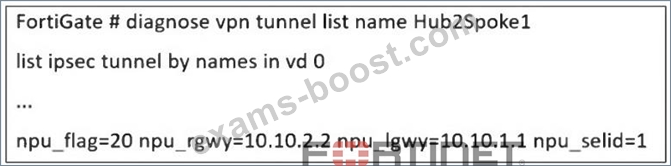
An administrator is extensively using IPsec on FortiGate. Many tunnels show information similar to the output shown in the exhibit.
What can the administrator conclude?
- A. Only the inbound IPsec SA is copied to the NPU.
- B. IPsec SAs cannot be offloaded.
- C. The two IPsec SAs, inbound and outbound, are copied to the NPU.
- D. Only the outbound IPsec SA is copied to the NPU.
Answer: C
Explanation:
The diagnose vpn tunnel list name Hub2Spoke1 command output provides key information about the offloading status of an IPsec VPN tunnel to the Network Processing Unit (NPU).
# npu_flag=20:
# This flag indicates that both inbound and outbound IPsec Security Associations (SAs) have been offloaded to the NPU, meaning the VPN traffic is processed in hardware instead of the CPU.
# npu_rgwy=10.10.2.2 and npu_lgwy=10.10.1.1:
# These IPs represent the remote gateway (rgwy) and local gateway (lgwy), confirming that the tunnel is successfully offloaded.
# npu_selid=1:
# This value means the session selector for the NPU offloaded SA is active.
Since both inbound and outbound SAs are offloaded, the administrator can conclude that the FortiGate NPU is handling IPsec encryption and decryption efficiently, reducing CPU load and improving VPN performance.
NEW QUESTION # 83
Refer to the exhibit, which shows the packet capture output of a three-way handshake between FortiGate and FortiManager Cloud.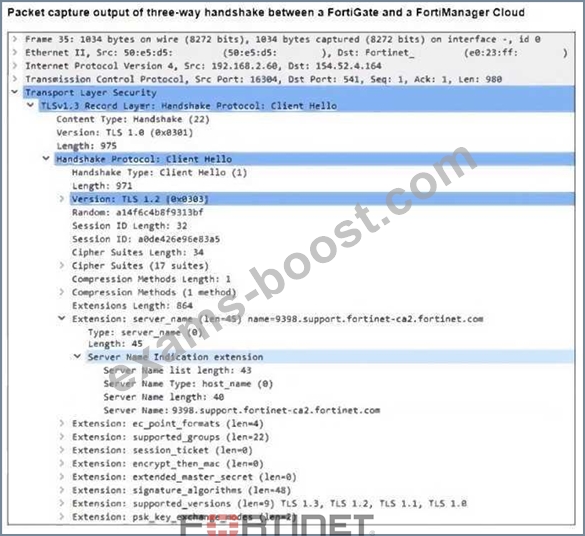
What two conclusions can you draw from the exhibit? (Choose two.)
- A. The wildcard for the domain *.fortinet-ca2.support.fortinet.com must be supported by FortiManager Cloud.
- B. FortiGate will receive a certificate that supports multiple domains because FortiManager operates in a cloud computing environment.
- C. FortiGate is connecting to the same IP server and will receive an independent certificate for its connection between FortiGate and FortiManager Cloud.
- D. If the TLS handshake contains 17 cipher suites it means the TLS version must be 1.0 on this three-way handshake.
Answer: A,B
Explanation:
The packet capture output displays a TLS Client Hello message from FortiGate to FortiManager Cloud. This message contains Server Name Indication (SNI), which is used to indicate the domain name that FortiGate is trying to connect to.
FortiGate will receive a certificate that supports multiple domains because FortiManager operates in a cloud computing environment.
FortiManager Cloud hosts multiple customers and domains under a shared infrastructure. The TLS handshake includes SNI (Server Name Indication), which allows FortiManager Cloud to serve multiple certificates based on the requested domain. This means FortiGate will likely receive a multi-domain or wildcard certificate that can be used for multiple customers under FortiManager Cloud.
The wildcard for the domain .fortinet-ca2.support.fortinet.com must be supported by FortiManager Cloud.
The SNI extension contains the domain 9398.support.fortinet-ca2.fortinet.com.
FortiManager Cloud must support wildcard certificates such as *.fortinet-ca2.support.fortinet.com to securely manage multiple subdomains and customers.
This ensures that FortiGate can validate the server certificate without any TLS errors.
NEW QUESTION # 84
Refer to the exhibit, which shows the FortiGuard Distribution Network of a FortiGate device.
FortiGuard Distribution Network on FortiGate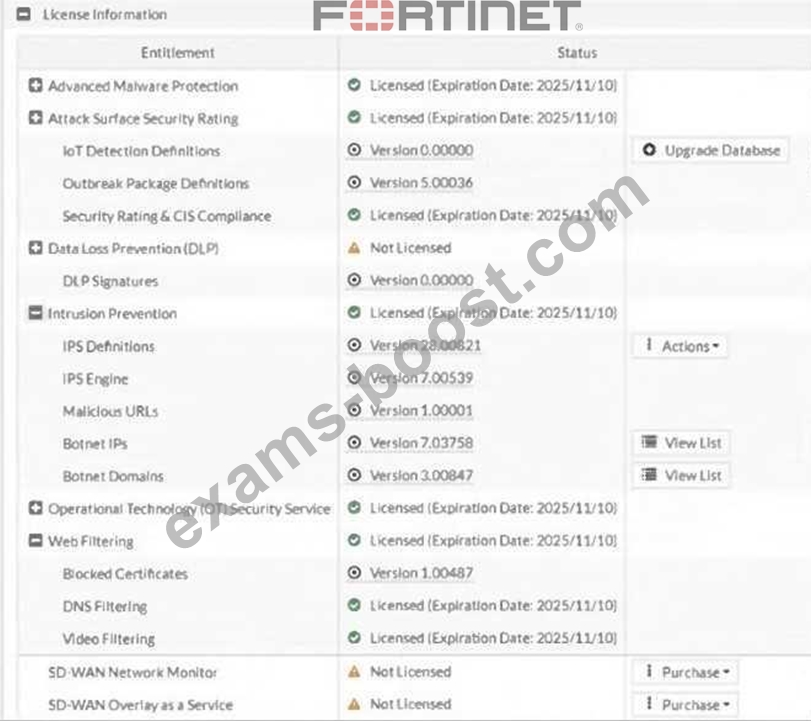
An administrator is trying to find the web filter database signature on FortiGate to resolve issues with websites not being filtered correctly in a flow-mode web filter profile. Why is the web filter database version not visible on the GUI, such as with IPS definitions?
- A. The web filter database is stored locally, but the administrator must run over CLI diagnose autoupdate versions.
- B. The web filter database is stored locally on FortiGate, but it is hidden behind the GUI. It requires enabling debug mode to make it visible.
- C. The web filter database is not hosted on FortiGate: FortiGate queries FortiGuard or FortiManager for web filter ratings on demand.
- D. The web filter database is only accessible after manual syncing with a valid FDS server using diagnose test update info.
Answer: C
Explanation:
Unlike IPS or antivirus databases, FortiGate does not store a full web filter database locally.
Instead, FortiGate queries FortiGuard (or FortiManager, if configured) dynamically to classify and filter web content in real time.
Key points:
Web filtering works on a cloud-based model:
When a user requests a website, FortiGate queries FortiGuard servers to check its category and reputation.
The response is then cached locally for faster lookups on repeated requests.
No local web filter database version:
Unlike IPS and antivirus, which download and store signature updates locally, web filtering relies on cloud-based queries.
This is why no database version appears in the GUI.
Flow mode vs Proxy mode:
In proxy mode, FortiGate can cache some web filter data, improving performance. In flow mode, all queries happen dynamically, with no locally stored database.
NEW QUESTION # 85
An administrator needs to install an IPS profile without triggering false positives that can impact applications and cause problems with the user's normal traffic flow. Which action can the administrator take to prevent false positives on IPS analysis?
- A. Install missing or expired SSUTLS certificates on the client PC to prevent expected false positives.
- B. Use an IPS profile with action monitor, however, the administrator must be aware that this can compromise network integrity.
- C. Enable Scan Outgoing Connections to avoid clicking suspicious links or attachments that can deliver botnet malware and create false positives.
- D. Use the IPS profile extension to select an operating system, protocol, and application for all the network internal services and users to prevent false positives.
Answer: D
Explanation:
False positives in Intrusion Prevention System (IPS) analysis can disrupt legitimate traffic and negatively impact user experience. To reduce false positives while maintaining security, administrators can:
Use IPS profile extensions to fine-tune the settings based on the organization's environment.
Select the correct operating system, protocol, and application types to ensure that IPS signatures match the network's actual traffic patterns, reducing false positives.
Customize signature selection based on the network's specific services, filtering out unnecessary or irrelevant signatures.
NEW QUESTION # 86
Which two approaches facilitate efficient ADVPN deployment?
- A. Loopback
- B. IPsec templates
- C. VPN Manager enable
- D. Best link only
Answer: B,C
Explanation:
Comprehensive and Detailed Explanation From Exact Extract documents and Knowledge:
To deploy ADVPN (Auto-Discovery VPN) efficiently across an enterprise, Fortinet recommends centralized orchestration and standardized provisioning:
* VPN Manager (A): Within FortiManager, the VPN Manager is the primary tool for orchestrating complex VPN topologies. It allows administrators to define a Hub-and-Spoke community and enable ADVPN features (like shortcuts) globally across all participating devices from a single interface.
* IPsec templates (D): These templates (found under Provisioning Templates in FortiManager) allow administrators to define standard Phase 1 and Phase 2 settings once and apply them to multiple model devices or device groups. This ensures consistency across the enterprise and significantly reduces the manual configuration required for each spoke.
NEW QUESTION # 87
Refer to the exhibit.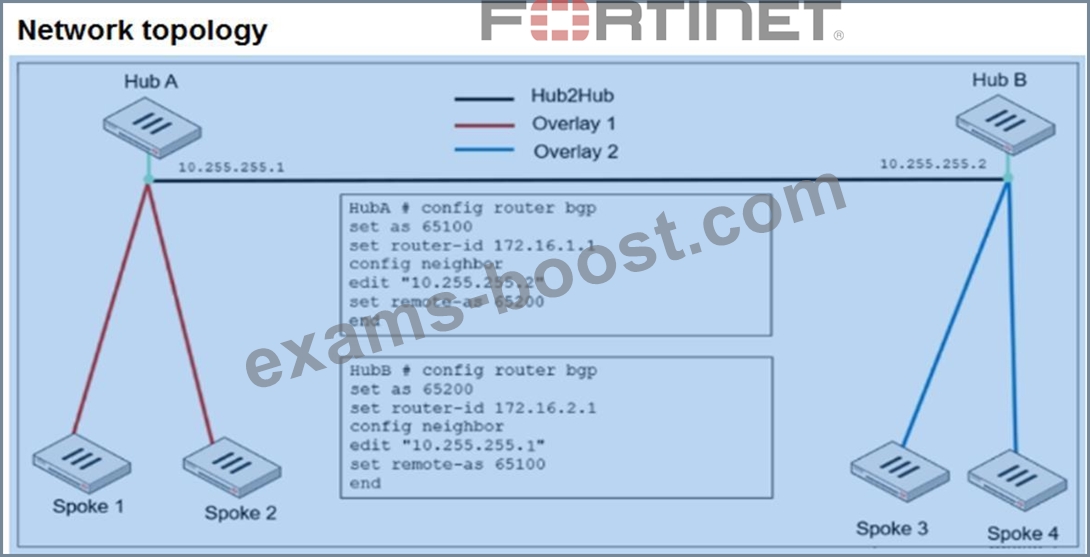
An ADVPN network is shown.
You must configure an ADVPN using IBGP for each local region and EBGP across regions to connect Overlay 1 with Overlay 2.
Which two options must you configure in the Hub2Hub BGP peering? (Choose two.)
- A. set next-hop-self enable
- B. set attribute-unchanged next-hop
- C. set ibgp-enforce-multihop advpn
- D. set ebgp-enforce-multihop enable
Answer: B,D
Explanation:
In the Hub2Hub peering, ebgp-enforce-multihop is required because the EBGP session between regions must support peering beyond a directly connected single-hop expectation in the ADVPN design.
attribute-unchanged next-hop is required so the original BGP next hop is preserved across regions. This allows the remote side to learn the actual tunnel endpoint information needed to build dynamic ADVPN shortcut paths between overlays.
NEW QUESTION # 88
An administrator applied a block-all IPS profile for client and server targets to secure the server, but the database team reported the application stopped working immediately after. How can an administrator apply IPS in a way that ensures it does not disrupt existing applications in the network?
- A. Use an IPS profile with all signatures in monitor mode and verify patterns before blocking.
- B. Select flow mode in the IPS profile to accurately analyze application patterns.
- C. Set the IPS profile signature action to default to discard all possible false positives.
- D. Limit the IPS profile to server targets only to avoid blocking connections from the server to clients.
Answer: A
Explanation:
Applying an aggressive IPS profile without prior testing can disrupt legitimate applications by incorrectly identifying normal traffic as malicious. To prevent disruptions while still monitoring for threats:
Enable IPS in "Monitor Mode" first:
This allows FortiGate to log and analyze potential threats without actively blocking traffic.
Administrators can review logs and fine-tune IPS signatures to minimize false positives before switching to blocking mode.
Verify and adjust signature patterns:
Some signatures might trigger unnecessary blocks for legitimate application traffic. By analyzing logs, administrators can disable or modify specific rules causing false positives.
NEW QUESTION # 89
Refer to the exhibits.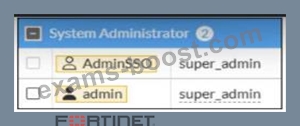
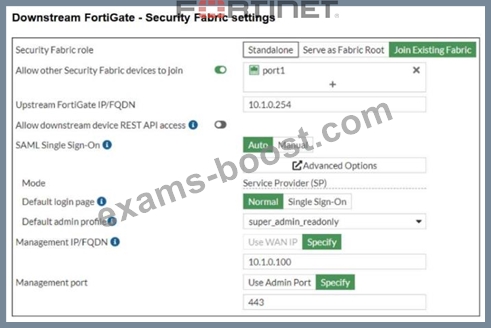
The system administrator settings configured on a root FortiGate and the Security Fabric settings configured on a downstream FortiGate are shown.
When prompted to sign in with Security Fabric to the downstream FortiGate, a user enters the single sign-on (SSO) provider credentials.
What is the result?
- A. The downstream FortiGate creates an SSO administrator account for AdminSSO with the super_admin_readonly profile.
- B. The downstream FortiGate creates an SSO administrator account for AdminSSO with the super_admin profile.
- C. The user is prompted to create an administrator account for AdminSSO.
- D. The downstream FortiGate relies on the root FortiGate and does not create an administrator account.
Answer: B
NEW QUESTION # 90
A company's guest internet policy, operating in proxy mode, blocks access to Artificial Intelligence Technology sites using FortiGuard. However, a guest user accessed a page in this category using port 8443.
Which configuration changes are required for FortiGate to analyze HTTPS traffic on nonstandard ports like
8443 when full SSL inspection is active in the guest policy?
- A. To analyze nonstandard ports in web filter profiles, use TLSv1.3 in the SSL/SSH Inspection Profile.
- B. Add a URL wildcard domain to the website CA certificate and use it in the SSL/SSH Inspection Profile.
- C. In the Protocol Port Mapping section of the SSL/SSH Inspection Profile, enter 443, 8443 to analyze both standard (443) and non-standard (8443) HTTPS ports.
- D. Administrators can block traffic on nonstandard ports by enabling the SNI check in the SSL/SSH Inspection Profile.
Answer: C
Explanation:
When FortiGate is operating in proxy mode with full SSL inspection enabled, it inspects encrypted HTTPS traffic by default on port 443. However, some websites may use non-standard HTTPS ports (such as 8443), which FortiGate does not inspect unless explicitly configured.
To ensure that FortiGate inspects HTTPS traffic on port 8443, administrators must manually add port 8443 in the Protocol Port Mapping section of the SSL/SSH Inspection Profile. This allows FortiGate to treat HTTPS traffic on port 8443 the same as traffic on port 443, enabling proper inspection and enforcement of FortiGuard category-based web filtering.
NEW QUESTION # 91
Users in your organization who are on an IPsec VPN between FortiGate A and FortiGate B are experiencing intermittent issues since implementing VXLAN. You suspect that packets exceeding the 1500-byte default maximum transmission unit (MTU) are causing the problems. How would you adjust the interface MTU value help resolve issues caused by protocols that add extra headers to IP packets?
- A. Adjust the MTU on interfaces only on FortiGate A and FortiGate B.
- B. Adjust the MTU on interfaces only in wired connections like Point-to-Point Protocol over Ethernet (PPPOE), optic fiber, and Ethernet cable.
- C. Adjust the MTU on interfaces in controlled environments where all devices along the path allow MTU interface changes.
- D. Adjust the MTU on all FortiGate interfaces after adjusting the TCP maximum segment size (MSS).
Answer: C
Explanation:
Changing the interface MTU helps only when the entire path supports the new MTU value. In environments where you control all devices along the path, you can safely increase or otherwise adjust the MTU so encapsulation overhead from protocols such as VXLAN or IPsec does not cause fragmentation or drops.
NEW QUESTION # 92
Refer to the exhibit, which shows a command output.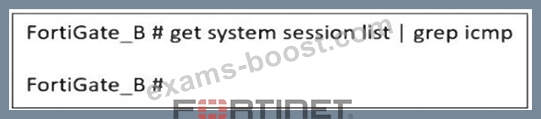
FortiGate_A and FortiGate_B are members of an FGSP cluster in an enterprise network.
While testing the cluster using the ping command, the administrator monitors packet loss and found that the session output on FortiGate_B is as shown in the exhibit.
What could be the cause of this output on FortiGate_B?
- A. FortiGate_A and FortiGate_B have the same standalone-group-id value.
- B. session-pickup-connectionless is set to disable on FortiGate_B.
- C. The session synchronization is encrypted.
- D. FortiGate_B is configured in passive mode.
Answer: B
Explanation:
The Fortinet FGSP (FortiGate Session Life Support Protocol) cluster allows session synchronization between two FortiGate devices to provide seamless failover. However, ICMP (ping) is a connectionless protocol, and by default, FortiGate does not synchronize connectionless sessions unless explicitly enabled.
In the exhibit:
# The command get system session list | grep icmp on FortiGate_B returns no output, meaning that ICMP sessions are not being synchronized from FortiGate_A.
# If session-pickup-connectionless is disabled, FortiGate_B will not receive ICMP sessions, causing packet loss during failover.
NEW QUESTION # 93
A FortiGate device with UTM profiles is reaching the resource limits, and the administrator expects the traffic in the enterprise network to increase.
The administrator has received an additional FortiGate of the same model.
Which two protocols should the administrator use to integrate the additional FortiGate device into this enterprise network? (Choose two.)
- A. FGCP in active-passive mode and with VDOM disabled
- B. FGSP with external load balancers
- C. FGCP in active-active mode and with switches
- D. VRRP with switches
Answer: B,C
Explanation:
When adding an additional FortiGate to an enterprise network that is already reaching its resource limits, the goal is to distribute traffic efficiently and ensure high availability.
FGSP (FortiGate Session Life Support Protocol) with external load balancers FGSP allows session-aware load balancing between multiple FortiGate units without requiring them to be in an HA (High Availability) cluster.
With external load balancers, incoming traffic is evenly distributed across multiple FortiGate devices.
This approach is useful for scaling out traffic handling capacity while ensuring that sessions remain synchronized between firewalls.
FGSP is effective when stateful failover is required but without the constraints of traditional HA.
FGCP (FortiGate Clustering Protocol) in active-active mode and with switches FGCP active-active mode enables multiple FortiGate devices to share traffic loads, increasing throughput and efficiency.
Active-active mode is suitable for balancing UTM processing across multiple FortiGates, making it ideal when resource limits are a concern.
Using switches ensures redundancy and avoids single points of failure in the network.
This mode is commonly used in enterprise networks where both scalability and redundancy are required.
NEW QUESTION # 94
To secure your enterprise network traffic, which step does FortiGate perform first, when handling the first packets of a session?
- A. Decryption
- B. A reverse path forwarding (RPF) check
- C. IP integrity header checking
- D. Installation of the session key in the network processor (NP)
Answer: B
Explanation:
When a new session begins, FortiGate first performs a reverse path forwarding (RPF) check to validate that the packet arrives on the correct interface according to the routing table. This prevents spoofing and ensures the packet is legitimate before any further inspection, decryption, or session offloading occurs.
NEW QUESTION # 95
A company's users on an IPsec VPN between FortiGate A and B have experienced intermittent issues since implementing VXLAN. The administrator suspects that packets exceeding the 1500-byte default MTU are causing the problems.
In which situation would adjusting the interface's maximum MTU value help resolve issues caused by protocols that add extra headers to IP packets?
- A. Adjust the MTU on interfaces only if FortiGate has the FortiGuard enterprise bundle, which allows MTU modification.
- B. Adjust the MTU on interfaces in controlled environments where all devices along the path allow MTU interface changes.
- C. Adjust the MTU on interfaces only in wired connections like PPPoE, optic fiber, and ethernet cable.
- D. Adjust the MTU on interfaces in all FortiGate devices that support the latest family of Fortinet SPUs: NP7, CP9 and SP5.
Answer: B
Explanation:
When using IPsec VPNs and VXLAN, additional headers are added to packets, which can exceed the default 1500-byte MTU. This can lead to fragmentation issues, dropped packets, or degraded performance.
To resolve this, the MTU (Maximum Transmission Unit) should be adjusted only if all devices in the network path support it. Otherwise, some devices may still drop or fragment packets, leading to continued issues.
Why adjusting MTU helps:
* VXLAN adds a 50-byte overhead to packets.
* IPsec adds additional encapsulation (ESP, GRE, etc.), increasing the packet size.
* If packets exceed the MTU, they may be fragmented or dropped, causing intermittent connectivity issues.
* Lowering the MTU on interfaces ensures packets stay within the supported size limit across all network devices.
NEW QUESTION # 96
Refer to the exhibits.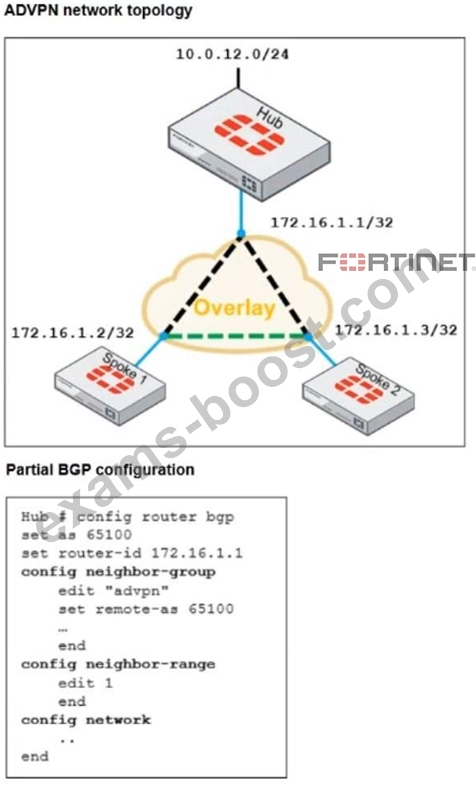
The ADVPN network topology and partial BGP configuration are shown.
Which two parameters must you configure in the config neighbor range for spokes shown in the exhibit? (Choose two.)
- A. set route-reflector-client enable
- B. set prefix 172.16.1.0 255.255.255.0
- C. set prefix 10.0.12.0 255.255.255.0
- D. set neighbor-group advpn
Answer: B,D
Explanation:
For the hub to automatically create iBGP neighbors for the spokes in this ADVPN, the neighbor- range must match the spokes' overlay IP addresses (172.16.1.2 and 172.16.1.3), so the prefix is set to 172.16.1.0/24. The neighbor-range must also be tied to the preconfigured neighbor-group advpn so that all dynamically created spoke neighbors inherit the BGP settings (including remote- as 65100).
NEW QUESTION # 97
Refer to the exhibit, which shows a corporate network and a new remote office network.
An administrator must integrate the new remote office network with the corporate enterprise network.
What must the administrator do to allow routing between the two networks?
- A. The administrator must configure virtual links on both FortiGate devices.
- B. The administrator must implement OSPF over IPsec on both FortiGate devices.
- C. The administrator must implement BGP to inject the new remote office network into the corporate FortiGate device
- D. The administrator must configure a static route to the subnet 192.168.l.0/24 on the corporate FortiGate device.
Answer: B
Explanation:
In this scenario, the corporate network and the new remote office network need to communicate over the Internet, which requires a secure and dynamic routing method. Since both networks are using OSPF (Open Shortest Path First) as the routing protocol, the best approach is to establish an OSPF over IPsec VPN to ensure secure and dynamic route propagation.
OSPF is already running on the corporate network, and extending it over an IPsec tunnel allows dynamic route exchange between the corporate FortiGate and the remote office FortiGate. IPsec provides encryption for traffic over the Internet, ensuring secure communication. OSPF over IPsec eliminates the need for manual static routes, allowing automatic route updates if networks change.
The new remote office ' s 192.168.1.0/24 subnet will be advertised dynamically to the corporate network without additional configuration.
NEW QUESTION # 98
......
Fortinet FCSS_EFW_AD-7.6 Exam Practice Test Questions: https://www.exams-boost.com/FCSS_EFW_AD-7.6-valid-materials.html
Free FCSS_EFW_AD-7.6 Braindumps Download Updated: https://drive.google.com/open?id=1aNpnhYfGde8iuaKzRPHDP1JifNz9Tzlz