

The CompTIA N10-009 Questions & Practice Test are Available On-Demand
Valid N10-009 Exam Dumps Ensure you a HIGH SCORE
NEW QUESTION # 248
Which of the following can be used when a server at a remote site is physically unreachable?
- A. Crash cart
- B. Console
- C. OOB management
- D. Jump box
Answer: C
Explanation:
Out-of-band (OOB) managementallows administrators to manage devices remotely even if the primary network is down. This is especially useful when physical access to the server is not possible. OOB management often uses a separate management interface, ensuring access regardless of the server's operational state.
Reference:
NEW QUESTION # 249
A user recently moved a workstation to a different part of the office. The user is able to access the internet and print but is unable to access server resources. Which of the following is the most likely cause of the issue?
- A. Duplicate IP address
- B. Wrong VLAN assignment
- C. Error-disabled port
- D. Incorrect default gateway
Answer: B
Explanation:
If a workstation can access the internet and printers (likely in another VLAN) but not internal servers, the port was likely placed into the wrong VLAN after the move. VLAN assignment controls Layer 2 segmentation, restricting access to resources on different VLANs.
A . A wrong default gateway would prevent internet access.
C . An error-disabled port would block all connectivity.
D . A duplicate IP would cause general network issues, not just missing server access.
Reference (CompTIA Network+ N10-009):
NEW QUESTION # 250
Which protocol synchronizes clocks across network devices to ensure accurate timestamps in logs?
- A. SNMP
- B. SMTP
- C. NTP
- D. Syslog server
Answer: C
Explanation:
NTP (Network Time Protocol) synchronizes clocks across network devices, ensuring accurate timestamps in logs. This is critical for correlating events across different systems during investigations.
* A. Syslog collects logs but relies on accurate timestamps already present.
* B. SMTP is an email protocol, unrelated to time synchronization.
* C. SNMP is for monitoring and management, not time.
References (CompTIA Network+ N10-009):
* Domain: Network Operations - Time synchronization (NTP), log correlation, security operations.
NEW QUESTION # 251
A research facility is expecting to see an exponential increase in global network traffic in the near future. The offices are equipped with 2.5Gbps fiber connections from the ISP, but the facility is currently only utilizing 1Gbps connections. Which of the following would need to be configured in order to use the ISP's connection speed?
- A. Link aggregation
- B. 802.1Q tagging
- C. Port duplex
- D. Network address translation
Answer: A
Explanation:
Understanding Link Aggregation:
Definition: Link aggregation combines multiple network connections into a single logical link to increase bandwidth and provide redundancy.
Usage in High-Bandwidth Scenarios:
Combining Links: By aggregating multiple 1Gbps connections, the facility can utilize the full
2.5Gbps bandwidth provided by the ISP.
Benefits: Enhanced throughput, load balancing, and redundancy, ensuring better utilization of available bandwidth.
NEW QUESTION # 252
An IT manager needs to connect ten sites in a mesh network. Each needs to be secured with reduced provisioning time. Which of the following technologies will best meet this requirement?
- A. SD-WAN
- B. VPN
- C. NFV
- D. VXLAN
Answer: A
Explanation:
* Definition of SD-WAN:
* Software-Defined Wide Area Network (SD-WAN) is a technology that simplifies the management and operation of a WAN by decoupling the networking hardware from its control mechanism. It allows for centralized management and enhanced security.
* Benefits of SD-WAN:
* Reduced Provisioning Time:SD-WAN enables quick and easy deployment of new sites with centralized control and automation.
* Security:Incorporates advanced security features such as encryption, secure tunneling, and integrated firewalls.
* Scalability:Easily scales to accommodate additional sites and bandwidth requirements.
* Comparison with Other Technologies:
* VXLAN (Virtual Extensible LAN):Primarily used for network virtualization within data centers.
* VPN (Virtual Private Network):Provides secure connections but does not offer the centralized management and provisioning efficiency of SD-WAN.
* NFV (Network Functions Virtualization):Virtualizes network services but does not specifically address WAN management and provisioning.
* Implementation:
* SD-WAN solutions are implemented by deploying edge devices at each site and connecting them to a central controller. This allows for dynamic routing, traffic management, and security policy enforcement.
References:
* CompTIA Network+ course materials and networking solution guides.
NEW QUESTION # 253
A network engineer performed a migration to a new mail server. The engineer changed the MX record, verified the change was accurate, and confirmed the new mail server was reachable via the IP address in the A record. However, users are not receiving email. Which of the following should the engineer have done to prevent the issue from occurring?
- A. Reduce the TTL record prior to the MX record change.
- B. Change the email client configuration to match the MX record.
- C. Update the NS record to reflect the IP address change.
- D. Perform a DNS zone transfer prior to the MX record change.
Answer: A
Explanation:
Understanding TTL (Time to Live):
TTL is a value in a DNS record that tells how long that record should be cached by DNS servers and clients. A higher TTL value means that the record will be cached longer, reducing the load on the DNS server but delaying the propagation of changes.
Impact of TTL on DNS Changes:
When an MX record change is made, it may take time for the change to propagate across all DNS servers due to the TTL setting. If the TTL is high, old DNS information might still be cached, leading to email being directed to the old server.
Best Practice Before Making DNS Changes:
To ensure that changes to DNS records propagate quickly, it is recommended to reduce the TTL value to a lower value (such as 300 seconds or 5 minutes) well in advance of making the changes. This ensures that any cached records will expire quickly, and the new records will be used sooner.
Verification of DNS Changes:
After reducing the TTL and making the change to the MX record, it is important to verify the propagation using tools like dig or nslookup.
Comparison with Other Options:
Change the email client configuration to match the MX record: Email clients generally do not need to match the MX record directly; they usually connect to a specific mail server specified in their settings.
Perform a DNS zone transfer prior to the MX record change: DNS zone transfers are used to replicate DNS records between DNS servers, but they are not related to the propagation of individual record changes.
Update the NS record to reflect the IP address change: NS records specify the DNS servers for a domain and are not related to MX record changes.
Reference:
CompTIA Network+ study materials and DNS best practices.
NEW QUESTION # 254
A network technician was recently onboarded to a company. A manager has tasked the technician with documenting the network and has provided the technician With partial information from previous documentation.
Instructions:
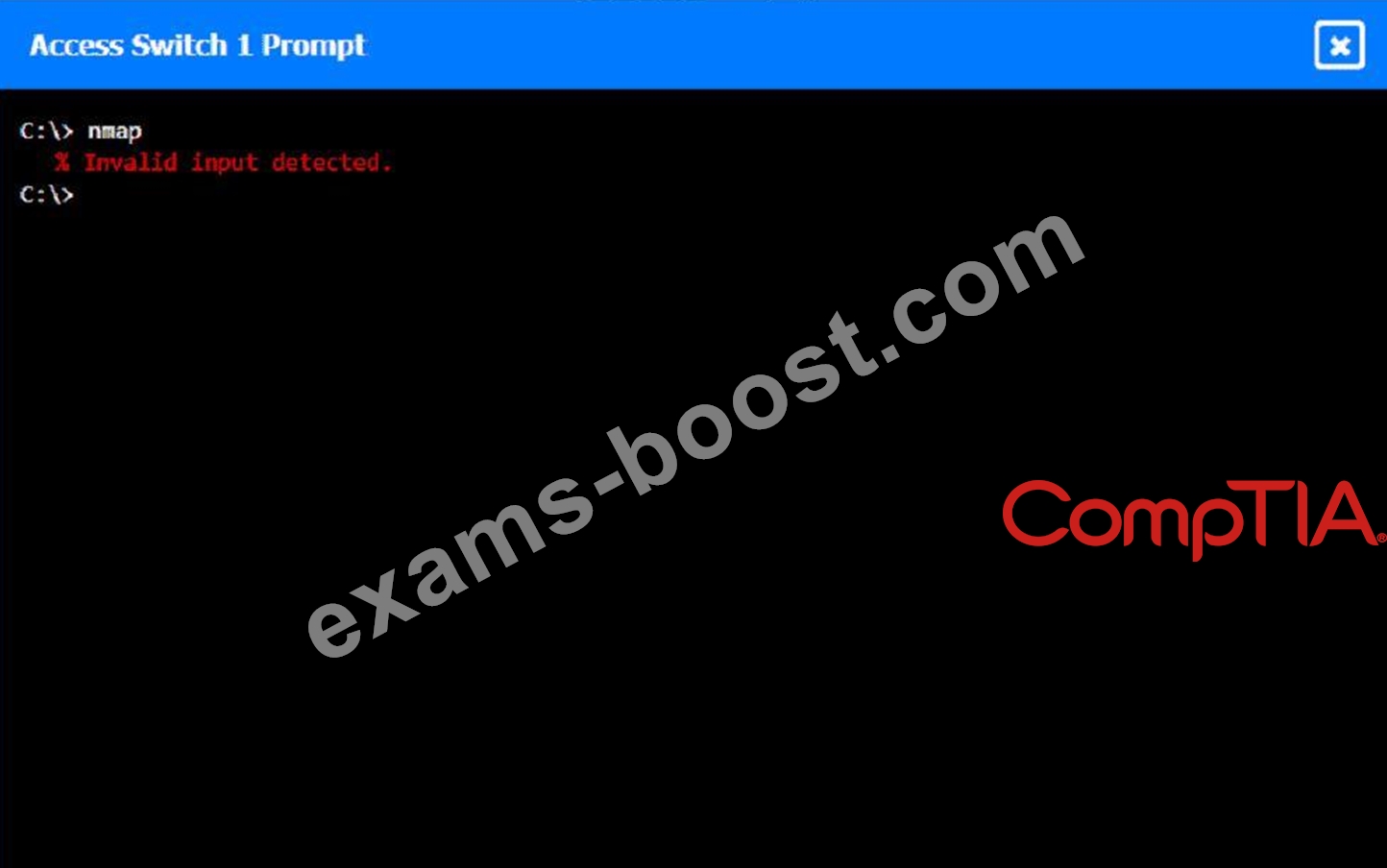
Click on each switch to perform a network discovery by entering commands into the terminal. Fill in the missing information using drop-down menus provided.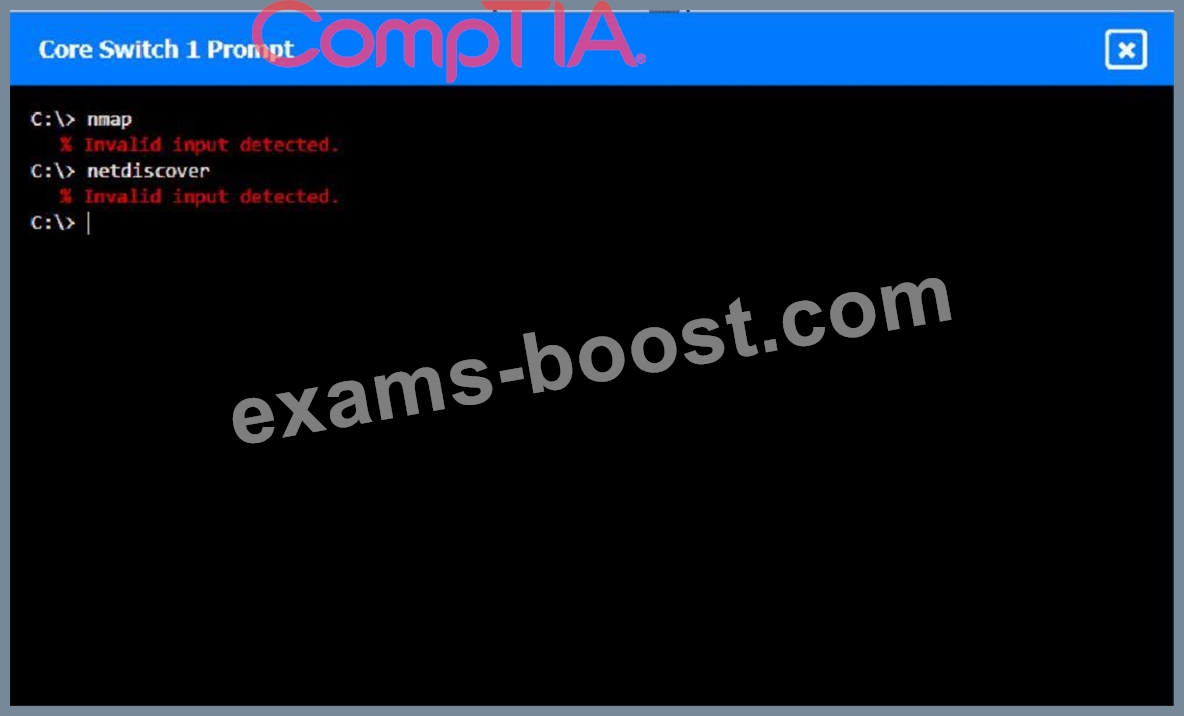
Answer:
Explanation:
See the Explanation for detailed information on this simulation.
Explanation:
(Note: Ips will be change on each simulation task, so we have given example answer for the understanding) To perform a network discovery by entering commands into the terminal, you can use the following steps:
Click on each switch to open its terminal window.
Enter the command show ip interface brief to display the IP addresses and statuses of the switch interfaces.
Enter the command show vlan brief to display the VLAN configurations and assignments of the switch interfaces.
Enter the command show cdp neighbors to display the information about the neighboring devices that are connected to the switch.
Fill in the missing information in the diagram using the drop-down menus provided.
Here is an example of how to fill in the missing information for Core Switch 1:
The IP address of Core Switch 1 is 192.168.1.1.
The VLAN configuration of Core Switch 1 is VLAN 1: 192.168.1.0/24, VLAN 2: 192.168.2.0/24, VLAN 3:
192.168.3.0/24.
The neighboring devices of Core Switch 1 are Access Switch 1 and Access Switch 2.
The interfaces that connect Core Switch 1 to Access Switch 1 are GigabitEthernet0/1 and GigabitEthernet0/2.
The interfaces that connect Core Switch 1 to Access Switch 2 are GigabitEthernet0/3 and GigabitEthernet0/4.
You can use the same steps to fill in the missing information for Access Switch 1 and Access Switch 2.
NEW QUESTION # 255
A network administrator determines that some switch ports have more errors present than expected.
The administrator traces the cabling associated with these ports.
Which of the following would most likely be causing the errors?
- A. arp
- B. ipconfig
- C. tracert
- D. nmap
Answer: B
NEW QUESTION # 256
Which of the following routing protocols has routes that are classified with an administrative distance of 110?
- A. BGP
- B. RIP
- C. EIGRP
- D. OSPF
Answer: D
Explanation:
OSPF (Open Shortest Path First) is a link-state routing protocol that uses an administrative distance of 110. This means that OSPF routes are preferred over routes from other routing protocols, such as RIP (Routing Information Protocol), which has an administrative distance of
120.
BGP (Border Gateway Protocol) is a path vector routing protocol that uses an administrative distance of 200. EIGRP (Enhanced Interior Gateway Routing Protocol) is a hybrid routing protocol that uses an administrative distance of 90.
Static routes have an administrative distance of 1.
NEW QUESTION # 257
You are tasked with verifying the following requirements are met in order to ensure network security.
Requirements:
Datacenter
Ensure network is subnetted to allow all devices to communicate properly while minimizing address space usage Provide a dedicated server to resolve IP addresses and hostnames correctly and handle port 53 traffic Building A Ensure network is subnetted to allow all devices to communicate properly while minimizing address space usage Provide devices to support 5 additional different office users Add an additional mobile user Replace the Telnet server with a more secure solution Screened subnet Ensure network is subnetted to allow all devices to communicate properly while minimizing address space usage Provide a server to handle external 80/443 traffic Provide a server to handle port 20/21 traffic INSTRUCTIONS Drag and drop objects onto the appropriate locations. Objects can be used multiple times and not all placeholders need to be filled.
Available objects are located in both the Servers and Devices tabs of the Drag & Drop menu.
If at any time you would like to bring back the initial state of the simulation, please click the Reset All button.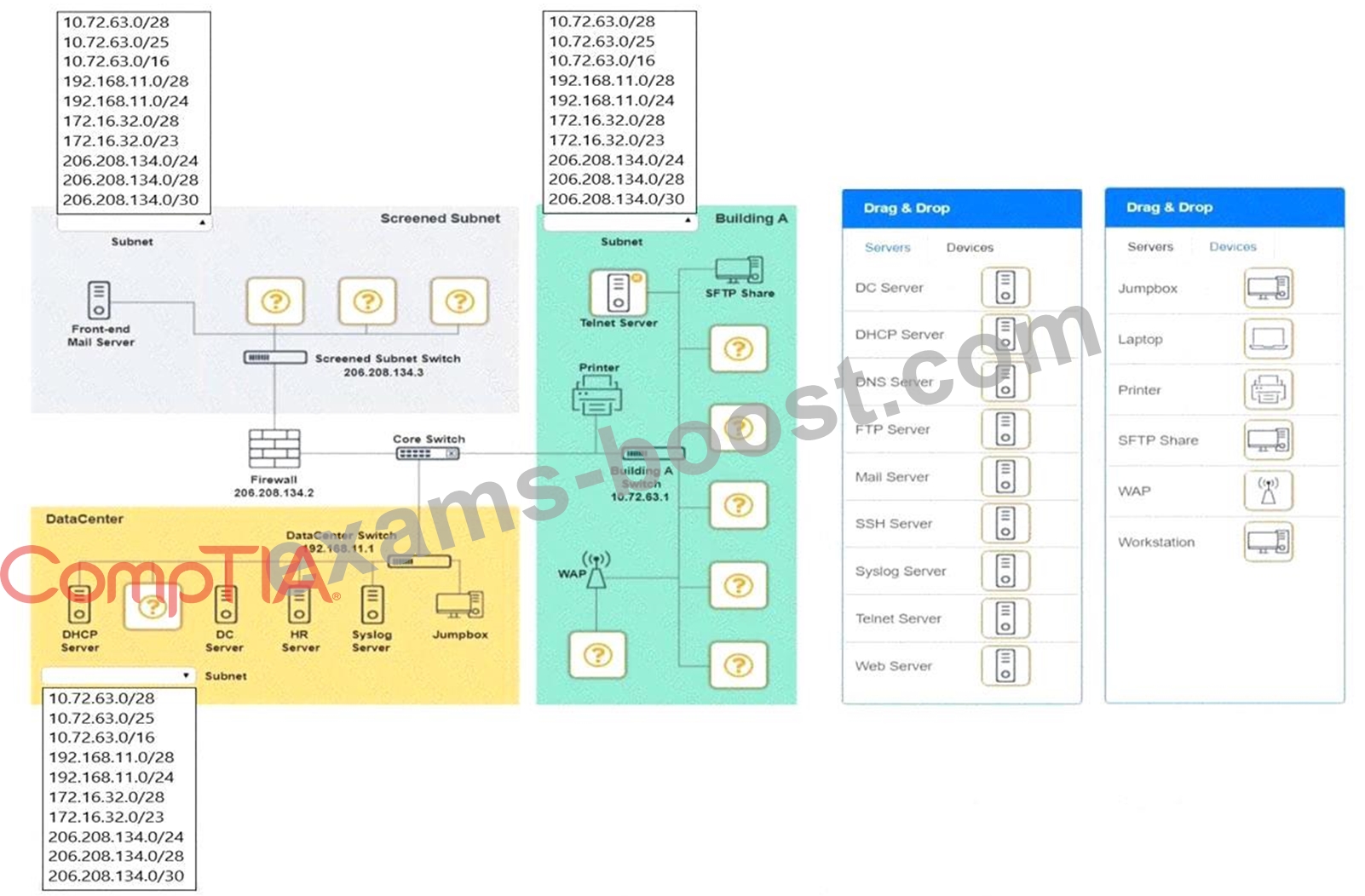
Answer:
Explanation:
See explanation below.
Explanation:
Screened Subnet devices - Web server, FTP server
Building A devices - SSH server top left, workstations on all 5 on the right, laptop on bottom left DataCenter devices - DNS server.
A screenshot of a computer AI-generated content may be incorrect.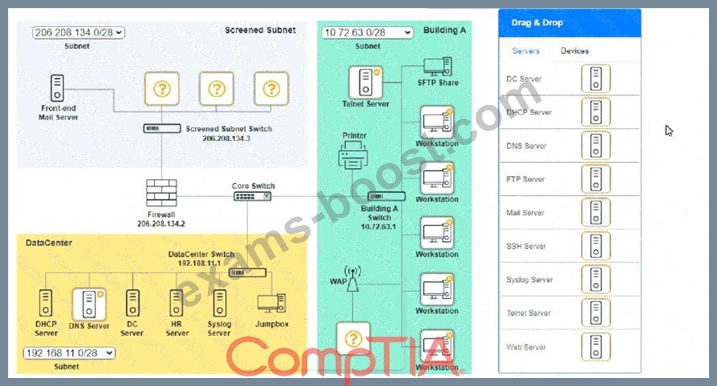
A screenshot of a computer AI-generated content may be incorrect.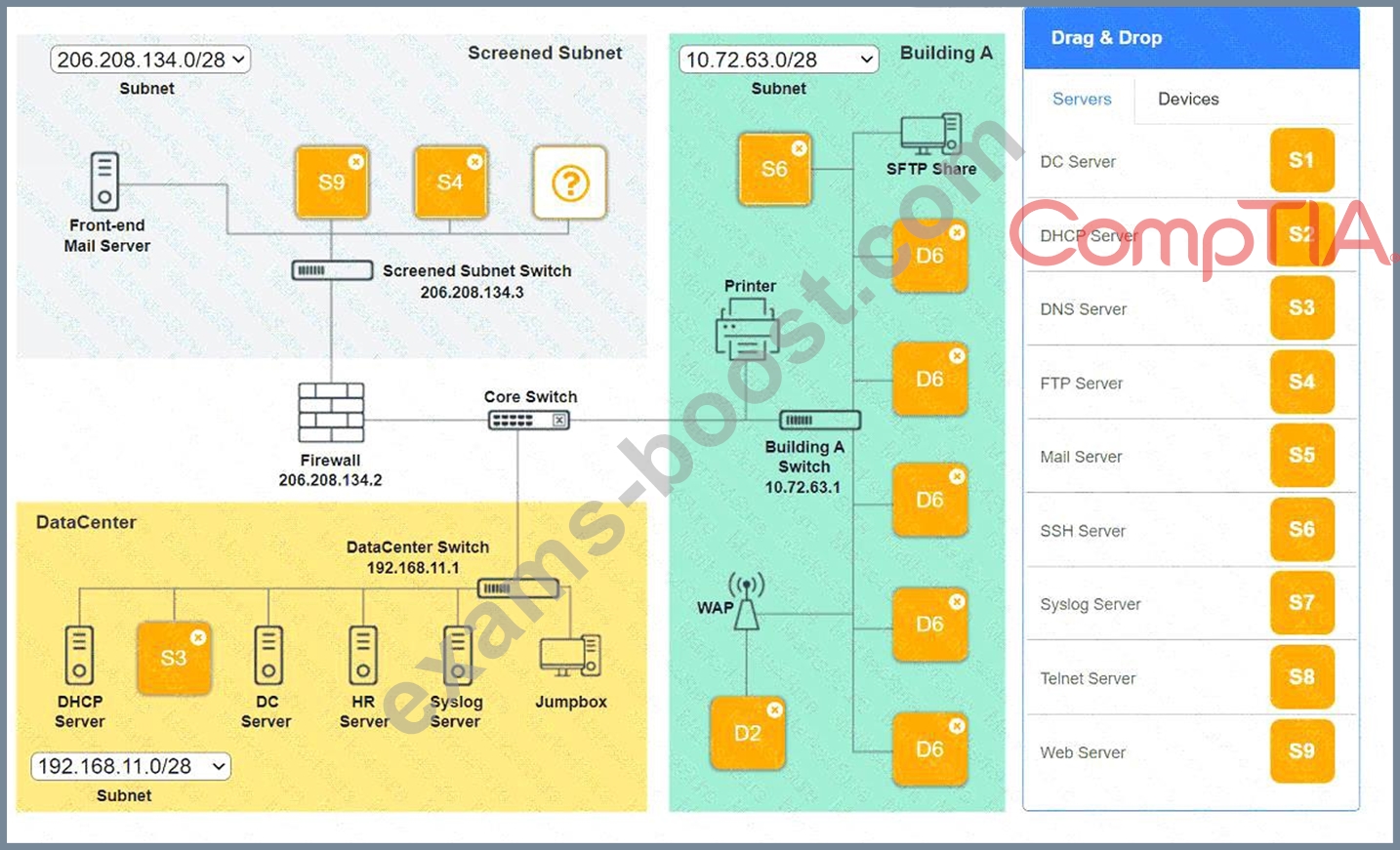
A screenshot of a computer AI-generated content may be incorrect.
NEW QUESTION # 258
A firewall administrator is mapping a server's internal IP address to an external IP address for public use.
Which of the following is the name of this function?
- A. BGP
- B. VIP
- C. PAT
- D. NAT
Answer: D
Explanation:
Network Address Translation (NAT) is a process that allows a device, typically a firewall or router, to map private IP addresses to public IP addresses. This enables internal network devices to communicate over the internet using a single or a limited number of public IP addresses.
Static NAT (One-to-One Mapping): Maps a single private IP address to a single public IP address, commonly used for servers that need to be accessible from the internet.
Dynamic NAT (Many-to-Many Mapping): Dynamically assigns a public IP from a pool to internal devices.
PAT (Port Address Translation): A type of NAT where multiple private IPs share a single public IP using different port numbers.
Incorrect Options:
B:VIP (Virtual IP Address): Used in load balancing and high-availability configurations, not for NAT.
C:PAT (Port Address Translation): A specific form of NAT, but the question refers to general NAT, making option A the best choice.
D:BGP (Border Gateway Protocol): A routing protocol used to exchange information between different networks, not related to NAT.
NEW QUESTION # 259
A network technician is troubleshooting a faulty NIC and tests the theory. Which of the following should the technician do next?
- A. Establish a plan of action.
- B. Develop a theory.
- C. Implement the solution.
- D. Document the findings.
Answer: C
Explanation:
Once the theory has been tested and confirmed, the next step is to implement the solution based on the CompTIA troubleshooting model.
CompTIA Troubleshooting Model:
Identify the problem.
Establish a theory of probable cause.
Test the theory.
Establish a plan of action and implement the solution. ✅ (Correct step) Verify full system functionality.
Document findings, actions, and outcomes.
Breakdown of Options:
A . Develop a theory - The theory has already been developed and tested.
B . Establish a plan of action - This happens before implementation, but since the issue is confirmed, it's time to act.
C . Implement the solution - Correct answer. The problem is confirmed, so the fix should be applied.
D . Document the findings - Documentation is the final step, not the next one.
Reference:
CompTIA Network+ (N10-009) Official Study Guide - Domain 5.1: Explain network troubleshooting methodology.
NEW QUESTION # 260
A network engineer discoversnetwork trafficthat is sendingconfidential informationto anunauthorized and unknown destination. Which of the followingbest describesthe cause of this network traffic?
- A. Adware
- B. Darkware
- C. Malware
- D. Ransomware
Answer: C
Explanation:
Comprehensive and Detailed Explanation:
Malwarerefers toany malicious softwarethat canexfiltrate confidential data, includingspyware, trojans, and rootkits. This fits the scenario whereunauthorized data transferis occurring.
Breakdown of Options:
* A. Adware- Displaysads, doesnot typically steal data.
* B. Ransomware- Encrypts filesbut does not exfiltrate data.
* C. Darkware-Not a real cybersecurity term.
* D. Malware-Correct answer.Malicious software is responsible for unauthorized data exfiltration.
NEW QUESTION # 261
A network administrator is implementing security zones for each department. Which of the following should the administrator use to accomplish this task?
- A. NAC
- B. ACLs
- C. Port security
- D. Content filtering
Answer: B
Explanation:
Understanding ACLs:
Access Control Lists (ACLs): A set of rules used to control network traffic and restrict access to network resources by filtering packets based on IP addresses, protocols, or ports.
Implementing Security Zones:
Defining Zones: ACLs can be used to create security zones by applying specific rules to different departments, ensuring that only authorized traffic is allowed between these zones.
Control Traffic: ACLs control inbound and outbound traffic at network boundaries, enforcing security policies and preventing unauthorized access.
NEW QUESTION # 262
As part of an attack, a threat actor purposefully overflows the content-addressable memory (CAM) table on a switch. Which of the following types of attacks is this scenario an example of?
- A. MAC flooding
- B. Evil twin
- C. ARP spoofing
- D. DNS poisoning
Answer: A
Explanation:
Definition of MAC Flooding:
MAC flooding is an attack where a malicious actor sends numerous fake MAC addresses to a switch, overwhelming its CAM table. The CAM table stores MAC addresses and their associated ports for efficient traffic forwarding.
Impact of MAC Flooding:
CAM Table Overflow: When the CAM table is full, the switch cannot learn new MAC addresses and is forced to broadcast traffic to all ports, leading to a degraded network performance and potential data interception.
Switch Behavior: The switch operates in a fail-open mode, treating the network as a hub, which can be exploited for eavesdropping on traffic.
NEW QUESTION # 263
......
N10-009 Exam Practice Questions prepared by CompTIA Professionals: https://www.exams-boost.com/N10-009-valid-materials.html
Pass N10-009 Exam with Latest Questions: https://drive.google.com/open?id=1KuvYuPy9IeVZaKAqHmm5g9lo6lPa-DT6