

[Aug-2022] 301a Dumps are Available for Instant Access using Exams-boost
301a Dumps 2022 - New F5 301a Exam Questions
Who should take the F5 301a: BIG-IP LTM Specialist: Architect Set-Up & Deploy Exam
People who choose to receive an F5 Professional Certification, which certifies their abilities to manipulate the whole device stack, from standard network experience to specialized application-layer awareness, and the ability to combine the two realms. Candidates should be familiar with network fundamentals, protocols, and general traffic control principles. The student should also be familiar with the basics of F5 technologies as they pertain to network fundamentals, protocols, and traffic control. Exams-boost provides applicants with validated questions and correct responses that would be asked throughout their final test. As a result, candidates are more likely to achieve high scores on the final test, and one of the best things is that we even have F5 301a exam dumps in PDF format, which candidates can import and review offline.
The following knowledge/abilities are required of candidates:
- Describe the benefits of using a complete device proxy.
- Recognize and identify the TMOS elements (F5 Traffic Management Operating System).
- Describe HTTP's legitimate uses and processes.
- Describe the Open Systems Interconnection (OSI) model's seven layers.
The F5 BIG-IP Local Traffic Manager (LTM) Specialist: Maintain & Troubleshoot 301a Exam certification is a globally recognized credential that certifies individuals as F5 Certified Technology Specialists. If an applicant wishes to advance in their profession, they must develop their experience, qualifications, and abilities. This specialized expertise and ability is shown by the F5 BIG-IP Local Traffic Manager (LTM) Specialist: Maintain & Troubleshoot 301a Exam qualification. If an applicant has passed the F5 LTM Specialist: Architect, Setup, and Deploy 301a Exam and has knowledge of the related technology and skills needed to pass the F5 BIG-IP Local Traffic Manager (LTM) Specialist: Maintain & Troubleshoot 301a Exam, he can take this exam.
How much F5 301a: BIG-IP LTM Specialist: Architect Set-Up & Deploy Exam Cost and Details
Examination Name F5 301a: BIG-IP LTM Specialist: Architect Set-Up & Deploy Exam Passing Score: 260 Length of Exam: 95 min Types of questions: Multiple Choice Questions No. of Questions: 82 Questions Examination Fees: $175 USD
How to Prepare For F5 301a: BIG-IP LTM Specialist: Architect Set-Up & Deploy Exam
Preparation Guide for F5 301a: BIG-IP LTM Specialist: Architect Set-Up & Deploy Exam
Introduction
An F5 Certified BIG-IP Administrator can handle application delivery networks (ADNs) and F5 Traffic Management Operating System (TMOS) devices, as well as conduct routine management and troubleshooting. The F5-CA qualification requires passing two exams:
- Exam 101-Fundamentals of Application Delivery
- Exam 301a-TMOS Administration
Pre-existing BIG-IP implementations and provisional fault isolation are managed by an F5 Certified BIG-IP Administrator. They must be able to edit BIG-IP artefacts and make appropriate configuration adjustments. They're still in charge of application delivery networks (ADNs) and managing and troubleshooting F5 Traffic Management Operating System (TMOS) devices on a regular basis. These Certified Experts manage BIG-IP infrastructure such as virtual servers, pools, pool owners, nodes, accounts, and displays using TMSH and a setup utility. They also maintain BIG-IP repositories and build, rebuild, and manage them. Certified BIG-IP Administrators must therefore review the state, functionality, and statistics of a resource in order to consider how BIG-IP networks are actually handling traffic.
The function of BIG-IP systems as a proxy mechanism inside an ADN is defined by administrators. BIG-IP devices are set up, licensed, and provisioned by them. Profiles are used by a Certified BIG-IP Administrator to monitor how BIG-IP networks handle traffic across virtual servers. They're also in need of utilizing different medical methods to troubleshoot and diagnose issues. After it has been mounted, configured, and applied, passing this exam demonstrates independence in conducting day-to-day operations and simple troubleshooting of TMOS-based systems in different application environments. Individuals may opt to finish their credential path here or go on to the Technical Professional, Technical Specialist, Cloud, or Security Solutions tracks. In this guide we will cover all the aspects of F5-301a exam dumps and F5-301a practice exams.
NEW QUESTION 24
An LTM Specialist is configuring a virtual server with an IP address.
Which configuration is unsupported?
- A. Standard virtual server with an HTTP profile
- B. Performance 14 virtual server with a FastHTTP profile
- C. Standard virtual server with a TCP profile
- D. Performance 14 virtual server with an HTTP profile
Answer: D
NEW QUESTION 25
To improve application security, an LTM Specialist must configure a BIG application access. The BIG IP system to authenticate the client certificate before permitting application access. The BIG-IP system must also support the ability to red to redirect users to a certificate enrolment system without generating a browser error.
Within the Client SSL profile, which value should the LTM Specialist select for the Client Certificate option?
- A. Request
- B. Require
- C. ignore
- D. Demand
Answer: B
NEW QUESTION 26
When importing a PEM formatted SSL certificate, which text needs to appear first in the file?
- A. ...BEGIN CERTIFICATE....
- B. ...SECURITY CERTIFICATE....
- C. ...SSL CERTIFICATE....
- D. --START CERTIFICATE....
Answer: A
NEW QUESTION 27
In an iApp, which configuration protects against accidental changes to an application Services configuration?
- A. Components
- B. Template
- C. Name
- D. Strict Updates
Answer: D
NEW QUESTION 28
A new web application is being deployed Mutual SSL authentication must be used to authenticate clients.
Which of the following two tasks must be completed to meet the requirements? (Choose two)
- A. configure the client SSL profile with "Client Certificate" set to require
- B. generate a CSR to register a certificate with the CA
- C. instruct the desktop team to update the web browser to the most recent release
- D. configure the client SSL profile with the Trusted .Certificate Authorities
- E. configure the server SSL profile with "Client Certificate" Set to require
Answer: A,D
NEW QUESTION 29
While working with a web developer, it is determined that additional logic is required to assess the pool member availability.
Which two monitor types should be used in this scenario? (Choose two)
- A. Scripted
- B. External
- C. TCP
- D. Gateway ICMP
- E. TCP Echo
Answer: A,B
NEW QUESTION 30
An LTM Specialist configures a new HTTPS virtual server that contains a valid example.com ssl certificate. The LTM Special receives an error in the browser when connecting.
What must be added to the SSL Client profile to fix this issue?
- A. A public root certificate
- B. A new example com certificate
- C. A sell-sign certificate
- D. An intermediate certificate
Answer: D
NEW QUESTION 31
AN LTM Specialist is setting up a new HTTPS virtual server to decrypt client traffic. SNAT the traffic and send the encrypted traffic to the poor member, the client's IP address must be included in the traffic sent to the pool member.
What is a complete set of profiles that must be configured for the virtual server to meet these requirements?
- A. TCP, Client SSL, HTTP
- B. TCP, Client SSL, Server SSL
- C. TCP , Server SSL, HTTP
- D. TCP, Client SSL, Server SSL, HTTP
Answer: D
NEW QUESTION 32
AN LTM Specialist receives reports that an external company application is having reliability issues. The F5 Administrator finds the following in /vat/log/ltm file.
The LTM Specialist determines that the F5 LTM device is entering into Aggressive Mode Adaptive Reaping, which is causing the site reliability issues.
What is the most likely reason that the LTM device has entered into Aggressive Mode Adaptive Reaping?
- A. The site is under DDOS attack
- B. The LTM device exceeds licensed traffic limits.
- C. The LTM device has not provisioned AVR.
- D. The site has too many licensed modules.
Answer: A
NEW QUESTION 33
Exhibit.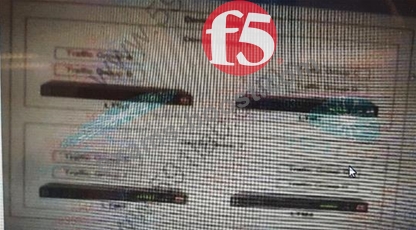
- The ITM devices LTM 1 and LTM2 are configured in Device Group X (Sync-Failover)
- LTM3 and LTM4 are configured in Device Group Y (Sync-Only)
- An LTM specialist configures Device Group Z (Sync-Only) to keep several profiles in (sync-Only) to keep several profiles in sync across all devices.
- Device GROUP X has four Traffic Groups A, B, C and D configured.
- Device Group Y has four Traffic Groups E, F, G, and H configured
- Auto Fallback IS NOT Enabled.
- Each Device group is healthy and able to pass traffic for any traffic group assigned to that Device Group.
The data center that contains LTM2 and LTM4 loses power. After 10 minutes; power is restored and all devices are up and healthy.
What is the state of each Traffic Group on each ITM device after power is restored?
A)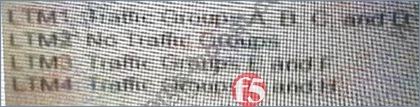
B)
C)
D)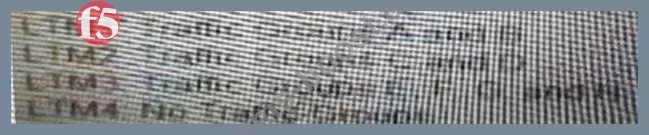
- A. Option B
- B. Option C
- C. Option D
- D. Option A
Answer: D
NEW QUESTION 34
A web server is being overloaded with HTTPS traffic. To decrease the load on the server, the LTM Specialist and the Server. Administrator decide to perform SSL offloading on the LTM device. The configuration of the virtual server is as follows: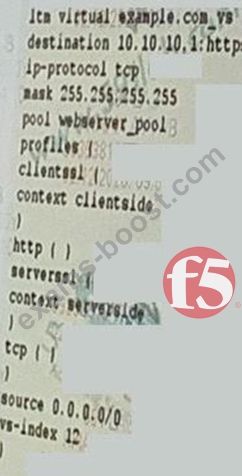
Which change must be made to the configuration to perform SSL offloading?
- A. Remove the severssl profile
- B. Remove the clientssl and http profiles
- C. Remove the clientssl and serverssl profiles
- D. Remove the clients profile
Answer: A
NEW QUESTION 35
Exhibit.
The LTM devices LTM1 and LTM2 are configured in a Device Group (Sync Failover) with Network Failover configured on both the management and HA and Internal VLANS. and ConfigSync is confined in a Device Group (Sync Failover) with Network Failover and internal are tagged on a single trunk with subnets Connection Mirroring is configured on both the HA interlace directly connected between LTM1 and LTM2, and the management interlace is connected to a management switch. The LTM devices have four Traffic Groups defined, and both LTM devices are healthy and capable of passing traffic for any of the Traffic Groups.
An LTM Specialist disconnects the cable for the HA network in an effort to test failover.
Which HA functionality works in this case?
- A. ConfigSync works. Connection Mirroring docs NOT work
- B. ConfigSync does NOT work. Connection Mirroring floes NOT work.
- C. ConfigSync does NOT work; Connection Mirroring works
- D. ConfigSync works Connection Mirroring works
Answer: C
NEW QUESTION 36
An LTM Administrator receives an email from the NOC stating that the switch connected to the backend server was shut down for maintenance. The BIG-IP device handles only UDP traffic. The BIG IP device did not fail over to a DR location when no pool members were available.
When the LTM Administrator checks the pool, it confirms that the monitor is still marking UP the pool member.
A tcpdump of the traffic shows the following output: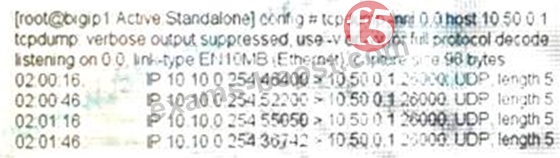
A list of the monitor configuration shows the following: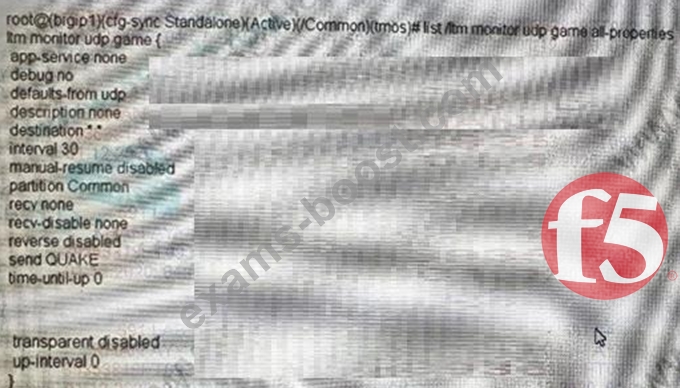
Which two modifications to the LTM configuration will mark this pool member down, when the switch is down? (Choose two.)
- A. add a reverse string to the game monitor
- B. also assign a gatewayjcmp monitor to the pool
- C. enable manuai-resume on the same monitor
- D. enable reverse and wait for the next connection
- E. increase the timeout to three times the interval
Answer: A,B
NEW QUESTION 37
Two LTM devices must be manually configured to restrict in the same Device Group.
What is the correct order of steps to meet this requirement?
- A. Configure VLAN, Configure Self-IPs, Configure Config-Sync IP. Configure Failover type, Establish Device Trust, Sync Device Trust, Create Device Group.
- B. Configure Self-IPs, Configure VLAN, Configure Config-Sync IP. Configure Failover type, Establish Device Trust, Sync Device Trust, Create Device Group
- C. Configure VLAN, Configure-Sync IP, Configure Failover type, Establish Device Trust, Sync Device Trust, Create type, Establish Device Sync Device Trust, Create Device Group.
- D. Configure VLAN, Configure Config-Sync IP. Configure Self-IPs. Configure Failover type. Establish Device Trust, Create Device Group
Answer: A
NEW QUESTION 38
An LTM Specialist needs to deploy a virtual server that will load balance traffic targeting https://register.example.com to a set of three web servers. Persistence needs to be ensured. No persistence mirroring is allowed SSL offloading is required.
A fourth web server with fewer resources will be used to handle requests from engine bots to https://register.example.comvrobots.txt by an iRule. The (Rule will use the HTTP_REQUEST event. .
What are the required profile and persistence settings to implement this
- A. tcp. dientssl, hup, source address persistence
- B. tcp, clientssl, serverssl, ssl persistence
- C. tcp, clientssl, http, serverssl cookie persistence
- D. tcp, clientssl, http. cookie persistence
Answer: D
Explanation:
The option is wrong, it should be clientssl and serverssl. If the title requires ssl offload instead of encryption, you need clientssl instead of serverssl. irule needs HTTP profile to enable HTTP_REQUEST. If the session cannot be mirrored, the cookie session remains to meet the demand.
NEW QUESTION 39
An LTM device configuration is as shown:
An LTM device configuration is as shown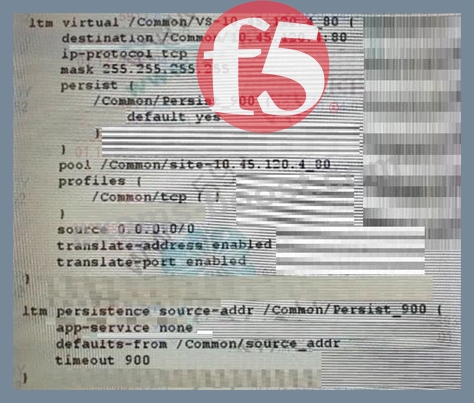
What should be the two expected outcomes based on this configuration? (Choose two.)
- A. A client session that has been idle for 20 minutes will be balanced to a new pool member
- B. A client session that has been idle for 14 minutes will be balanced to a new pool member
- C. A client session that has been idle for 48 minutes will be sent to the same pool members
- D. A client session that has been idle for 16 minutes will be sent to the same pool member
- E. A client session that has been idle for 12 minutes will be sent to the same pool member
Answer: A,E
NEW QUESTION 40
......
F5 301a Exam Practice Test Questions: https://www.exams-boost.com/301a-valid-materials.html
Free 301a Braindumps Download Updated: https://drive.google.com/open?id=1xSBXHyrZ3ZLKEKqMwEq7D-DJRnC_C6Q7