

[2025] Free HPE7-A01 Exam Dumps to Pass Exam Easily
HPE7-A01 Exam Dumps, HPE7-A01 Practice Test Questions
To prepare for the HPE7-A01 certification exam, candidates can take advantage of a variety of resources, including Aruba training courses, study guides, and practice exams. Aruba offers a number of training courses that cover topics related to wireless networking and network design. These courses are designed to help candidates prepare for the HPE7-A01 certification exam.
HP HPE7-A01 exam is designed to test the knowledge and skills of IT professionals about the Aruba campus access solutions. Aruba Certified Campus Access Professional Exam certification focuses on providing individuals with a thorough understanding of network access and the design, implementation, and operation of secure wireless and wired networks. HPE7-A01 exam is sought after by network professionals who want to validate their expertise in managing and configuring wireless systems while ensuring secure device and user access.
NEW QUESTION # 54
Your customer is interested in hearing more about how roles can help keep consistent policy enforcement in a distributed overlay fabric.
How would you explain this concept to them?
- A. Role-based policies enhance User Based Tunneling across the campus network and the policy traffic is protected with iPsec
- B. Group Based Policy ID is applied on egress VTEP after device authentication and policy is enforced on ingress VTEP
- C. Role-based policies are tied to IP addresses which have an advantage over IP-based policies and role names are sent between VTEPs
- D. Group Based Policy ID is applied on ingress VTEP after device authentication and policy is enforced on egress VTEP
Answer: D
Explanation:
This is the correct explanation of how roles can help keep consistent policy enforcement in a distributed overlay fabric. Roles are used to assign group based policy IDs (GBPs) to devices after they authenticate with ClearPass or a local database. GBPs are then used to tag the traffic from the devices and send them to the ingress VTEP, which applies the GBP on the VXLAN header. The egress VTEP then enforces the policy based on the GBP and the destination device.
The other options are incorrect because they either do not describe the correct sequence of events or do not use the correct terms.
NEW QUESTION # 55
In an ArubaOS 10 architecture using an AP and a gateway, what happens when a client attempts to join the network and the WLAN is configured with OWE?
- A. Authentication information is not exchanged
- B. The Gateway will not respond.
- C. RADIUS protocol is utilized.
- D. No encryption is applied.
Answer: A
Explanation:
This is the correct statement about what happens when a client attempts to join the network and the WLAN is configured with OWE (Opportunistic Wireless Encryption). OWE is a standard that provides encryption for open networks without requiring any authentication or credentials from the client or the network. OWE uses a Diffie-Hellman key exchange mechanism to establish a secure session between the client and the AP without exchanging any authentication information. The other options are incorrect because they either describe scenarios that require authentication or encryption methods that are not used by OWE.
References:
https://www.arubanetworks.com/assets/wp/WP_WiFi6.pdf
https://www.arubanetworks.com/assets/ds/DS_AP510Series.pdf
NEW QUESTION # 56
What does the 802.3bz standard describe?
- A. 60 GHz P2P Wi-Fi
- B. 60 W and 90W PoE
- C. AP directed roaming between APs
- D. 2.5Gb and 5Gb Ethernet ports
Answer: D
Explanation:
802.3bz is a standard for Ethernet over twisted pair at speeds of 2.5 and 5 Gbit/s. These use the same cabling as the ubiquitous Gigabit Ethernet, yet offer higher speeds. The resulting standards are named 2.5GBASE-T and 5GBASE-T.
Option A: 2.5Gb and 5Gb Ethernet ports
This is because option A shows how to identify the speed of an Ethernet port based on its name and the standard it supports. A port that supports 2.5GBASE-T or 5GBASE-T is a multi-gigabit port that can operate at speeds of up to 2.5 Gbit/s or 5 Gbit/s over twisted pair cables23.
Therefore, option A is correct.
1: https://en.wikipedia.org/wiki/2.5GBASE-T_and_5GBASE-T 2:
https://kb.netgear.com/000049004/What-is-Multi-Gigabit-Ethernet-and-how-can-I-benefit-from-using-NETGEA
https://arstechnica.com/gadgets/2016/09/5gbps-ethernet-standard-details-8023bz/
NEW QUESTION # 57
Which feature supported by SNMPv3 provides an advantage over SNMPv2c?
- A. GetBulk
- B. Community strings
- C. Transport mapping
- D. Encryption
Answer: D
Explanation:
Encryption is a feature supported by SNMPv3 that provides an advantage over SNMPv2c. Encryption protects the confidentiality and integrity of SNMP messages by encrypting them with a secret key.
SNMPv2c does not support encryption and relies on community strings for authentication and authorization, which are transmitted in clear text and can be easily intercepted or spoofed. Transport mapping, community strings, and GetBulk are features that are common to both SNMPv2c and SNMPv3.
References:
https://www.arubanetworks.com/techdocs/ArubaOS_86_Web_Help/Content/arubaos- solutions/snmp/snmp.htm
https://www.arubanetworks.com/techdocs/ArubaOS_86_Web_Help/Content/arubaos- solutions/snmp/snmpv3.htm
NEW QUESTION # 58
A customer wants to enable wired authentication across all their CX switches One of the requirements is that the switch must be able to authenticate a single computer connected through a VoIP phone.
Which feature should be enabled to support this requirement?
- A. Multi-Auth Mode
- B. Multi-Domain Authentication
- C. Device-Based Mode
- D. MAC Authentication
Answer: B
Explanation:
Explanation
Multi-Domain Authentication is the feature that should be enabled to support the requirement that the switch must be able to authenticate a single computer connected through a VoIP phone. Multi-Domain Authentication is a feature that allows an Aruba CX switch to apply different authentication methods and policies to different devices connected to the same port. For example, a VoIP phone and a computer can be connected to the same port using a single cable, but they can be authenticated separately using different credentials and assigned to different VLANs. The other options are incorrect because they either do not support multiple devices on the same port or do not provide authentication. References:
https://www.arubanetworks.com/techdocs/AOS-CX/10.05/HTML/5200-7540/GUID-7D9E9F6E-5C2A-4F7E-BE
https://www.arubanetworks.com/assets/tg/TB_ArubaCX_Switching.pdf
NEW QUESTION # 59
Your customer is having connectivity issues with a newly-deployed Microbranch group The access points in this group are online in Aruba Central, but no VPN tunnels are forming..
What is the most likely cause of this issue?
- A. The SSL certificate on the gateway used to encrypt the connection has not been added to the APs trust list
- B. There may be a firewall blocking GRE tunneling between the AP and the gateway
- C. There is a time difference between the AP and the gateways The gateways should have NTP added
- D. The gateway group is running in automatic cluster mode and should be in manual cluster mode
Answer: B
Explanation:
This is the most likely cause of the issue where the access points in a Microbranch group are online in Aruba Central, but no VPN tunnels are forming. A Microbranch group is a group that contains both APs and Gateways and allows them to form VPN tunnels for secure communication. The VPN tunnels use GRE (Generic Routing Encapsulation) as the encapsulation protocol and IPSec as the encryption protocol. If there is a firewall blocking GRE traffic between the AP and the gateway, the VPN tunnels cannot be established. The other options are incorrect because they either do not affect the VPN tunnel formation or do not apply to a Microbranch group.
References:
https://www.arubanetworks.com/techdocs/ArubaOS_86_Web_Help/Content/arubaos- solutions/gateways/microb
https://www.arubanetworks.com/assets/tg/TB_ArubaGateway.pdf
NEW QUESTION # 60
By default, Best Effort is higher priority than which priority traffic type?
- A. Background
- B. Network Control
- C. Internet Control
- D. All queues
Answer: A
Explanation:
This is because Best Effort traffic is all other kinds of non-detrimental traffic that are not sensitive to Quality of Service metrics (jitter, packet loss, latency). A typical example would be peer-to-peer and email applications2. Background traffic is a type of traffic that is used for system maintenance or backup purposes and does not affect the performance or availability of the network3.
Therefore, Best Effort traffic has a higher priority than Background traffic in terms of network resources allocation and management.
1: https://www.arubanetworks.com/techdocs/ArubaDocPortal/content/docportal.htm 2: https://stackoverflow.com/questions/33854306/best-effort-traffic-and-real-time-traffic-difference 3: https://www.informit.com/articles/article.aspx?p=25315&seqNum=4
NEW QUESTION # 61
You are configuring an SVI on an Aruba CX switch that needs to have the following characteristics:
* VLANID = 25
. IPv4 address 10 105 43 1 with mask 255 255 255.0
* IPv6 address fd00:5708::f02d:4df6 with a 64 bit prefix length
* member of VRF eng
* VRF eng and VLAN 25 have not yet been created
Which command lists will satisfy the requirements with the least number of commands?
- A.
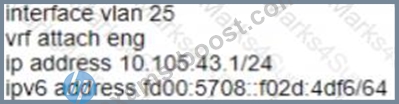
- B.
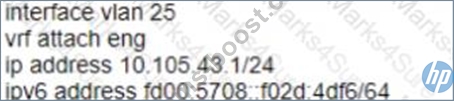
- C.
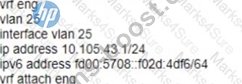
- D.
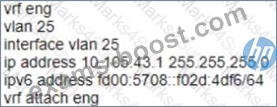
Answer: B
Explanation:
Explanation
The other options either use more commands or do not create the VRF or the VLAN.
Option C uses the following commands:
* vrf eng: This command creates a VRF named eng and enters the VRF configuration mode1.
* vlan 25: This command creates a VLAN with ID 25 and enters the VLAN configuration mode2.
* interface vlan 25: This command creates an SVI on VLAN 25 and enters the interface configuration mode3.
* ip address 10.105.43.1/24 ipv6 address fd00:5780::102d:4df6/64 vrf attach eng: This command assigns an IPv4 address of 10.105.43.1 with a subnet mask of 255.255.255.0 and an IPv6 address of fd00:5780::102d:4df6 with a prefix length of 64 to the SVI, and attaches it to the VRF eng.
NEW QUESTION # 62
A customer is looking for a wireless authentication solution for all of their loT devices that meet the following requirements:
- The wireless traffic between the IoT devices and the Access Points
must be encrypted
- Unique passphrase per device
- Use fingerprint information to perform role-based access
Which solutions will address the customer's requirements? (Select two.)
- A. MPSK and an internal RADIUS server
- B. Local User Derivation Rules
- C. ClearPass Policy Manager
- D. MPSK Local with MAC Authentication
- E. MPSK Local with EAP-TLS
Answer: A,C
Explanation:
MPSK is a feature that allows device-specific or group-specific passphrases for WPA2 PSK- based deployments. The passphrases are generated by a RADIUS server such as ClearPass Policy Manager and sent to the APs. The wireless traffic between the IoT devices and the APs is encrypted using the passphrases. The passphrases can also be used to perform role-based access by mapping them to different VLANs and user roles. ClearPass Policy Manager is a network access control solution that can provide device fingerprinting and profiling for IoT devices based on various attributes such as MAC address, DHCP options, HTTP user agents, etc.
ClearPass Policy Manager can also integrate with other IoT platforms and services to enhance the visibility and security of IoT devices.
NEW QUESTION # 63
Refer to the exhibit.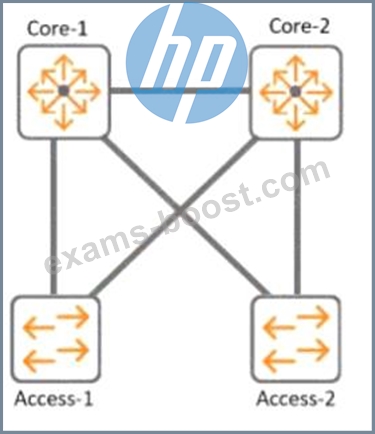
With Core-1. what is the default value for config-revision?
- A. 0
- B. 0. 0
- C. 1
- D. 1-0
Answer: C
Explanation:
The default value for config-revision on Core-1 is 0. Config-revision is a parameter that indicates the configuration version of a VSX pair. It is used to synchronize the configuration between the VSX peers and to detect any configuration mismatch. The config-revision value is set to 0 by default on both VSX peers and is incremented by 1 every time a configuration change is made on either peer. The other options are incorrect because they do not reflect the default value of config-revision. References:
https://www.arubanetworks.com/techdocs/AOS-CX/10.04/HTML/5200-6728/bk01-ch07.htmlhttps://www.aruba
NEW QUESTION # 64
A company deployed Dynamic Segmentation with their CX switches and Gateways After performing a security audit on their network, they discovered that the tunnels built between the CX switch and the Aruba Gateway are not encrypted. The company is concerned that bad actors could try to insert spoofed messages on the Gateway to disrupt communications or obtain information about the network.
Which action must the administrator perform to address this situation?
- A. Enable Secure Mode Enhanced
- B. Enable Enhanced security
- C. Enable Enhanced PAPI security
- D. Enable GRE security
Answer: C
Explanation:
Explanation
PAPI is the protocol that is used to establish tunnels between the CX switch and the Aruba Gateway for Dynamic Segmentation1. By default, PAPI uses a simple checksum to verify the integrity of the messages, but it does not encrypt the payload2. This could expose the network to spoofing or replay attacks by malicious actors. To address this situation, the administrator must enable Enhanced PAPI security, which uses AES-256 encryption and HMAC-SHA1 authentication to protect the tunnel traffic2. Enhanced PAPI security can be enabled on the CX switch by using the command system papi enhanced-security enable3. This will ensure that the tunnels built between the CX switch and the Aruba Gateway are encrypted and authenticated.
NEW QUESTION # 65
You are doing tests in your lab and with the following equipment specifications
* AP1 has a radio that generates a 10 dBm signal
* AP2 has a radio that generates a 11 dBm signal
* AP1 has an antenna with a gain of 9 dBi
* AP2 has an antenna with a gain of 12 dBi.
* The antenna cable for AP1 has a 2 dB loss
* The antenna cable for AP2 has a 3 dB loss
What would be the calculated Equivalent Isotropic Radiated Power (EIRP) for APT?
- A. 26 dBm
- B. -12 dBm
- C. 17 dBm
- D. 30 dBm
Answer: C
Explanation:
EIRP = Transmitter power + Antenna gain - Cable loss
EIRP for AP1 = 10 dBm + 9 dBi - 2 dB = 17 dBm
NEW QUESTION # 66
you need to have different routing-table requirements With Aruba CX 6300 VSF configuration.
Assuming the correct layer-2 VLAN already exists, how would you create a new SVI for a separate routing table?
- A. create a new VLAN, and attach the VRF to it.
- B. Create a new routing table, and attach VLANS to it
- C. Create a new VLAN. and attach the routing table to it
- D. Create a new SVI and use attach command.
Answer: D
Explanation:
Explanation
The correct answer is C. Create a new SVI and use attach command.
To create a new SVI for a separate routing table, you need to use the attach command to associate the SVI with a VRF (Virtual Routing and Forwarding) instance. A VRF is a logical entity that allows multiple routing tables to coexist on the same switch. Each VRF has its own set of interfaces, routing protocols, and routes that are isolated from other VRFs.
According to the AOS-CX Virtual Switching Framework (VSF) Guide1, one of the steps to configure VRF-aware VSF is:
Configure the VRFs on each member switch and assign the SVIs to the respective VRFs using the attach command. For example:
switch(config)# vrf red
switch(config-vrf)# exit
switch(config)# interface vlan 10
switch(config-if-vlan)# ip address 10.1.1.1/24
switch(config-if-vlan)# attach vrf red
The above commands create a VRF named red and assign VLAN 10 SVI to it. The SVI has an IP address of
10.1.1.1/24.
The other options are incorrect because:
A: You cannot attach a VRF to a VLAN directly. You need to create an SVI for the VLAN and then attach the VRF to the SVI.
B: You cannot create a new routing table manually. You need to create a VRF and then use routing protocols or static routes to populate the routing table for the VRF.
D: You cannot attach a routing table to a VLAN directly. You need to create an SVI for the VLAN and then attach a VRF that has a routing table associated with it.
NEW QUESTION # 67
What is true regarding 802.11k?
- A. It considers several metrics before it determines if a client should be steered to the 5GHz band, including client RSSI
- B. It extends radio measurements to define mechanisms for wireless network management of stations
- C. It reduces roaming delay by pre-authenticating clients with multiple target APs before a client roams to an AP
- D. It provides mechanisms for APs and clients to dynamically measure the available radio resources.
Answer: B,D
NEW QUESTION # 68
What is a primary benefit of BSS coloring?
- A. BSS color tags are applied to client devices and can reduce the threshold for interference
- B. BSS color tags improve performance by allowing clients on the same channel to share airtime.
- C. BSS color tags are applied to Wi-Fi channels and can reduce the threshold for interference
- D. BSS color tags improve security by identifying rogue APs and removing them from the network.
Answer: A
Explanation:
This is the correct definition of BSS coloring and its primary benefit. BSS coloring is a mechanism that assigns a color code to each BSS (Basic Service Set), which consists of an AP and its associated clients.
The color code is added to the PHY header of each frame transmitted by the AP or the client.
BSS coloring helps reduce co-channel interference by allowing devices to differentiate between frames from their own BSS and frames from neighboring BSSs that use the same channel.
Devices can then adjust their threshold for interference based on the color code and decide whether to transmit or defer based on the channel status. The other options are incorrect because they either describe different mechanisms or benefits of BSS coloring or use incorrect terms.
NEW QUESTION # 69
You need to ensure that voice traffic sent through an ArubaOS-CX switch arrives with minimal latency.
What is the best scheduling technology to use for this task?
- A. QoS shaping
- B. DWRR queuing
- C. Strict queuing
- D. Rate limiting
Answer: C
Explanation:
Strict queuing is the best scheduling technology to use for voice traffic on an AOS-CX switch.
Scheduling is a mechanism that determines how packets are transmitted from different queues on an egress port. Strict queuing is a scheduling method that gives the highest priority queue absolute preference over all other queues, regardless of their size or utilization. Voice traffic should be assigned to the highest priority queue and scheduled with strict queuing to ensure minimal latency and jitter. The other options are incorrect because they are either not scheduling methods or not optimal for voice traffic.
References:
https://www.arubanetworks.com/techdocs/AOS-CX/10.04/HTML/5200-6728/bk01-ch02.html
https://www.arubanetworks.com/techdocs/AOS-CX/10.04/HTML/5200-6728/bk01-ch03.html
NEW QUESTION # 70
How is Dynamic Multicast Optimization (DMO) implemented in an HPE Aruba wireless network?
DMO is configured individually tor each SSID in use in the network.
The AP uses OOS to provide equal air time for multicast traffic,
DMO is configured globally for each SSID in use in the network.
The controller converts multicast streams into unicast streams.
- A. The controller does not convert multicast streams into unicast streams. The AP does the conversion, as it is closer to the wireless clients and can optimize the transmission based on the client capabilities and channel conditions.
- B. The AP does not use QoS to provide equal air time for multicast traffic. QoS is a feature that prioritizes different types of traffic based on their importance and latency sensitivity. QoS does not affect how multicast streams are transmitted over the wireless link.
- C. DMO is configured individually for each SSID in use in the network.
DMO is a feature that allows the AP to convert multicast streams into unicast streams over the wireless link. This enhances the quality and reliability of streaming video, while preserving the bandwidth available to the non-video clients. DMO is configured individually for each SSID in use in the network, as different SSIDs may have different multicast requirements. According to the Aruba document Configuring WLAN Settings for an SSID Profile, one of the steps to configure DMO is:
Dynamic multicast optimization: Select Enabled to allow IAP to convert multicast streams into unicast streams over the wireless link. Enabling Dynamic Multicast Optimization (DMO) enhances the quality and reliability of streaming video, while preserving the bandwidth available to the non-video clients.
The other options are incorrect because: - D. DMO is not configured globally for each SSID in use in the network. DMO is configured individually for each SSID, as different SSIDs may have different multicast requirements.
Answer: C
Explanation:
The correct answer is
NEW QUESTION # 71
Refer to Exhibit: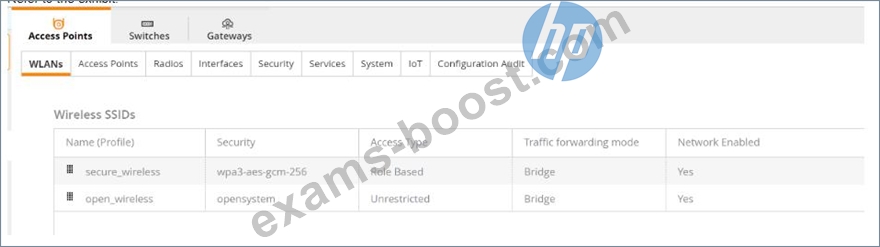
A company has deployed 200 AP-635 access points. To take advantage of the 6 GHz band, the administrator has attempted to configure a new WPA3-OWE SSID in Central but is not working as expected.
What would be the correct action to fix the issue?
- A. Change the SSID to WPA3-Enterprise (CCM).
- B. Change the SSID to WPA3-Enhanced Open.
- C. Change the SSID to WPA3-Personal.
- D. Change the SSID to WPA3-Enterprise (CNSA).
Answer: B
Explanation:
The correct action to fix the issue is C. Change the SSID to WPA3-Enhanced Open.
WPA3-OWE is not a valid SSID type in Central. OWE stands for Opportunistic Wireless Encryption, and it is a feature that provides encryption for open networks without requiring authentication. OWE is also known as Enhanced Open, and it is one of the options for WPA3 SSIDs in Central1.
According to the Aruba document Configuring WLAN Settings for an SSID Profile, one of the steps to configure a WPA3 SSID is:
Select the Security Level from the drop-down list. The following options are available:
WPA3-Personal: This option uses Simultaneous Authentication of Equals (SAE) to provide stronger password-based authentication and key exchange than WPA2-Personal.
WPA3-Enterprise: This option uses 192-bit cryptographic strength for authentication and encryption, as defined by the Commercial National Security Algorithm (CNSA) suite.
WPA3-Enterprise (CCM): This option uses 128-bit cryptographic strength for authentication and encryption, as defined by the Counter with CBC-MAC (CCM) mode.
WPA3-Enhanced Open: This option uses Opportunistic Wireless Encryption (OWE) to provide encryption for open networks without requiring authentication.
The other options are incorrect because:
A) WPA3-Enterprise (CNSA) is a valid SSID type, but it requires 802.1X authentication with a RADIUS server, which may not be suitable for the company's use case.
B) WPA3-Personal is a valid SSID type, but it requires a passphrase to join the network, which may not be suitable for the company's use case.
D) WPA3-Enterprise (CCM) is a valid SSID type, but it requires 802.1X authentication with a RADIUS server, which may not be suitable for the company's use case.
NEW QUESTION # 72
You are troubleshooting an issue with a pair of Aruba CX 8360 switches configured with VSX Each switch has multiple VRFs. You need to find the IP address of a particular client device with a known MAC address You run the "show arp" command on the primary switch in the pair but do not find a matching entry for the client MAC address.
The client device is connected to an Aruba CX 6100 switch by VSX LAG.
Which action can be used to find the IP address successfully?
- A.

- B.

- C.

- D.

Answer: A
Explanation:
Explanation
The show arp command displays the ARP table for a specific VRF or all VRFs on the switch. The ARP table contains the IP address to MAC address mappings for hosts that are directly connected to the switch or reachable through a gateway. If the client device is connected to another switch by VSX LAG, the ARP entry for the client device will not be present on the primary switch unless it has communicated with it recently.
Therefore, to find the IP address of the client device, the administrator should run the show arp command on the secondary switch in the VSX pair, specifying the VRF name that contains the client device's subnet.
References:
https://techhub.hpe.com/eginfolib/Aruba/OS-CX_10.04/5200-6692/GUID-9B8F6E8F-9C7A-4F0D-AE7B-9D8E
NEW QUESTION # 73
List the firewall role derivation flow in the correct order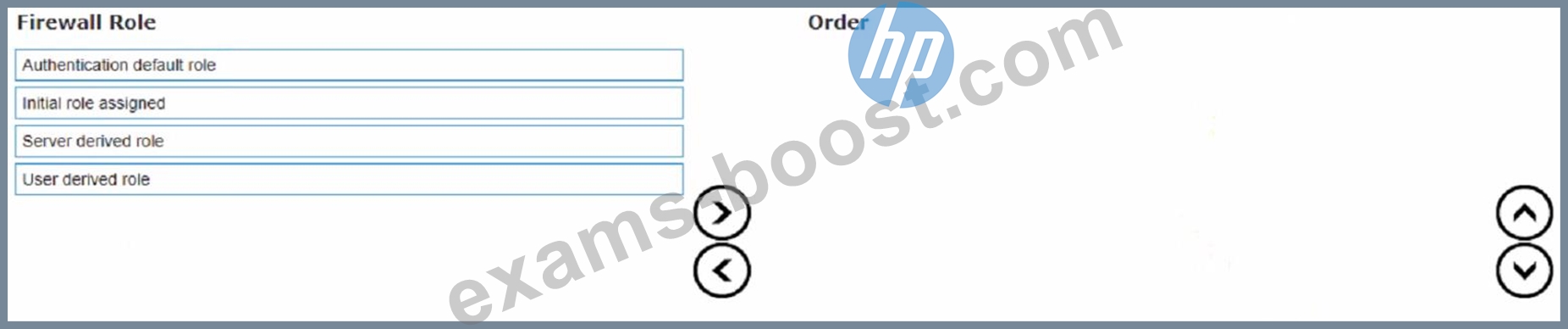
Answer:
Explanation: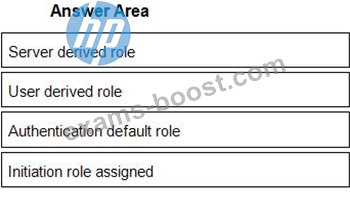
1 - Server derived role
2 - User derived role
3 - Authentication default role
4 - Initiation role assigned
NEW QUESTION # 74
Which statements are true about VSX LAG? (Select two.)
- A. The total number of configured links may not exceed 8 for the pair or 4 per switch
- B. Outgoing traffic is switched to a port based on a hashing algorithm which may be either switch in the pair
- C. LAG traffic is passed over VSX ISL links only while upgrading firmware on the switch pair
- D. Up to 255 VSX lags can be configured on all 83xx and 84xx model switches.
- E. Outgoing traffic is preferentially switched to local members of the LAG.
Answer: A,E
Explanation:
The correct answers are A and D.
According to the web search results, VSX LAG is a feature that allows multiple PSKs to be used on a single SSID, providing device-specific or group-specific passphrases for enhanced security and deployment flexibility for headless IoT devices1. VSX LAGs span both aggregation switches and appear as one device to partner downstream or upstream devices or both when forming a LAG with the VSX pair2.
One of the statements that is true about VSX LAG is that the total number of configured links may not exceed 8 for the pair or 4 per switch1. This means that a VSX LAG across a downstream switch can have at most a total of eight member links, and a switch can have a maximum of four member links. When creating a VSX LAG, it is recommended to select an equal number of member links in each segment for load balancing1.
Another statement that is true about VSX LAG is that outgoing traffic is preferentially switched to local members of the LAG2. This means that when active forwarding and active gateway are enabled, north-south and south-north traffic bypasses the ISL link and uses the local ports on the switch. This optimizes the traffic path and reduces the load on the ISL link2.
The other statements are false or not relevant for VSX LAG. Outgoing traffic is not switched to a port based on a hashing algorithm, which may be either switch in the pair. This is a characteristic of MLAG (Multi-Chassis Link Aggregation), which is a different feature from VSX LAG. LAG traffic is not passed over VSX ISL links only while upgrading firmware on the switch pair. This is a scenario that may occur when performing hitless upgrades, which is a feature that allows software updates without impacting network availability. The number of VSX lags that can be configured on all 83xx and 84xx model switches is not 255, but depends on the switch model and firmware version. For example, the AOS-CX 10.04 supports up to 64 VSX lags for 8320 switches and up to 128 VSX lags for 8325 and 8400 switches.
NEW QUESTION # 75
Review the exhibit.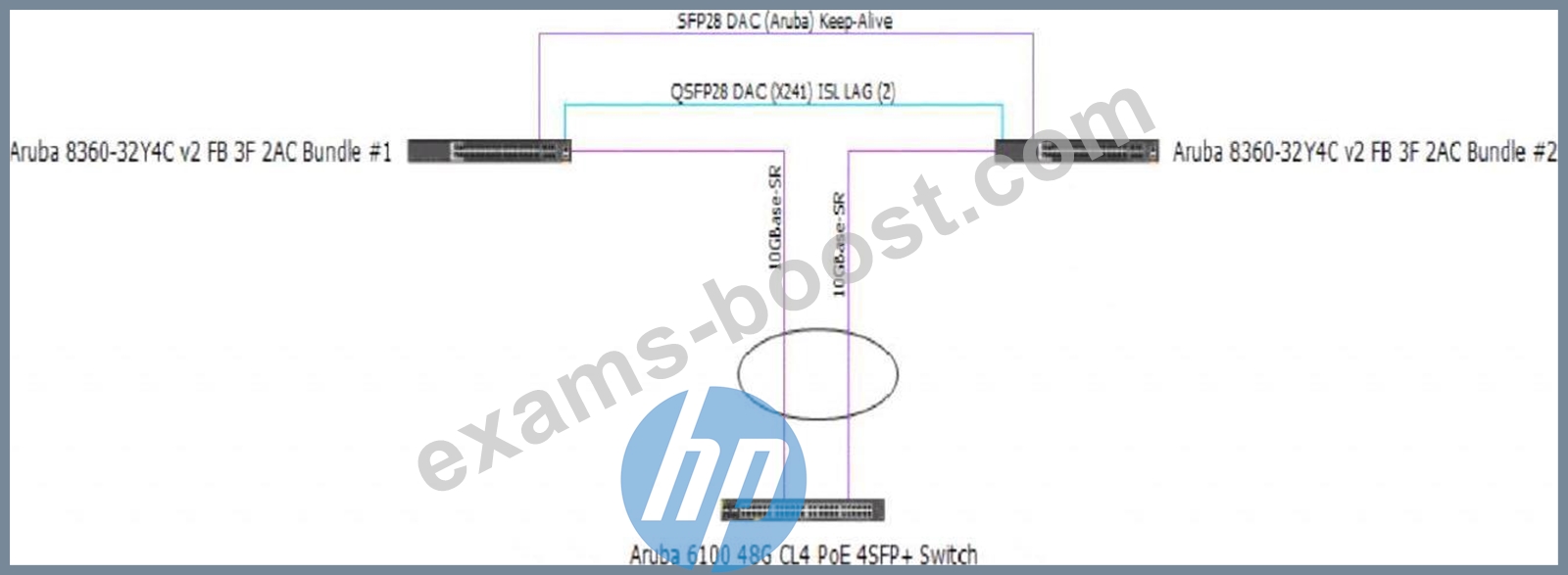
You are troubleshooting an issue with a 10 102.39 0/24 subnet which is also VLAN 1000 used Tor wireless clients on a pair of Aruba CX 8360 switches The subnet SVI is configured on the 8360 pair, and the DHCP server is a Microsoft Windows Server 2022 Standard with an IP address of 10 200 1.100. The
10.102.250.0/24 subnet is used for switch management.
A large number of DHCP requests are failing You are observing sporadic DHCP behavior across clients attached to the CX 6100 switch.
Which action may help fix the issue?
- A.

- B.

- C.

- D.

Answer: D
Explanation:
Option B is the correct action that may help fix the issue of sporadic DHCP behavior across clients attached to the CX 6100 switch. Option B enables DHCP relay on VLAN 1000 interface on Core-1 switch, which allows DHCP requests from clients in VLAN 1000 to be forwarded to the DHCP server in a different subnet (10.200.1.100). Without DHCP relay, clients in VLAN 1000 cannot obtain IP addresses from the DHCP server because they are in different broadcast domains. The other options are incorrect because they either do not enable DHCP relay or do not configure it correctly.
References:
https://www.arubanetworks.com/techdocs/AOS-CX/10.04/HTML/5200-6728/bk01-ch02.html
https://www.arubanetworks.com/techdocs/AOS-CX/10.04/HTML/5200-6728/bk01-ch03.html
NEW QUESTION # 76
With the Aruba CX switch configuration, what is the Active Gateway feature that is used for and is unique to VSX configuration?
- A. copied over the ISL link for an optimized path.
- B. Active Gateway can once MSTP instances are created for VLAN load sharing.
- C. Sixteen different VMACS are supported for each IPV4 and IPV6 stack simultaneously
- D. Sixteen different VMACs are supported total as shared.
Answer: C
Explanation:
The active gateway feature is used to provide active-active layer 3 default gateway for hosts on the same subnet. It allows the switch to convert multicast streams into unicast streams over the wireless link, which improves the quality and reliability of streaming video, while preserving the bandwidth available to the non-video clients. The active gateway feature is unique to VSX configuration because it eliminates the need for VRRP and avoids traffic being pushed over the ISL link, which can cause latency in the network12.
The correct answer to the question is C. Sixteen different VMACs are supported for each IPv4 and IPv6 stack simultaneously. This means that you can have a maximum of eight VMACs for IPv4, and a maximum of eight VMACs for IPv6, on a VSX pair. Only 15 VMACs are supported on 6400 switch series2.
The other options are incorrect because:
A) Sixteen different VMACs are not supported total as shared. They are supported for each IPv4 and IPv6 stack separately.
B) Active gateway can be used without MSTP instances. MSTP is a protocol that allows multiple spanning tree instances to coexist on the same switch, but it does not affect how active gateway works.
D) Active gateway does not copy traffic over the ISL link for an optimized path. It avoids using the ISL link for routed traffic and uses the local switch interface MAC instead of the virtual MAC address (VMAC) for source address1.
NEW QUESTION # 77
With Aruba CX 6300. how do you configure ip address 10 10 10 1 for the interface in default state for interface 1/1/1?
- A. int 1/1/1. no switching, ip address 10 10 10.1/24
- B. int 1/1/1. ip address 10.10.10.1/24
- C. int 1/1/1. switching, ip address 10 10 10 1/24
- D. int 1/1/1. routing, ip address 10.10.10 1/24
Answer: A
Explanation:
To configure an IP address for an interface in default state for interface 1/1/1 on Aruba CX 6300 switch, you need to disable switching on the interface first with the command no switching. Then you can assign an IP address with the command ip address. The other options are incorrect because they either do not disable switching or use invalid keywords suchas switching or routing. References:
https://www.arubanetworks.com/techdocs/AOS-CX_10_08/UG/bk01-ch01.htmlhttps://www.arubanetworks.com
NEW QUESTION # 78
You are are doing tests in your lab and with the following equipment specifications:
* AP1 has a radio that generates a 16 dBm signal.
* AP2 has a radio that generates a 13 dBm signal.
* AP1 has an antenna with a gain of 8 dBi.
* AP2 has an antenna with a gain of 12 dBi.
* The antenna cable for AP1 has a 4 dB loss.
* The antenna cable for AP2 has a 3 dB loss.
What would be the calculated Equivalent Isotropic Radiated Power (EIRP) for AP1?
- A. 40 dBm
- B. 15 dBm
- C. 20 dBm
- D. -9 dBm
Answer: C
Explanation:
The Equivalent Isotropic Radiated Power (EIRP) is the measured radiated power of an antenna in a specific direction. It is also called Equivalent Isotropic Radiated Power. It is the output power when a signal is concentrated into a smaller area by the Antenna. The EIRP can take into account the losses in transmission line, connectors and includes the gain of the antenna. It is represented in dB2.
The formula for EIRP is:
EIRP=PT-Lc+Ga where PT is the output power of the transmitter in dBm, Lc is the cable and connector loss in dB, and Ga is the antenna gain in dBi.
For AP1, the EIRP can be calculated as:
EIRP=16-4+8=20 dBm
Therefore, the answer B is correct.
NEW QUESTION # 79
......
HPE7-A01 certification exam is an excellent opportunity for IT professionals to validate their skills and expertise in wireless networking using Aruba solutions. Aruba Certified Campus Access Professional Exam certification demonstrates a professional's ability to design, deploy, and support secure and reliable wireless networks and can lead to exciting career opportunities in the wireless networking field. With preparation and dedication, IT professionals can pass the HPE7-A01 exam and distinguish themselves in the industry as Aruba Certified Campus Access Professionals.
HPE7-A01 Exam Dumps, HPE7-A01 Practice Test Questions: https://www.exams-boost.com/HPE7-A01-valid-materials.html
Free HPE7-A01 Study Guides Exam Questions and Answer: https://drive.google.com/open?id=1u8fVHBtivg1cUexIWbvg-eoHbkC8iXay