

DP-203 Practice Microsoft Verified Answers - Pass Your Exams For Sure! [2026]
Valid Way To Pass Microsoft Certified: Azure Data Engineer Associate's DP-203 Exam
NEW QUESTION # 104
You have an Azure Data Lake Storage Gen2 account named account1 that stores logs as shown in the following table.
You do not expect that the logs will be accessed during the retention periods.
You need to recommend a solution for account1 that meets the following requirements:
Automatically deletes the logs at the end of each retention period
Minimizes storage costs
What should you include in the recommendation? To answer, select the appropriate options in the answer area.
NOTE: Each correct selection is worth one point.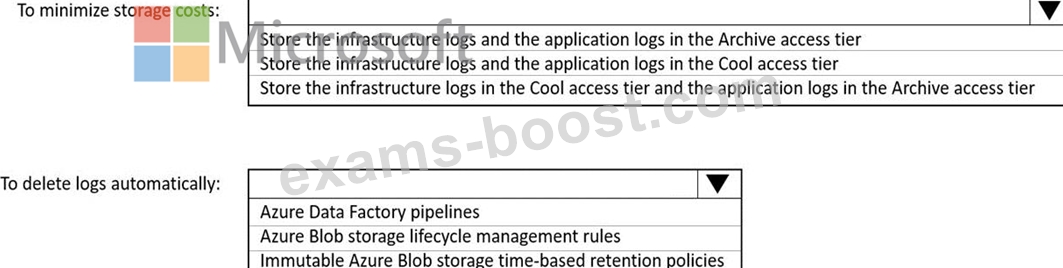
Answer:
Explanation: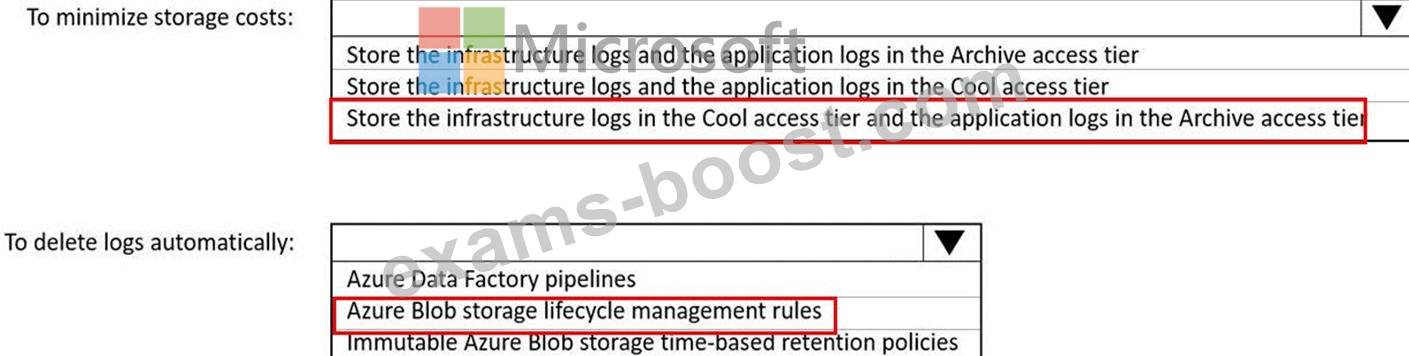
Reference:
https://docs.microsoft.com/en-us/azure/storage/blobs/access-tiers-overview
NEW QUESTION # 105
You configure version control for an Azure Data Factory instance as shown in the following exhibit.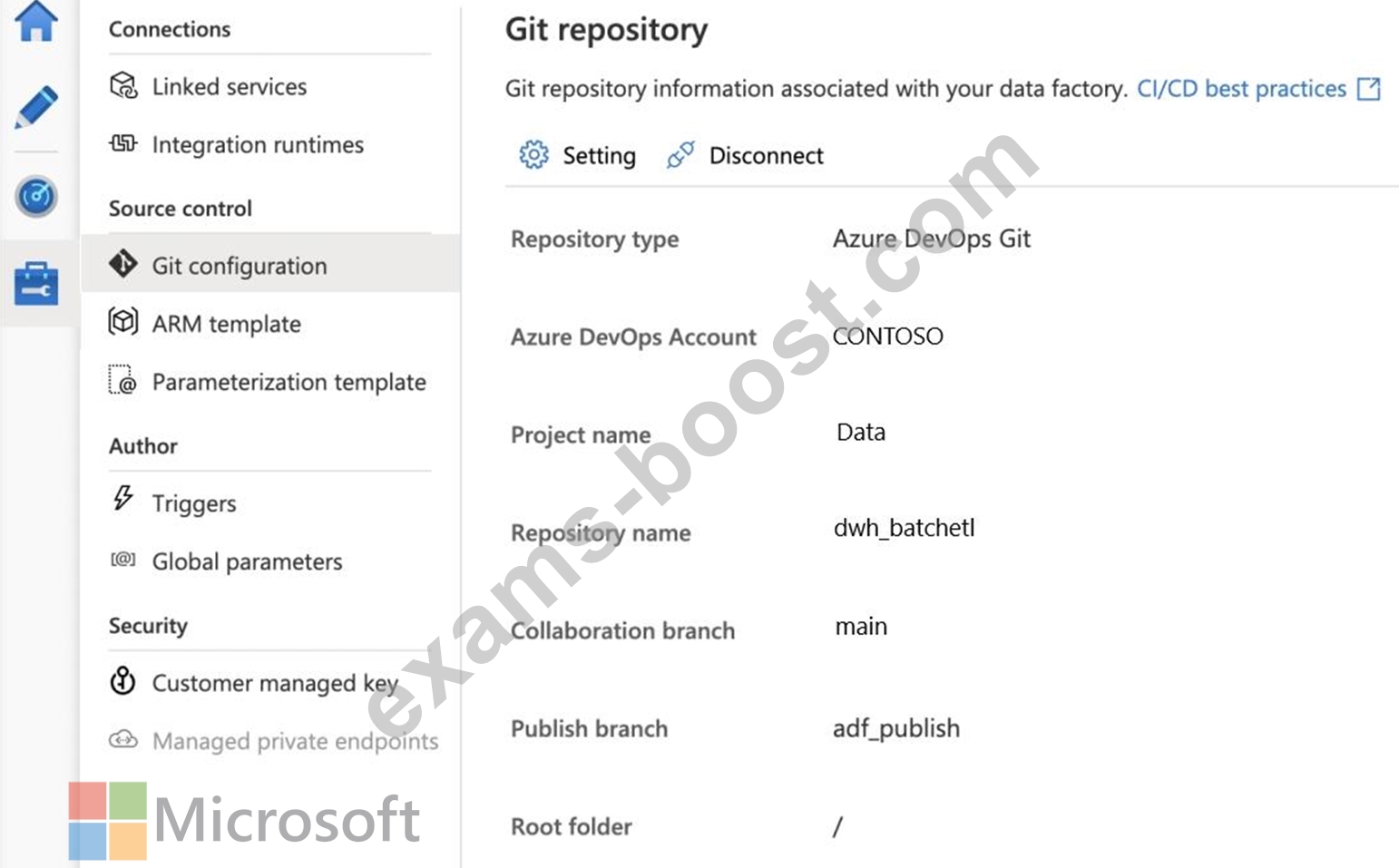
Use the drop-down menus to select the answer choice that completes each statement based on the information presented in the graphic.
NOTE: Each correct selection is worth one point.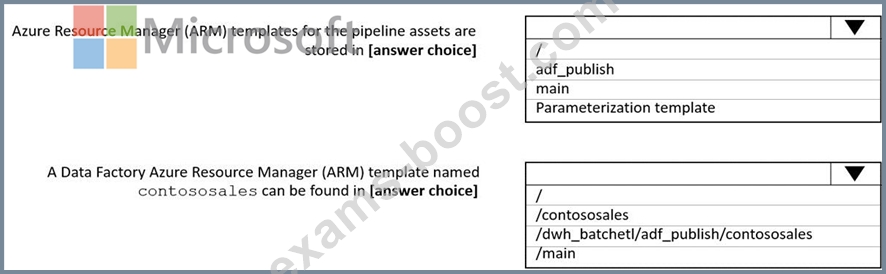
Answer:
Explanation: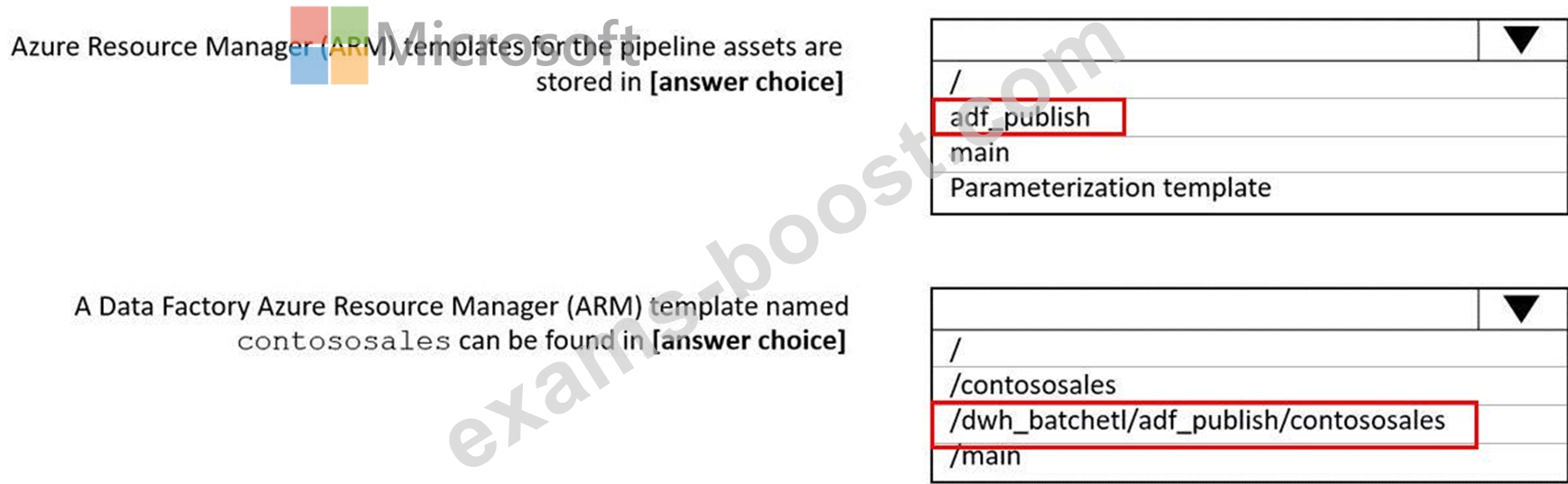
Reference:
https://docs.microsoft.com/en-us/azure/data-factory/source-control
NEW QUESTION # 106
You are developing an Azure Synapse Analytics pipeline that will include a mapping data flow named Dataflow1. Dataflow1 will read customer data from an external source and use a Type 1 slowly changing dimension (SCO) when loading the data into a table named DimCustomer1 in an Azure Synapse Analytics dedicated SQL pool.
You need to ensure that Dataflow1 can perform the following tasks:
* Detect whether the data of a given customer has changed in the DimCustomer table.
* Perform an upsert to the DimCustomer table.
Which type of transformation should you use for each task? To answer, select the appropriate options in the answer area NOTE; Each correct selection is worth one point.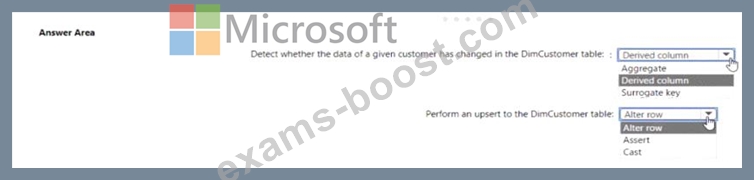
Answer:
Explanation: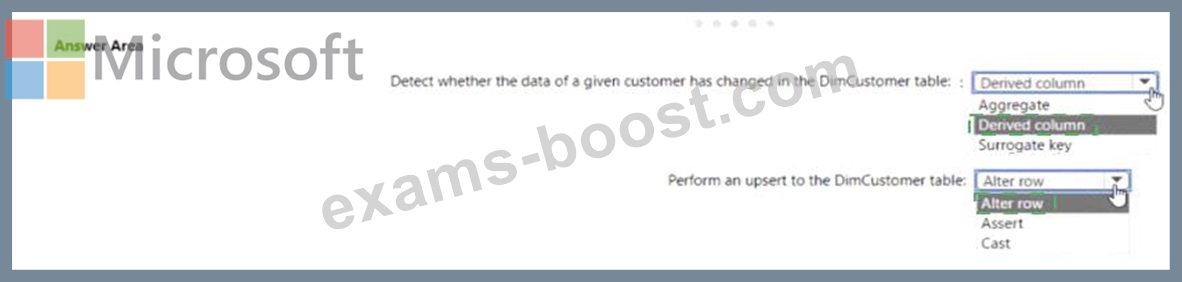
Explanation: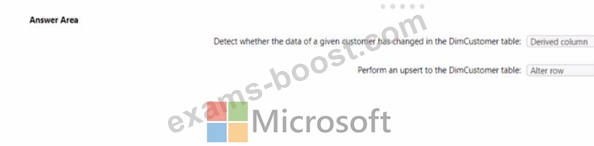
NEW QUESTION # 107
You need to design a data retention solution for the Twitter teed data records. The solution must meet the customer sentiment analytics requirements.
Which Azure Storage functionality should you include in the solution?
- A. change feed
- B. time-based retention
- C. soft delete
- D. Iifecycle management
Answer: D
Explanation:
Topic 1, Contoso
Transactional Date
Contoso has three years of customer, transactional, operation, sourcing, and supplier data comprised of 10 billion records stored across multiple on-premises Microsoft SQL Server servers. The SQL server instances contain data from various operational systems. The data is loaded into the instances by using SQL server integration Services (SSIS) packages.
You estimate that combining all product sales transactions into a company-wide sales transactions dataset will result in a single table that contains 5 billion rows, with one row per transaction.
Most queries targeting the sales transactions data will be used to identify which products were sold in retail stores and which products were sold online during different time period. Sales transaction data that is older than three years will be removed monthly.
You plan to create a retail store table that will contain the address of each retail store. The table will be approximately 2 MB. Queries for retail store sales will include the retail store addresses.
You plan to create a promotional table that will contain a promotion ID. The promotion ID will be associated to a specific product. The product will be identified by a product ID. The table will be approximately 5 GB.
Streaming Twitter Data
The ecommerce department at Contoso develops and Azure logic app that captures trending Twitter feeds referencing the company's products and pushes the products to Azure Event Hubs.
Planned Changes
Contoso plans to implement the following changes:
* Load the sales transaction dataset to Azure Synapse Analytics.
* Integrate on-premises data stores with Azure Synapse Analytics by using SSIS packages.
* Use Azure Synapse Analytics to analyze Twitter feeds to assess customer sentiments about products.
Sales Transaction Dataset Requirements
Contoso identifies the following requirements for the sales transaction dataset:
* Partition data that contains sales transaction records. Partitions must be designed to provide efficient loads by month. Boundary values must belong: to the partition on the right.
* Ensure that queries joining and filtering sales transaction records based on product ID complete as quickly as possible.
* Implement a surrogate key to account for changes to the retail store addresses.
* Ensure that data storage costs and performance are predictable.
* Minimize how long it takes to remove old records.
Customer Sentiment Analytics Requirement
Contoso identifies the following requirements for customer sentiment analytics:
* Allow Contoso users to use PolyBase in an A/ure Synapse Analytics dedicated SQL pool to query the content of the data records that host the Twitter feeds. Data must be protected by using row-level security (RLS). The users must be authenticated by using their own A/ureAD credentials.
* Maximize the throughput of ingesting Twitter feeds from Event Hubs to Azure Storage without purchasing additional throughput or capacity units.
* Store Twitter feeds in Azure Storage by using Event Hubs Capture. The feeds will be converted into Parquet files.
* Ensure that the data store supports Azure AD-based access control down to the object level.
* Minimize administrative effort to maintain the Twitter feed data records.
* Purge Twitter feed data records;itftaitJ are older than two years.
Data Integration Requirements
Contoso identifies the following requirements for data integration:
Use an Azure service that leverages the existing SSIS packages to ingest on-premises data into datasets stored in a dedicated SQL pool of Azure Synaps Analytics and transform the data.
Identify a process to ensure that changes to the ingestion and transformation activities can be version controlled and developed independently by multiple data engineers.
NEW QUESTION # 108
You are responsible for providing access to an Azure Data Lake Storage Gen2 account.
Your user account has contributor access to the storage account, and you have the application ID and access key.
You plan to use PolyBase to load data into an enterprise data warehouse in Azure Synapse Analytics.
You need to configure PolyBase to connect the data warehouse to storage account.
Which three components should you create in sequence? To answer, move the appropriate components from the list of components to the answer area and arrange them in the correct order.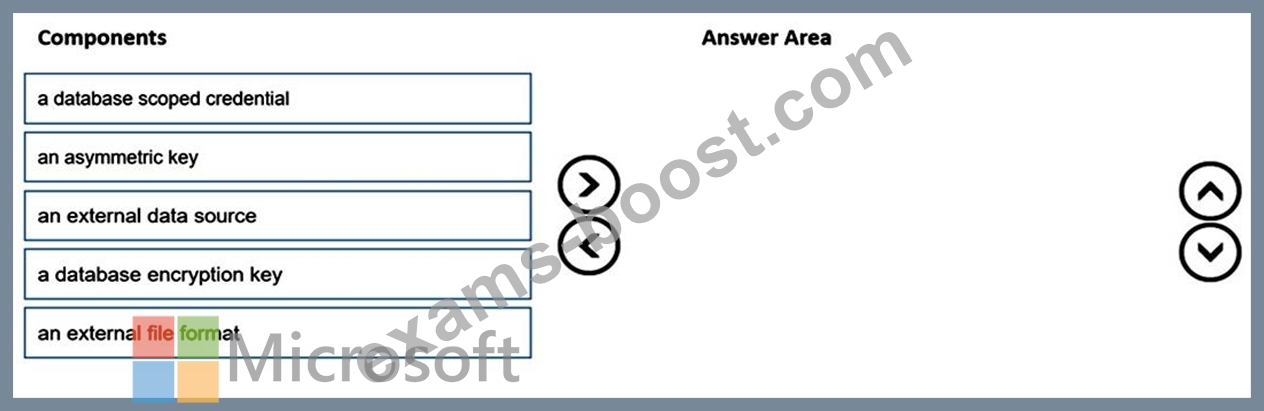
Answer:
Explanation: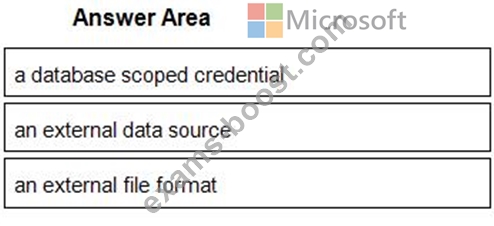
1 - a database scoped credential
2 - an external data source
3 - an external file format
NEW QUESTION # 109
You need to implement an Azure Synapse Analytics database object for storing the sales transactions data. The solution must meet the sales transaction dataset requirements.
What solution must meet the sales transaction dataset requirements.
What should you do? To answer, select the appropriate options in the answer area.
NOTE: Each correct selection is worth one point.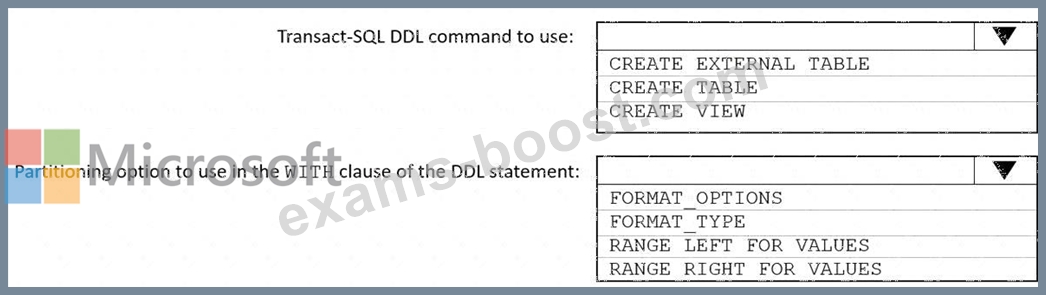
Answer:
Explanation: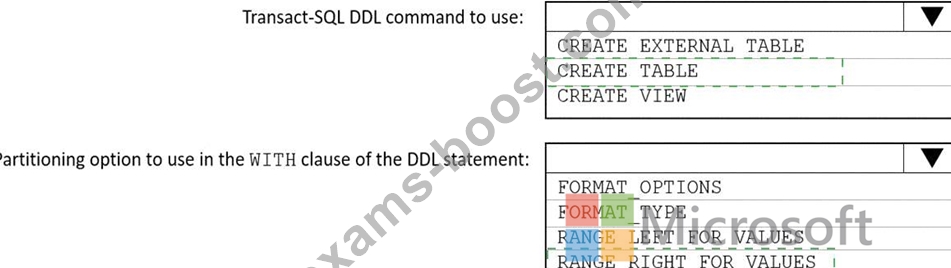
Explanation
Graphical user interface, text, application, table Description automatically generated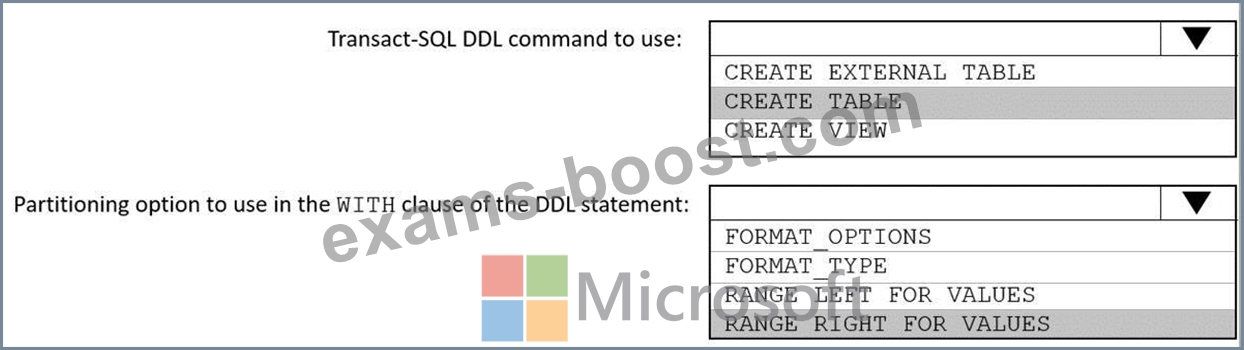
Box 1: Create table
Scenario: Load the sales transaction dataset to Azure Synapse Analytics Box 2: RANGE RIGHT FOR VALUES Scenario: Partition data that contains sales transaction records. Partitions must be designed to provide efficient loads by month. Boundary values must belong to the partition on the right.
RANGE RIGHT: Specifies the boundary value belongs to the partition on the right (higher values).
FOR VALUES ( boundary_value [,...n] ): Specifies the boundary values for the partition.
Scenario: Load the sales transaction dataset to Azure Synapse Analytics.
Contoso identifies the following requirements for the sales transaction dataset:
Partition data that contains sales transaction records. Partitions must be designed to provide efficient loads by month. Boundary values must belong to the partition on the right.
Ensure that queries joining and filtering sales transaction records based on product ID complete as quickly as possible.
Implement a surrogate key to account for changes to the retail store addresses.
Ensure that data storage costs and performance are predictable.
Minimize how long it takes to remove old records.
Reference:
https://docs.microsoft.com/en-us/sql/t-sql/statements/create-table-azure-sql-data-warehouse
NEW QUESTION # 110
You need to implement an Azure Databricks cluster that automatically connects to Azure Data lake Storage Gen2 by using Azure Active Directory (Azure AD) integration. How should you configure the new clutter? To answer, select the appropriate options in the answers are a. NOTE: Each correct selection is worth one point.
Answer:
Explanation:
NEW QUESTION # 111
You have an Azure Data Lake Storage Gen2 container.
Data is ingested into the container, and then transformed by a data integration application. The data is NOT modified after that. Users can read files in the container but cannot modify the files.
You need to design a data archiving solution that meets the following requirements:
* New data is accessed frequently and must be available as quickly as possible.
* Data that is older than five years is accessed infrequently but must be available within one second when requested.
* Data that is older than seven years is NOT accessed. After seven years, the data must be persisted at the lowest cost possible.
* Costs must be minimized while maintaining the required availability.
How should you manage the data? To answer, select the appropriate options in the answer area.
NOTE: Each correct selection is worth one point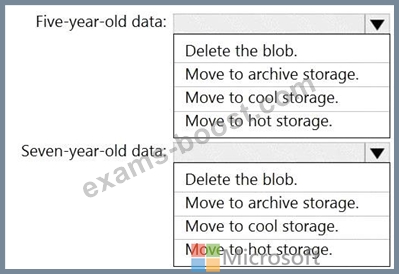
Answer:
Explanation: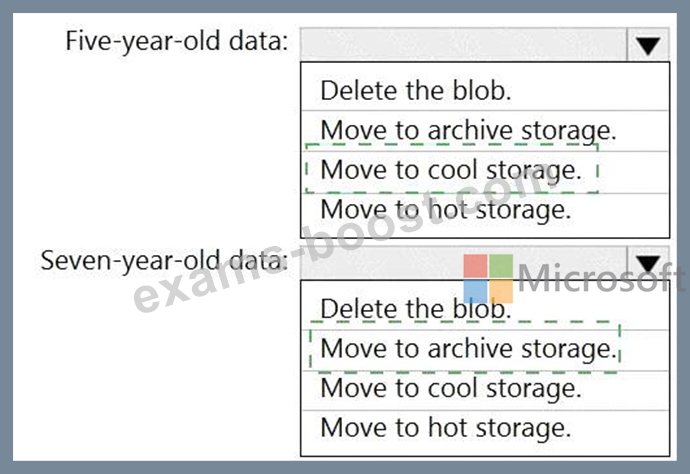
Explanation: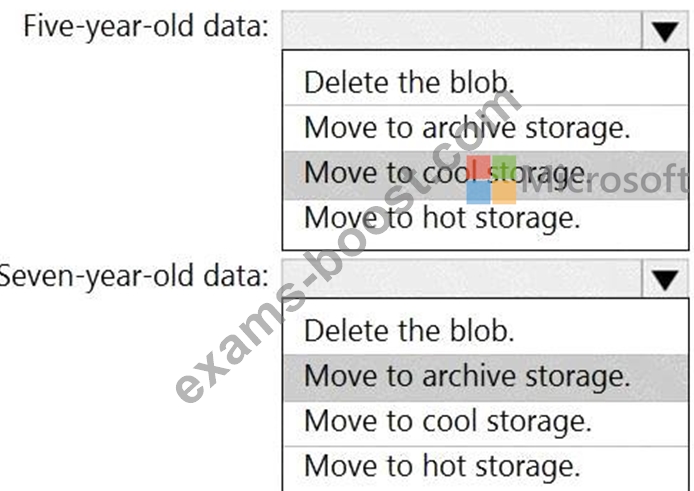
Box 1: Move to cool storage
Box 2: Move to archive storage
Archive - Optimized for storing data that is rarely accessed and stored for at least 180 days with flexible latency requirements, on the order of hours.
The following table shows a comparison of premium performance block blob storage, and the hot, cool, and archive access tiers.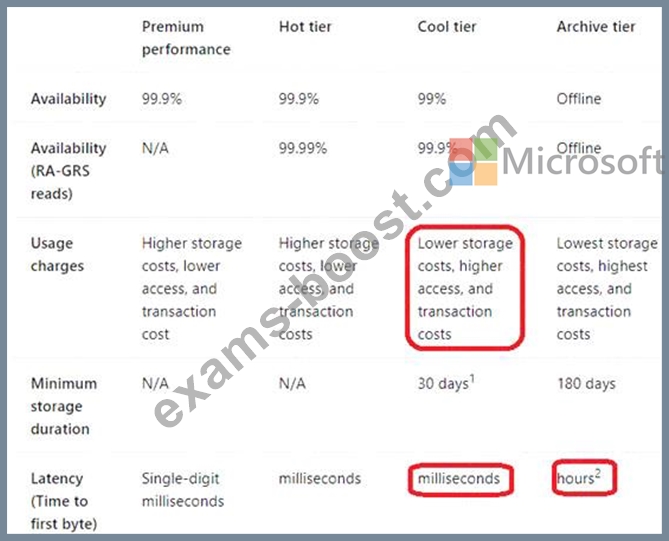
Reference:
https://docs.microsoft.com/en-us/azure/storage/blobs/storage-blob-storage-tiers Explanation:
Box 1: Replicated
Replicated tables are ideal for small star-schema dimension tables, because the fact table is often distributed on a column that is not compatible with the connected dimension tables. If this case applies to your schema, consider changing small dimension tables currently implemented as round-robin to replicated.
Box 2: Replicated
Box 3: Replicated
Box 4: Hash-distributed
For Fact tables use hash-distribution with clustered columnstore index. Performance improves when two hash tables are joined on the same distribution column.
Reference:
https://azure.microsoft.com/en-us/updates/reduce-data-movement-and-make-your-queries-more-efficient-with- the-general-availability-of-replicated-tables/
https://azure.microsoft.com/en-us/blog/replicated-tables-now-generally-available-in-azure-sql-data-warehouse/
NEW QUESTION # 112
You have Azure Data Factory configured with Azure Repos Git integration. The collaboration branch and the publish branch are set to the default values.
You have a pipeline named pipeline 1.
You build a new version of pipeline1 in a branch named feature 1.
From the Data Factory Studio, you select Publish
The source code of which branch will be built, and which branch will contain the output of the Azure Resource Manager (ARM) template? To answer, select the appropriate options in the answer area.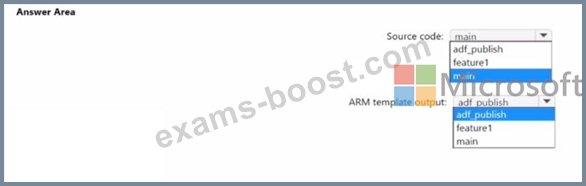
Answer:
Explanation: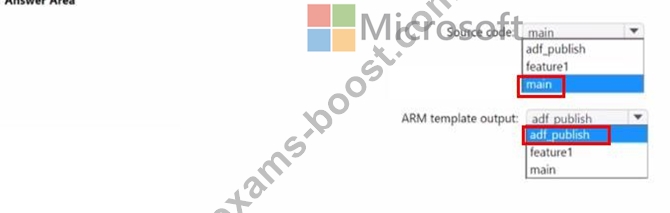
NEW QUESTION # 113
You need to create an Azure Data Factory pipeline to process data for the following three departments at your company: Ecommerce, retail, and wholesale. The solution must ensure that data can also be processed for the entire company.
How should you complete the Data Factory data flow script? To answer, drag the appropriate values to the correct targets. Each value may be used once, more than once, or not at all. You may need to drag the split bar between panes or scroll to view content.
NOTE: Each correct selection is worth one point.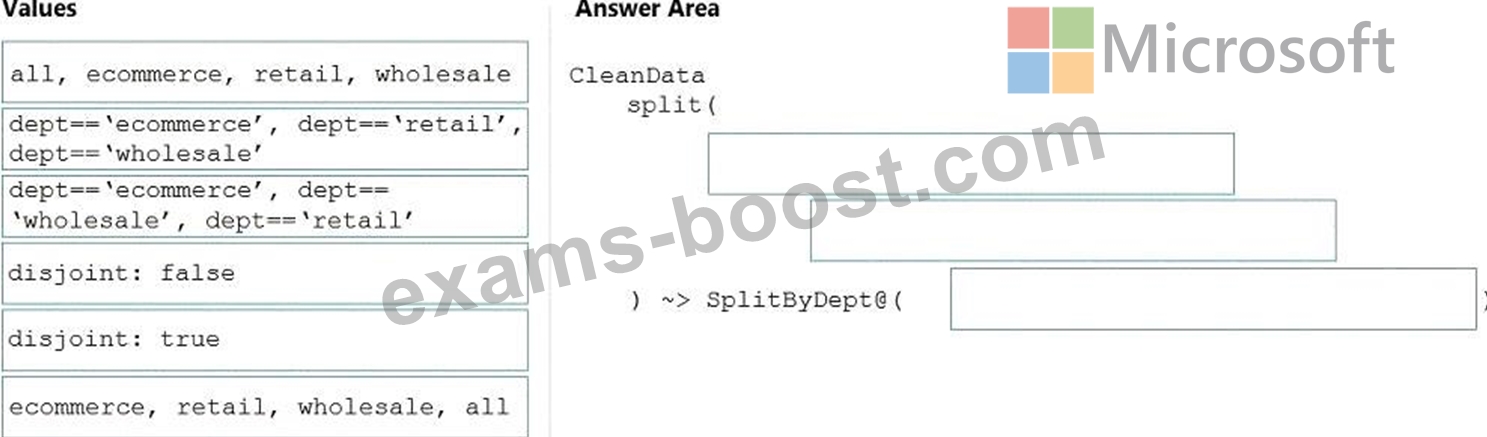
Answer:
Explanation: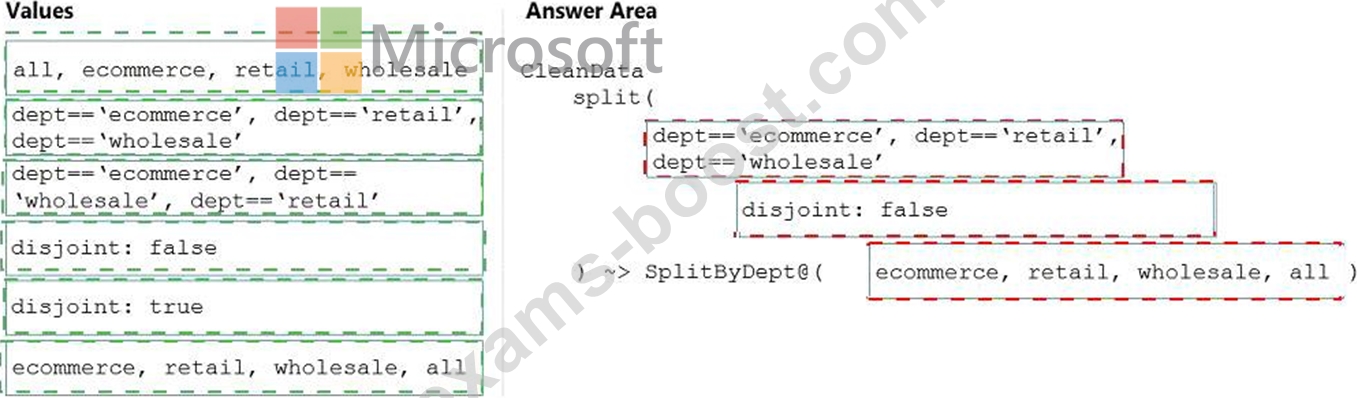
Explanation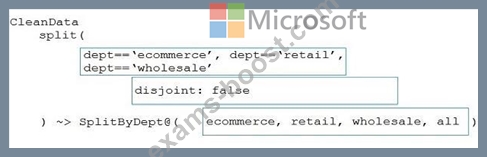
The conditional split transformation routes data rows to different streams based on matching conditions. The conditional split transformation is similar to a CASE decision structure in a programming language. The transformation evaluates expressions, and based on the results, directs the data row to the specified stream.
Box 1: dept=='ecommerce', dept=='retail', dept=='wholesale'
First we put the condition. The order must match the stream labeling we define in Box 3.
Syntax:
<incomingStream>
split(
<conditionalExpression1>
<conditionalExpression2>
disjoint: {true | false}
) ~> <splitTx>@(stream1, stream2, ..., <defaultStream>)
Box 2: discount : false
disjoint is false because the data goes to the first matching condition. All remaining rows matching the third condition go to output stream all.
Box 3: ecommerce, retail, wholesale, all
Label the streams
Reference:
https://docs.microsoft.com/en-us/azure/data-factory/data-flow-conditional-split
NEW QUESTION # 114
You have an Azure subscription that contains the resources shown in the following table.
The storage1 account contains a container named container1. The container1 container contains the following files.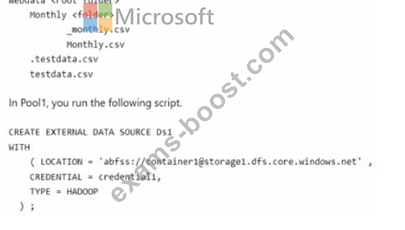
In the Built-in serverless SQL pool, you run the following script
For each of the following statements, select Yes if the statement is true. Otherwise, select No. NOTE: Each correct selection is worth one point.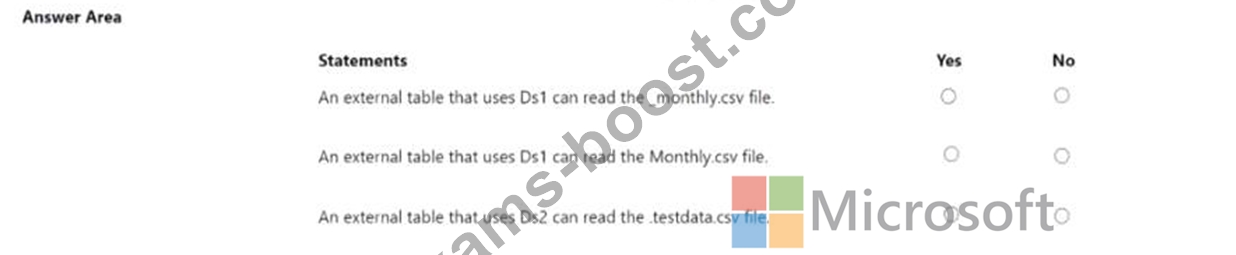
Answer:
Explanation: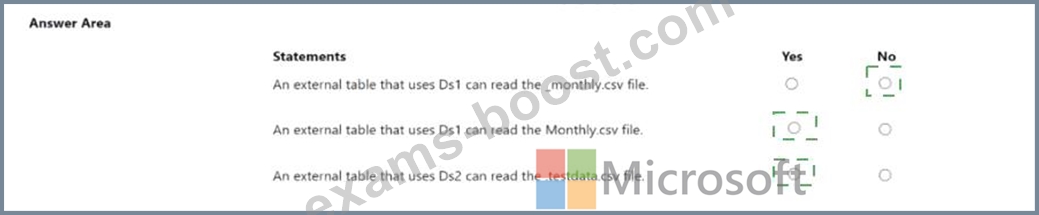
Explanation: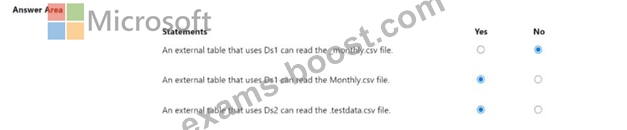
NEW QUESTION # 115
You are building an Azure Stream Analytics job that queries reference data from a product catalog file. The file is updated daily.
The reference data input details for the file are shown in the Input exhibit. (Click the Input tab.)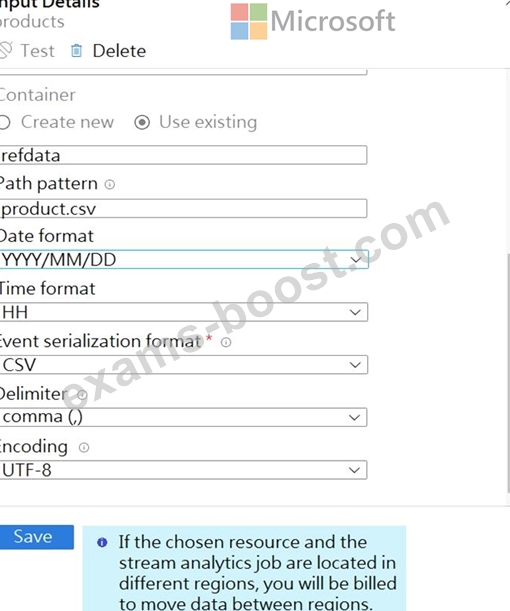
The storage account container view is shown in the Refdata exhibit. (Click the Refdata tab.)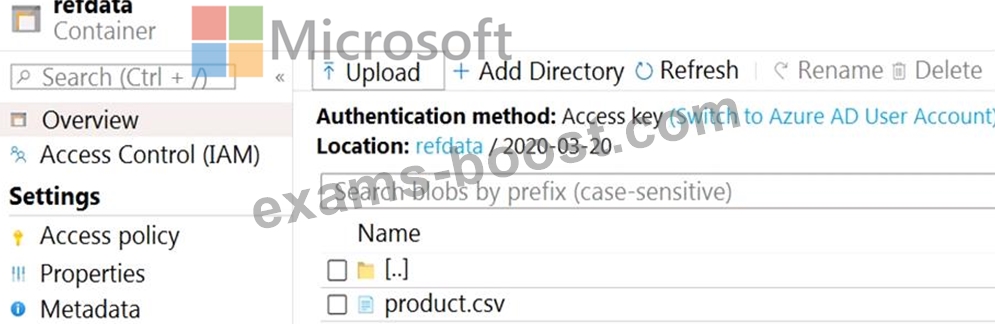
You need to configure the Stream Analytics job to pick up the new reference data.
What should you configure? To answer, select the appropriate options in the answer area.
NOTE: Each correct selection is worth one point.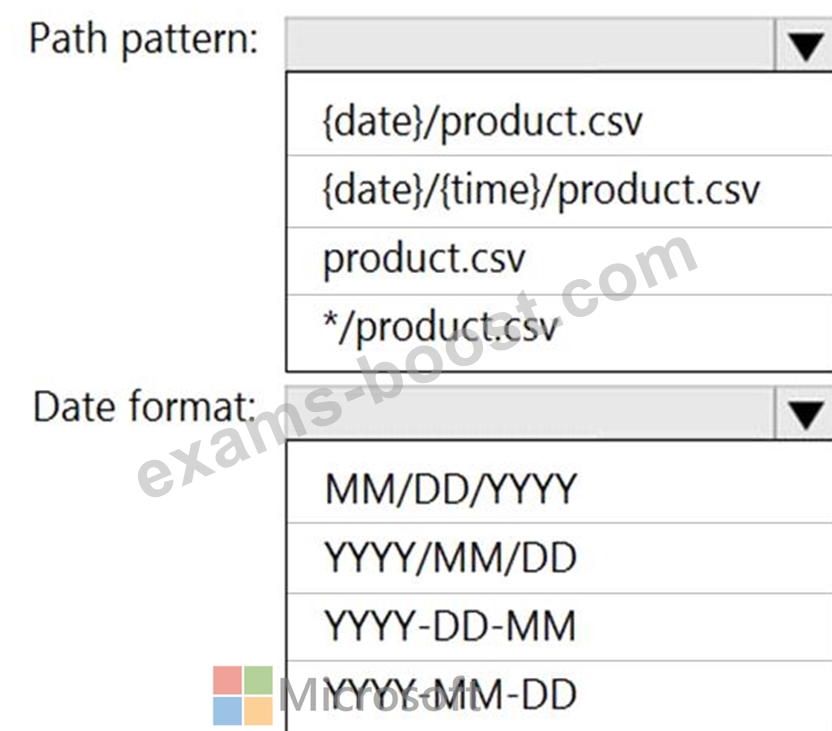
Answer:
Explanation: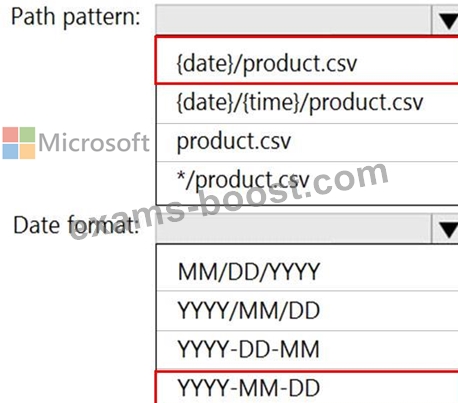
Reference:
https://docs.microsoft.com/en-us/azure/stream-analytics/stream-analytics-use-reference-data
NEW QUESTION # 116
You have the following Azure Stream Analytics query.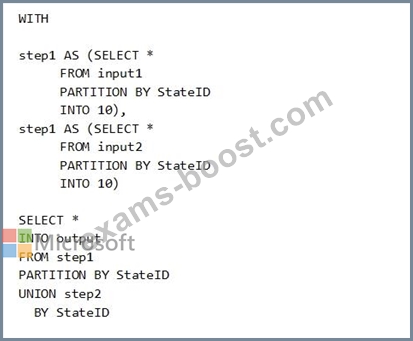
For each of the following statements, select Yes if the statement is true. Otherwise, select No.
NOTE: Each correct selection is worth one point.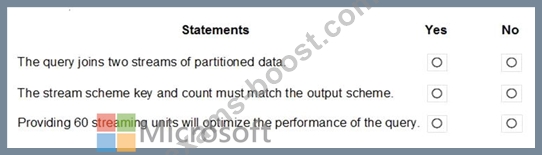
Answer:
Explanation: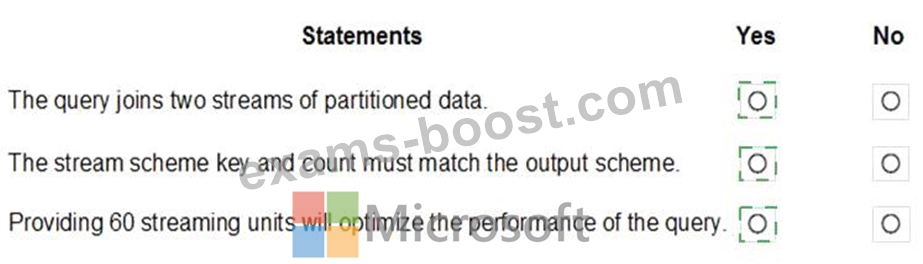
Explanation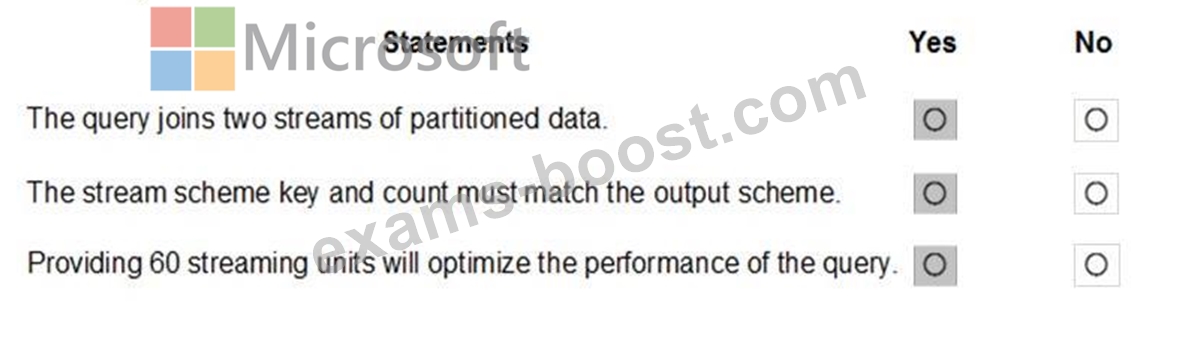
Box 1: Yes
You can now use a new extension of Azure Stream Analytics SQL to specify the number of partitions of a stream when reshuffling the data.
The outcome is a stream that has the same partition scheme. Please see below for an example:
WITH step1 AS (SELECT * FROM [input1] PARTITION BY DeviceID INTO 10),
step2 AS (SELECT * FROM [input2] PARTITION BY DeviceID INTO 10)
SELECT * INTO [output] FROM step1 PARTITION BY DeviceID UNION step2 PARTITION BY DeviceID Note: The new extension of Azure Stream Analytics SQL includes a keyword INTO that allows you to specify the number of partitions for a stream when performing reshuffling using a PARTITION BY statement.
Box 2: Yes
When joining two streams of data explicitly repartitioned, these streams must have the same partition key and partition count.
Box 3: Yes
10 partitions x six SUs = 60 SUs is fine.
Note: Remember, Streaming Unit (SU) count, which is the unit of scale for Azure Stream Analytics, must be adjusted so the number of physical resources available to the job can fit the partitioned flow. In general, six SUs is a good number to assign to each partition. In case there are insufficient resources assigned to the job, the system will only apply the repartition if it benefits the job.
Reference:
https://azure.microsoft.com/en-in/blog/maximize-throughput-with-repartitioning-in-azure-stream-analytics/
NEW QUESTION # 117
You have an Azure Stream Analytics job that is a Stream Analytics project solution in Microsoft Visual Studio. The job accepts data generated by IoT devices in the JSON format.
You need to modify the job to accept data generated by the IoT devices in the Protobuf format.
Which three actions should you perform from Visual Studio on sequence? To answer, move the appropriate actions from the list of actions to the answer area and arrange them in the correct order.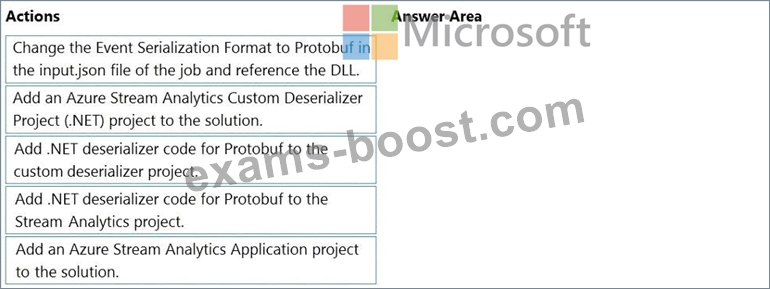
Answer:
Explanation: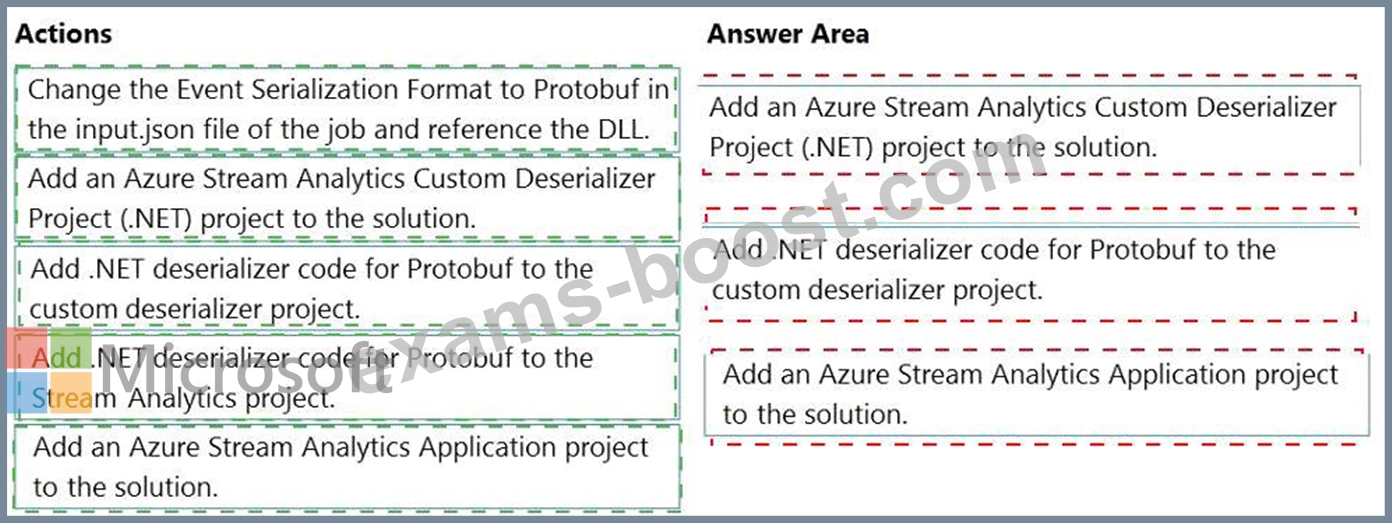
Explanation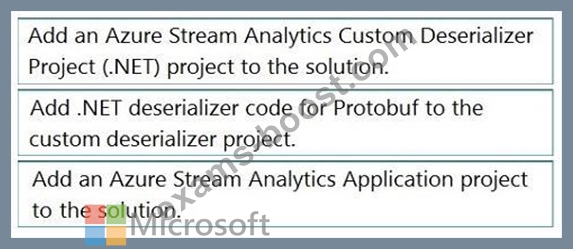
Step 1: Add an Azure Stream Analytics Custom Deserializer Project (.NET) project to the solution.
Create a custom deserializer
1. Open Visual Studio and select File > New > Project. Search for Stream Analytics and select Azure Stream Analytics Custom Deserializer Project (.NET). Give the project a name, like Protobuf Deserializer.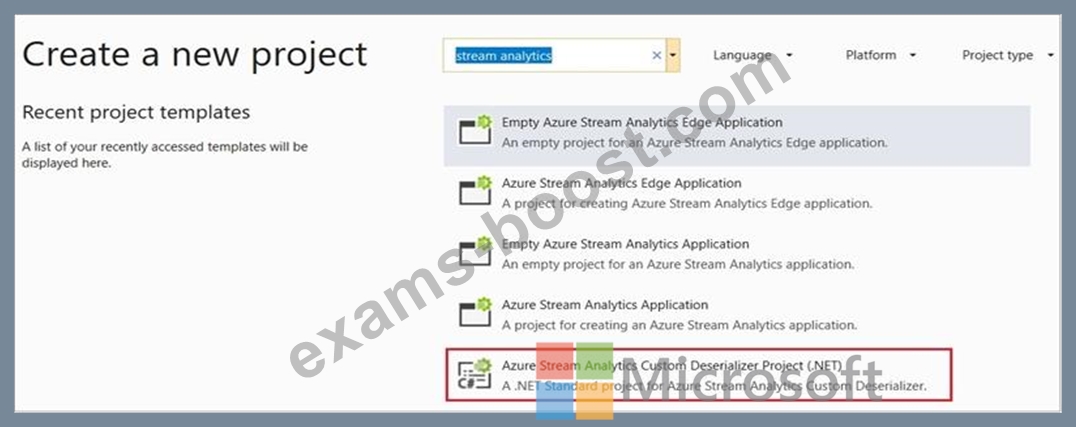
2. In Solution Explorer, right-click your Protobuf Deserializer project and select Manage NuGet Packages from the menu. Then install the Microsoft.Azure.StreamAnalytics and Google.Protobuf NuGet packages.
3. Add the MessageBodyProto class and the MessageBodyDeserializer class to your project.
4. Build the Protobuf Deserializer project.
Step 2: Add .NET deserializer code for Protobuf to the custom deserializer project Azure Stream Analytics has built-in support for three data formats: JSON, CSV, and Avro. With custom .NET deserializers, you can read data from other formats such as Protocol Buffer, Bond and other user defined formats for both cloud and edge jobs.
Step 3: Add an Azure Stream Analytics Application project to the solution Add an Azure Stream Analytics project In Solution Explorer, right-click the Protobuf Deserializer solution and select Add > New Project. Under Azure Stream Analytics > Stream Analytics, choose Azure Stream Analytics Application. Name it ProtobufCloudDeserializer and select OK.
Right-click References under the ProtobufCloudDeserializer Azure Stream Analytics project. Under Projects, add Protobuf Deserializer. It should be automatically populated for you.
Reference:
https://docs.microsoft.com/en-us/azure/stream-analytics/custom-deserializer
NEW QUESTION # 118
You have an Azure subscription that contains an Azure Synapse Analytics serverless SQL pool. You run the following query in the pool.
For each of the following statements, select Yes if the statement is true. Otherwise, select No. NOTE: Each correct selection is worth one point.
Answer:
Explanation:
Explanation:
NEW QUESTION # 119
You need to design a data retention solution for the Twitter feed data records. The solution must meet the customer sentiment analytics requirements.
Which Azure Storage functionality should you include in the solution?
- A. change feed
- B. lifecycle management
- C. time-based retention
- D. soft delete
Answer: B
Explanation:
Scenario: Purge Twitter feed data records that are older than two years.
Data sets have unique lifecycles. Early in the lifecycle, people access some data often. But the need for access often drops drastically as the data ages. Some data remains idle in the cloud and is rarely accessed once stored. Some data sets expire days or months after creation, while other data sets are actively read and modified throughout their lifetimes. Azure Storage lifecycle management offers a rule-based policy that you can use to transition blob data to the appropriate access tiers or to expire data at the end of the data lifecycle.
Reference:
https://docs.microsoft.com/en-us/azure/storage/blobs/lifecycle-management-overview This is a case study. Case studies are not timed separately. You can use as much exam time as you would like to complete each case. However, there may be additional case studies and sections on this exam. You must manage your time to ensure that you are able to complete all questions included on this exam in the time provided.
To answer the questions included in a case study, you will need to reference information that is provided in the case study. Case studies might contain exhibits and other resources that provide more information about the scenario that is described in the case study. Each question is independent of the other questions in this case study.
At the end of this case study, a review screen will appear. This screen allows you to review your answers and to make changes before you move to the next section of the exam. After you begin a new section, you cannot return to this section.
To start the case study
To display the first question in this case study, click the Next button. Use the buttons in the left pane to explore the content of the case study before you answer the questions. Clicking these buttons displays information such as business requirements, existing environment, and problem statements. If the case study has an All Information tab, note that the information displayed is identical to the information displayed on the subsequent tabs. When you are ready to answer a question, click the Question button to return to the question.
Overview
Litware, Inc. owns and operates 300 convenience stores across the US. The company sells a variety of packaged foods and drinks, as well as a variety of prepared foods, such as sandwiches and pizzas.
Litware has a loyalty club whereby members can get daily discounts on specific items by providing their membership number at checkout.
Litware employs business analysts who prefer to analyze data by using Microsoft Power BI, and data scientists who prefer analyzing data in Azure Databricks notebooks.
Topic 2, Litware, inc.
Requirements
Business Goals
Litware wants to create a new analytics environment in Azure to meet the following requirements:
See inventory levels across the stores. Data must be updated as close to real time as possible.
Execute ad hoc analytical queries on historical data to identify whether the loyalty club discounts increase sales of the discounted products.
Every four hours, notify store employees about how many prepared food items to produce based on historical demand from the sales data.
Technical Requirements
Litware identifies the following technical requirements:
Minimize the number of different Azure services needed to achieve the business goals.
Use platform as a service (PaaS) offerings whenever possible and avoid having to provision virtual machines that must be managed by Litware.
Ensure that the analytical data store is accessible only to the company's on-premises network and Azure services.
Use Azure Active Directory (Azure AD) authentication whenever possible.
Use the principle of least privilege when designing security.
Stage Inventory data in Azure Data Lake Storage Gen2 before loading the data into the analytical data store. Litware wants to remove transient data from Data Lake Storage once the data is no longer in use. Files that have a modified date that is older than 14 days must be removed.
Limit the business analysts' access to customer contact information, such as phone numbers, because this type of data is not analytically relevant.
Ensure that you can quickly restore a copy of the analytical data store within one hour in the event of corruption or accidental deletion.
Planned Environment
Litware plans to implement the following environment:
The application development team will create an Azure event hub to receive real-time sales data, including store number, date, time, product ID, customer loyalty number, price, and discount amount, from the point of sale (POS) system and output the data to data storage in Azure.
Customer data, including name, contact information, and loyalty number, comes from Salesforce, a SaaS application, and can be imported into Azure once every eight hours. Row modified dates are not trusted in the source table.
Product data, including product ID, name, and category, comes from Salesforce and can be imported into Azure once every eight hours. Row modified dates are not trusted in the source table.
Daily inventory data comes from a Microsoft SQL server located on a private network.
Litware currently has 5 TB of historical sales data and 100 GB of customer data. The company expects approximately 100 GB of new data per month for the next year.
Litware will build a custom application named FoodPrep to provide store employees with the calculation results of how many prepared food items to produce every four hours.
Litware does not plan to implement Azure ExpressRoute or a VPN between the on-premises network and Azure.
NEW QUESTION # 120
You have an Azure Data Lake Storage Gen 2 account named storage1.
You need to recommend a solution for accessing the content in storage1. The solution must meet the following requirements:
List and read permissions must be granted at the storage account level.
Additional permissions can be applied to individual objects in storage1.
Security principals from Microsoft Azure Active Directory (Azure AD), part of Microsoft Entra, must be used for authentication.
What should you use? To answer, drag the appropriate components to the correct requirements. Each component may be used once, more than once, or not at all. You may need to drag the split bar between panes or scroll to view content.
NOTE: Each correct selection is worth one point.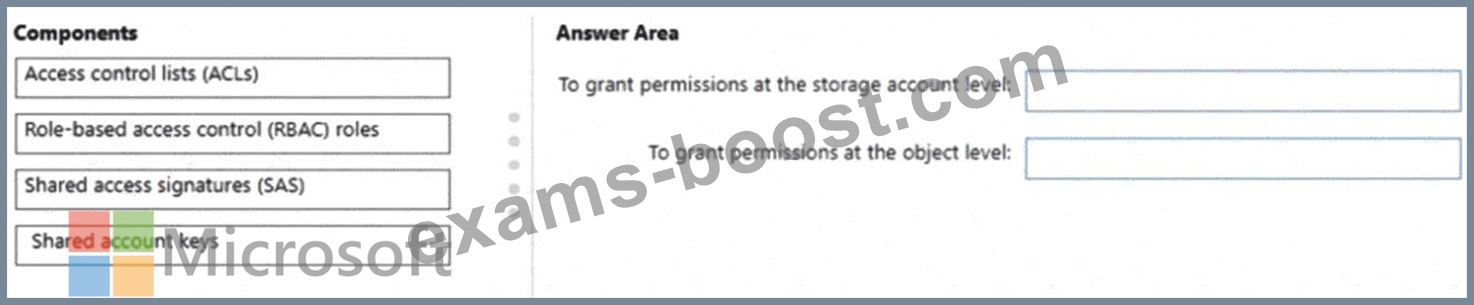
Answer:
Explanation: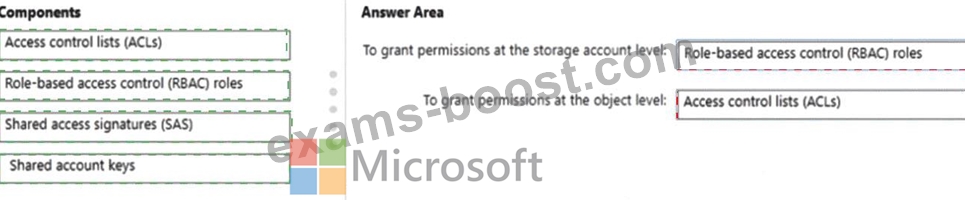
Explanation:
Box 1: Role-based access control (RBAC) roles
List and read permissions must be granted at the storage account level.
Security principals from Microsoft Azure Active Directory (Azure AD), part of Microsoft Entra, must be used for authentication.
Role-based access control (Azure RBAC)
Azure RBAC uses role assignments to apply sets of permissions to security principals. A security principal is an object that represents a user, group, service principal, or managed identity that is defined in Azure Active Directory (AD). A permission set can give a security principal a "coarse-grain" level of access such as read or write access to all of the data in a storage account or all of the data in a container.
Box 2: Access control lists (ACLs)
Additional permissions can be applied to individual objects in storage1.
Access control lists (ACLs)
ACLs give you the ability to apply "finer grain" level of access to directories and files. An ACL is a permission construct that contains a series of ACL entries. Each ACL entry associates security principal with an access level.
Reference: https://learn.microsoft.com/en-us/azure/storage/blobs/data-lake-storage-access-control-model
NEW QUESTION # 121
You have an Azure subscription.
You plan to build a data warehouse in an Azure Synapse Analytics dedicated SQL pool named pool1 that will contain staging tables and a dimensional model Pool1 will contain the following tables.

Answer:
Explanation:
NEW QUESTION # 122
You need to ensure that the Twitter feed data can be analyzed in the dedicated SQL pool. The solution must meet the customer sentiment analytics requirements.
Which three Transaction-SQL DDL commands should you run in sequence? To answer, move the appropriate commands from the list of commands to the answer area and arrange them in the correct order.
NOTE: More than one order of answer choices is correct. You will receive credit for any of the correct orders you select.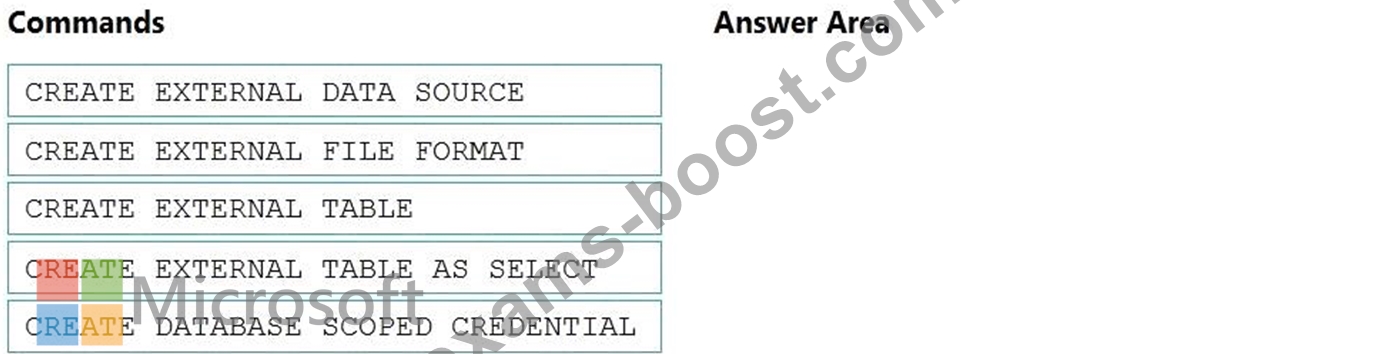
Answer:
Explanation: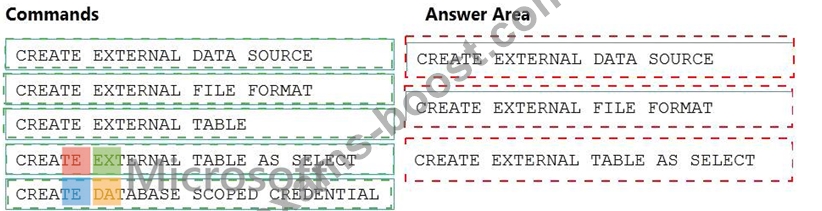
Explanation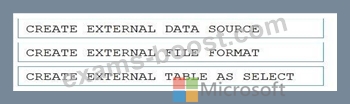
Scenario: Allow Contoso users to use PolyBase in an Azure Synapse Analytics dedicated SQL pool to query the content of the data records that host the Twitter feeds. Data must be protected by using row-level security (RLS). The users must be authenticated by using their own Azure AD credentials.
Box 1: CREATE EXTERNAL DATA SOURCE
External data sources are used to connect to storage accounts.
Box 2: CREATE EXTERNAL FILE FORMAT
CREATE EXTERNAL FILE FORMAT creates an external file format object that defines external data stored in Azure Blob Storage or Azure Data Lake Storage. Creating an external file format is a prerequisite for creating an external table.
Box 3: CREATE EXTERNAL TABLE AS SELECT
When used in conjunction with the CREATE TABLE AS SELECT statement, selecting from an external table imports data into a table within the SQL pool. In addition to the COPY statement, external tables are useful for loading data.
Reference:
https://docs.microsoft.com/en-us/azure/synapse-analytics/sql/develop-tables-external-tables
NEW QUESTION # 123
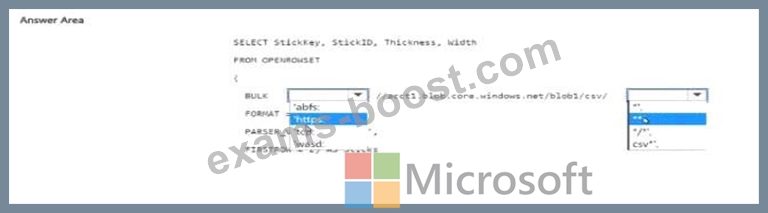
You have an Azure subscription that contains a storage account. The account contains a blob container named blob1 and an Azure Synapse Analytic serve-less SQL pool You need to Query the CSV files stored in blob1. The solution must ensure that all the files in a (older named csv and all its subfolders are queried How should you complete the query? to answer, select the appropriate options in the answer area NOTE: Each correct selection is worth one point.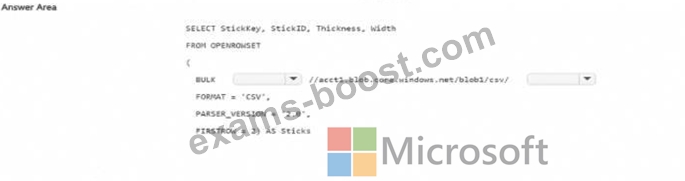
Answer:
Explanation: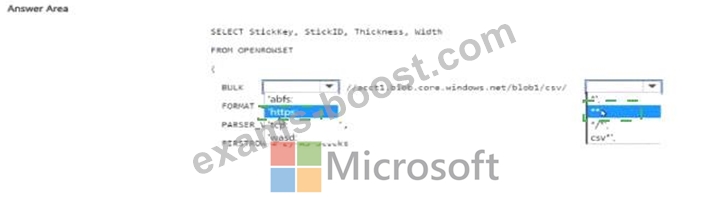
Explanation:
NEW QUESTION # 124
......
Microsoft DP-203 Pre-Exam Practice Tests | Exams-boost: https://www.exams-boost.com/DP-203-valid-materials.html
DP-203 practice test questions, answers, explanations: https://drive.google.com/open?id=1v0CkY5euFOghAfj_Itvel4uNf_w3ZtmP