

[Apr-2026] NCP-CI-Azure Dumps are Available for Instant Access from Exams-boost
Study resources for the Valid NCP-CI-Azure Braindumps!
Nutanix NCP-CI-Azure Exam Syllabus Topics:
| Topic | Details |
|---|---|
| Topic 1 |
|
| Topic 2 |
|
| Topic 3 |
|
| Topic 4 |
|
NEW QUESTION # 13
An administrator is planning an NC2 deployment in Azure and wants to connect the company's on-premises datacenter to the cloud environment.
What connectivity solution should the administrator use to avoid traffic between the locations flowing over the public internet?
- A. Point-to-Site VPN
- B. VTEP Gateways
- C. ExpressRoute
- D. Site-to-Site VPN
Answer: C
Explanation:
To connect the company's on-premises datacenter to the Azure cloud environment while avoiding traffic over the public internet, the administrator should use Azure ExpressRoute. ExpressRoute provides a private connection to Azure, offering more reliability, faster speeds, and lower latencies compared to typical internet connections. This service ensures that data traffic does not traverse the public internet, enhancing security and performance. Reference Azure ExpressRoute Overview
NEW QUESTION # 14
Exhibit.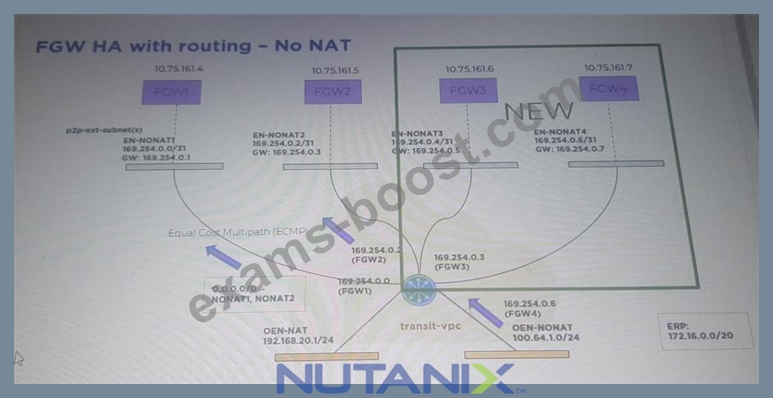
AN NC2 on Azure Cluster was deployed with two Flow gateways in HA (FGW1 and FGW2). After a week of use. Four bare-metal nodes, were added to the NC2 cluster and additional workloads were added.
It was determined that additional bandwidth for north/South traffic would be needed. Two additional Flow gateways were added (FGW3 and FGW4) from the NC2 portal configuration menu.
The existing workloads prior to expansion on the NC2 cluster will be able to use which Flow Gateways using the No-Nat (routed) traffic path?
- A. Only the Flow Gateway that each workload was originally using.
- B. FGW1 & FGW2 only, new workloads can use FGW3 & FGW4.
- C. All Flow Gateways can be used after the existing workloads reboot.
- D. All Flow Gateways can be used.
Answer: D
Explanation:
In the scenario presented, the NC2 cluster was initially deployed with two Flow Gateways (FGW1 and FGW2) in HA. After adding four bare-metal nodes and additional workloads, two more Flow Gateways (FGW3 and FGW4) were added to handle the increased bandwidth for north/south traffic. Given the configuration, the existing workloads can utilize all available Flow Gateways (FGW1, FGW2, FGW3, and FGW4) for No-NAT (routed) traffic paths. This setup allows for Equal Cost Multipath (ECMP) routing, distributing traffic load across all Flow Gateways.
Reference
Nutanix Flow Networking
NEW QUESTION # 15
What is the purpose of an organization in the NC2 console?
- A. To Link with a Public Cloud account
- B. To map the on-premises Prism Central environment
- C. To link with NC2 subscription plans
- D. To segregate clusters based on specific requirements
Answer: D
Explanation:
Purpose of an Organization in NC2: In the NC2 console, an organization serves to manage and segregate clusters based on specific requirements such as departmental needs, project goals, or security policies.
Cluster Management: This segregation allows administrators to apply unique configurations, permissions, and policies to different clusters within the same environment, providing flexibility and control over resource allocation and management.
Reference:
Nutanix NC2 Console Documentation
Best Practices for Managing NC2 Clusters
NEW QUESTION # 16
An organization uses a Pay As. You Go subscription plan and wants to pay directly to Nutanix.
What is a valid payment method available to pay directly to Nutanix?
- A. Via Credit Card
- B. Via Wire Transfer
- C. Via Physical Check
- D. Via Online Payment Platform
Answer: B
Explanation:
Payment Method Options: When using a Pay As You Go subscription plan and opting to pay directly to Nutanix, wire transfer is a valid and secure payment method.
Direct Payment: Wire transfers allow for the direct transfer of funds from the organization's bank account to Nutanix, ensuring a straightforward and efficient payment process.
Reference:
Nutanix Billing and Payment Documentation
Pay As You Go Subscription Payment Methods Guide
NEW QUESTION # 17
An administrator needs to extend an on-premises subnet to an NC2 cluster on Azure.
Which set of options should the administrator configure to complete this task?
- A. Subnet Type: On-premises VLAN subnets and VPC subnets Traffic Type: IPv4 unicast traffic IPv6 unicast traffic and ARP On-premises Hypervisor: ESXi and AHV
- B. Subnet Type: On-premises VLAN subnets and VPC subnets Traffic Type: IPv6 umcasi traffic and ARP On-premises Hypervisor: Hyper-V
- C. Subnet Type: VPC subnets
Traffic Type: IPv4 unicast traffic and ARP
On-premises Hypervisor: ESXi, AHV, Hyper-V - D. Subnet Type: On-premises VLAN subnets and VPC subnets Traffic Type: IPv4 unicast traffic and ARP On-premises Hypervisor: AHV
Answer: A
Explanation:
To extend an on-premises subnet to an NC2 cluster on Azure, the administrator should configure:
Subnet Type: Both on-premises VLAN subnets and VPC subnets. This ensures that the subnet can span both the on-premises environment and the Azure environment.
Traffic Type: Support for IPv4 unicast traffic, IPv6 unicast traffic, and ARP is necessary to ensure proper communication and address resolution across the extended subnet.
On-premises Hypervisor: ESXi and AHV are supported hypervisors for this type of configuration, allowing for a seamless extension of the subnet between these environments.
Reference
Nutanix Hybrid Cloud Networking
NEW QUESTION # 18
After creating a new Nutanix User VPC, what is needed to allow traffic to flow out of the Flow gateway VM when using the NATed Path?
- A. Add a default route on the Nutanix User VPC of 0.0.0.0/0 to the External Overlay network.
- B. Edit the External Flow Gateway Security Group on the External NIC to allow outbound traffic.
- C. Add a default route on the Transit VPC of 0.0.0.0/0 to the Flow Gateway.
- D. Add a default route on the Transit VPC of 0.0.0.0/0 to the Flow Gateway.
Answer: A
Explanation:
Edit the Internal Flow Gateway Security Group on the internal NIC to allow outbound taffic Explanation:
NATed Path Configuration: When using the NATed Path, it is essential to ensure that traffic can flow out of the Flow gateway VM to external networks.
Default Route: Adding a default route on the Nutanix User VPC ensures that all outbound traffic is directed to the appropriate network gateway.
Configuration Steps:
Navigate to the routing settings of the Nutanix User VPC.
Add a default route with the destination of 0.0.0.0/0, pointing to the External Overlay network.
Security Group Settings:
Ensure that the External Flow Gateway Security Group on the External NIC allows outbound traffic.
Ensure that the Internal Flow Gateway Security Group on the internal NIC allows outbound traffic (if needed for internal network flows).
Conclusion: Properly configuring the default route on the Nutanix User VPC enables outbound traffic flow via the NATed Path through the External Overlay network.
Reference:
Nutanix Flow Gateway Configuration Guide
Azure VPC Routing Documentation
NEW QUESTION # 19
An administrator is tasked with adding an Azure account to the NC2 console. A requirement is to configure an Azure user that can open, close or extend a support tunnel for the Nutanix Support team.
Which permission must be assigned to the user?
- A. Account Administrator
- B. Customer Auditor
- C. Cluster Auditor
- D. Cluster Administrator
Answer: A
Explanation:
* Account Administrator Role:This role grants the necessary permissions for managing the Azure account, including the ability to open, close, or extend a support tunnel. These capabilities are crucial for the Nutanix Support team to perform diagnostics and troubleshooting efficiently.
* Permissions Included:The Account Administrator role encompasses broader account management rights, ensuring that the user can interact with various support and operational aspects of the NC2 environment within Azure.
References:
* Azure Role-Based Access Control (RBAC) Documentation
* Nutanix NC2 Support Tunnel Requirements
NEW QUESTION # 20
What is the purpose of an organization in the NC2 console?
- A. To Link with a Public Cloud account
- B. To map the on-premises Prism Central environment
- C. To link with NC2 subscription plans
- D. To segregate clusters based on specific requirements
Answer: D
Explanation:
* Purpose of an Organization in NC2:In the NC2 console, an organization serves to manage and segregate clusters based on specific requirements such as departmental needs, project goals, or security policies.
* Cluster Management:This segregation allows administrators to apply unique configurations, permissions, and policies to different clusters within the same environment, providing flexibility and control over resource allocation and management.
References:
* Nutanix NC2 Console Documentation
* Best Practices for Managing NC2 Clusters
NEW QUESTION # 21
An administrator has been tasked with scoping an NC2 on Azure deployment. One of the requirements is to ensure that the bare metal instance will support up to 20 TB of storage capacity.
Which bare metal instance should the administrator choose?
- A. HB176rs
- B. ND96asr
- C. AN36
- D. AN36P
Answer: D
Explanation:
* Storage Capacity Requirement: The requirement specifies that the bare metal instance must support up to 20 TB of storage capacity.
* Instance Selection: Among the provided options, the AN36P instance is designed to support higher storage capacities and performance needs.
* AN36P Capabilities: The AN36P instance is optimized for storage-intensive applications and provides the necessary hardware specifications to handle up to 20 TB of storage.
* Comparison with Other Instances:
* ND96asr: Typically optimized for GPU workloads rather than storage.
* AN36: May not meet the 20 TB storage requirement.
* HB176rs: Geared towards high-performance computing rather than large storage capacities.
* Conclusion: Based on the requirements and instance specifications, AN36P is the most suitable choice for supporting up to 20 TB of storage.
References:
* Nutanix NC2 Instance Types
* Azure Virtual Machine Sizes
NEW QUESTION # 22
An administrator is tasked with allowing inbound connectivity for a user VM that resides on a NAT network.
The ...... communicating successfully with other VMs in the NAT network.
The cluster has the following characteristics
A Transit VPC exists
* A User VPC exists
* A NAT subnet has been created
* 25 floating IP addresses are in use by other VMs
* Routes have been configured
When the administrator attempts to assign a floating IP address to the VM, none are available.
What is the reason for this?
- A. Additional floating IP addresses need to be requested.
- B. An external DHCP server needs to be deployed into the cluster.
- C. An additional Flow Gateway instance is required.
- D. Geneve encapsulation only supports 25 Floating IP addresses.
Answer: A
Explanation:
* Floating IP Address Limitation:The cluster already has 25 floating IP addresses in use by other VMs.
If the administrator cannot assign a floating IP address to the new VM, it is because the pool of available floating IPs is exhausted.
* Requesting Additional Floating IPs:To resolve this issue, the administrator needs to request additional floating IP addresses to be allocated to the NAT subnet. This will ensure that there are enough IP addresses available for all VMs requiring inbound connectivity.
References:
* Nutanix Networking Configuration Guide
* Azure IP Address Management Documentation
NEW QUESTION # 23
An administrator needs the permission to create and manage multiple organizations and clusters in NC2, as well as manage user access for the entire company.
What role should be assigned to meet the minimum requirements of this task?
- A. Organization Administrator
- B. Customer Security Administrator
- C. Customer Administrator
- D. Cluster Administrator
Answer: C
Explanation:
Role Requirements: The task involves creating and managing multiple organizations and clusters, along with managing user access across the company.
Role Capabilities: The "Customer Administrator" role is designed to provide extensive administrative capabilities, including:
Creating and managing organizations.
Managing clusters.
Handling user access and permissions.
Comparison of Roles:
Cluster Administrator: Primarily focuses on managing individual clusters but does not encompass organization-wide administrative tasks.
Customer Security Administrator: Focuses on security-related tasks and does not have broad administrative capabilities across organizations and clusters.
Organization Administrator: Manages organizational settings but might not cover all aspects needed for multiple clusters and user access management.
Conclusion: The "Customer Administrator" role meets all the requirements for managing organizations, clusters, and user access comprehensively.
Reference:
Nutanix Role-Based Access Control Documentation
NC2 on Azure User Roles Guide
NEW QUESTION # 24
An administrator is tasked with preparing the company's Azure subscription for use with NCZ.
Which two Azure Resource Providers need to be registered? (Choose two.)
- A. Microsoft.Nutanix
- B. Microsoft.HybridCompute
- C. Microsoft.Network
- D. Microsoft.HybridNetwork
Answer: A,C
Explanation:
Azure Resource Providers: To prepare an Azure subscription for NC2, specific resource providers must be registered to enable necessary services and resources.
Required Providers:
Microsoft.Network: This provider is essential for networking functionalities, including virtual networks, subnets, and other network resources necessary for NC2 deployment.
Microsoft.Nutanix: This provider is specifically required for integrating and managing Nutanix resources within the Azure environment.
Other Providers:
Microsoft.HybridNetwork and Microsoft.HybridCompute: These are not specifically required for NC2 but might be relevant for other hybrid or extended network configurations.
Conclusion: Registering both "Microsoft.Network" and "Microsoft.Nutanix" ensures that all necessary network and Nutanix-specific resources are available for NC2 deployment.
Reference:
Azure Resource Providers Documentation
Nutanix on Azure Setup Guide
NEW QUESTION # 25
Native Azure VMs exist in a subnet (10.20.80.0/20) in the Prism Central VNet that need access to the workload running on the Nutanix User.
What needs to be modified to allow access from the native Azure VMs to the workloads running in the Nutanix User VPC?
- A. Change the ERP value to the the subnet range of the native Azure VMs (10.20.80.0/20) on the Transit VPC and the Nutanix User VPC.
- B. Remove the ERP value on the transit VPC and Nutanix User VPC.
- C. Adjust the Inbound Network Security Group on the Flow Gateway VM External NIC to allow traffic
102030.0/20. - D. Adjust the Inbound Network Security Group on the Flow Gateway VM Internal NIC to allow traffic
102030,0/20.
Answer: D
Explanation:
To allow access from the native Azure VMs to the workloads running in the Nutanix User VPC, the administrator needs to:
* Adjust the Inbound Network Security Group (NSG) on the Flow Gateway VM's Internal NIC.
* Specifically, allow traffic from the subnet range of the native Azure VMs (10.20.80.0/20) in the Inbound rules of the NSG associated with the Internal NIC of the Flow Gateway VM.
This configuration change permits the desired network traffic, ensuring that the native Azure VMs can communicate with the workloads in the Nutanix User VPC.References
* Azure Network Security Groups Overview
* Nutanix Networking and Security Best Practices
NEW QUESTION # 26
An administrator is seeking help with an ongoing NC2 issue. After reaching out to Nutanix support, the administrator is introduce to the NC2 specialist who can help troubleshoot the problem.
How can the administrator verify that the NC2 specialist has access to the necessary organizations?
- A. Add the specialist as an admin user to the organizations.
- B. Ensure the specialist is assigned the RBAC role with proper permissions.
- C. Confirm the Support Authorization on the organization is set to Full Access.
- D. Provide the specialist with the administrator's login credentials.
Answer: C
Explanation:
To verify that the NC2 specialist has access to the necessary organizations for troubleshooting the issue, the administrator should:
Confirm that the Support Authorization on the organization is set to Full Access. This ensures that the NC2 specialist has the required permissions to access the necessary resources and perform the necessary actions to resolve the issue.
Providing login credentials or adding the specialist as an admin user is not recommended due to security and privacy concerns. Ensuring the specialist is assigned the correct RBAC role is another valid approach but confirming the support authorization directly ensures they have the needed access.
Reference
Nutanix Support and Services
NEW QUESTION # 27
An administrator ran into an issue during an NC2 cluster deployment on Azure. The administrator has logged a case with Nutanix Support.
Support has requested the following logs from NC2 on Azure in order to diagnose the deployment issue:
* Cluster_agent
* Host_agent
* Hostsetup
What action should the administrator take to ensure the collect the appropriate logs?
- A. SSH to the CVM and use the logbay collect command.
- B. Login to Prism Element Web Console to generate a Logbay bundle.
- C. Login to Prism Element to access the CVM's console and run the logbay collect command.
- D. SSH to the PCVM and use the logbay collect command.
Answer: C
Explanation:
To collect the appropriate logs (Cluster_agent, Host_agent, and Hostsetup) for diagnosing the deployment issue with Nutanix Support, the administrator should:
* Log in to Prism Element to access the Controller VM (CVM) console.
* Run thelogbay collectcommand from the CVM console. This command collects the necessary logs and packages them for support.
This method ensures that the correct logs are gathered in a format that Nutanix Support can analyze.
References
* Nutanix Support Documentation on Log Collection
NEW QUESTION # 28
An administrator has been tasked with deploying a new production NC2 cluster on Azure and is studying the deployment requirements.
How many Azure Ready Nodes, at a minimum, must the administrator ensure are deployed withinthe cluster?
- A. 0
- B. 1
- C. 2
- D. 3
Answer: B
Explanation:
* Minimum Node Requirement:For production deployments, Nutanix typically requires a minimum of three nodes to ensure high availability and fault tolerance within the cluster.
* Azure Ready Nodes:Deploying at least three Azure Ready Nodes allows the cluster to provide redundancy, ensuring that the failure of a single node does not affect the overall availability and performance of the cluster.
References:
* Nutanix NC2 on Azure Deployment Guide
* High Availability and Redundancy Best Practices
NEW QUESTION # 29
An administrator is planning to expand an NC2 on Azure cluster.
Which statement is true regarding prerequisites for expanding the cluster?
- A. Cluster must be in a Cluster Connected state.
- B. Cluster must have at least three nodes.
- C. Cluster must be in a Cluster Stopped state.
- D. Cluster must have at least five nodes.
Answer: A
Explanation:
Cluster State Requirement: To expand a cluster, it must be operational and in a connected state to ensure seamless integration of additional nodes.
Cluster Stopped State: If the cluster is stopped, it cannot perform expansion operations.
Minimum Nodes Requirement: There is no minimum node count prerequisite for expanding the cluster as long as the cluster is connected.
Cluster Connected State: Ensuring the cluster is connected verifies that it is operational and can communicate with additional nodes being added.
Conclusion: The cluster must be in a Cluster Connected state to expand successfully.
Reference:
Nutanix Clusters Expansion Guide
Azure NC2 Configuration Documentation
NEW QUESTION # 30
An administrator is tasked with allowing inbound connectivity for a user VM that resides on a NAT network. The ...... communicating successfully with other VMs in the NAT network.
The cluster has the following characteristics
A Transit VPC exists
* A User VPC exists
* A NAT subnet has been created
* 25 floating IP addresses are in use by other VMs
* Routes have been configured
When the administrator attempts to assign a floating IP address to the VM, none are available.
What is the reason for this?
- A. Additional floating IP addresses need to be requested.
- B. An external DHCP server needs to be deployed into the cluster.
- C. An additional Flow Gateway instance is required.
- D. Geneve encapsulation only supports 25 Floating IP addresses.
Answer: A
NEW QUESTION # 31
An administrator needs to open the following ports in the firewall between an on-premises cluster and azure for disaster recovery:
* 22
* 2009
* 2020
* 2049
* 3260
* 9440
Which rile-type should be created on the firewall for communication to be appropriately established?
- A. Bi-directional (TCP)
- B. Outbound (TCP)
- C. Bi-directional (ICMP)
- D. Outbound (ICMP)
Answer: A
Explanation:
Port Requirements: The specified ports (22, 2009, 2020, 2049, 3260, 9440) are commonly used for various services and require TCP communication.
Port 22: SSH
Port 2009: Used for Nutanix internal communication
Port 2020: Nutanix services
Port 2049: NFS
Port 3260: iSCSI
Port 9440: Nutanix Prism management
Communication Type: To ensure proper disaster recovery setup, bi-directional communication is needed to allow traffic to flow both from on-premises to Azure and vice versa.
TCP Protocol: These ports use the TCP protocol, which provides reliable communication between devices.
Conclusion: Creating a bi-directional (TCP) rule on the firewall allows the necessary communication for disaster recovery processes.
Reference:
Nutanix Networking and Security Documentation
Azure Networking Documentation
NEW QUESTION # 32
......
Updated NCP-CI-Azure Tests Engine pdf - All Free Dumps Guaranteed: https://www.exams-boost.com/NCP-CI-Azure-valid-materials.html