

Dumps Moneyack Guarantee - FCSS_SOC_AN-7.4 Dumps UpTo 50% Off
Updated Nov-2025 Pass FCSS_SOC_AN-7.4 Exam - Real Practice Test Questions
Fortinet FCSS_SOC_AN-7.4 Exam Syllabus Topics:
| Topic | Details |
|---|---|
| Topic 1 |
|
| Topic 2 |
|
| Topic 3 |
|
| Topic 4 |
|
NEW QUESTION # 47
Exhibit: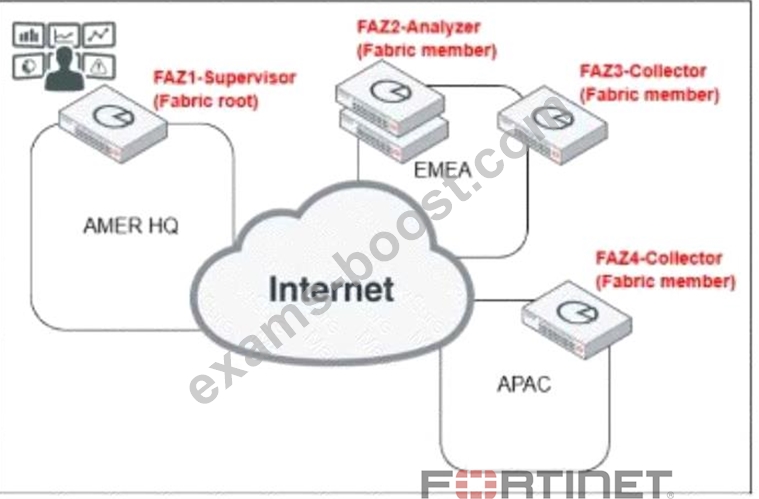
Which observation about this FortiAnalyzer Fabric deployment architecture is true?
- A. The APAC SOC team has access to FortiView and other reporting functions.
- B. The AMER HQ SOC team must configure high availability (HA) for the supervisor node.
- C. The EMEA SOC team has access to historical logs only.
- D. The AMER HQ SOC team cannot run automation playbooks from the Fabric supervisor.
Answer: D
Explanation:
* Understanding FortiAnalyzer Fabric Deployment:
* FortiAnalyzer Fabric deployment involves a hierarchical structure where the Fabric root (supervisor) coordinates with multiple Fabric members (collectors and analyzers).
* This setup ensures centralized log collection, analysis, and incident response across geographically distributed locations.
* Analyzing the Exhibit:
* FAZ1-Supervisoris located at AMER HQ and acts as the Fabric root.
* FAZ2-Analyzeris a Fabric member located in EMEA.
* FAZ3-CollectorandFAZ4-Collectorare Fabric members located in EMEA and APAC, respectively.
* Evaluating the Options:
* Option A:The statement indicates that the AMER HQ SOC team cannot run automation playbooks from the Fabric supervisor. This is true because automation playbooks and certain orchestration tasks typically require local execution capabilities which may not be fully supported on the supervisor node.
* Option B:High availability (HA) configuration for the supervisor node is a best practice for redundancy but is not directly inferred from the given architecture.
* Option C:The EMEA SOC team having access to historical logs only is not correct since FAZ2-Analyzer provides full analysis capabilities.
* Option D:The APAC SOC team has access to FortiView and other reporting functions through FAZ4-Collector, but this is not explicitly detailed in the provided architecture.
* Conclusion:
* The most accurate observation about this FortiAnalyzer Fabric deployment architecture is that the AMER HQ SOC team cannot run automation playbooks from the Fabric supervisor.
References:
* Fortinet Documentation on FortiAnalyzer Fabric Deployment.
* Best Practices for FortiAnalyzer and Automation Playbooks.
NEW QUESTION # 48
In managing connectors within a SOC, what is a key benefit of ensuring proper integration?
- A. It ensures seamless data exchange and process automation
- B. It enhances the aesthetic appeal of the SOC
- C. It simplifies the legal compliance of the SOC
- D. It reduces the need for cybersecurity training
Answer: A
NEW QUESTION # 49
Refer to the exhibits.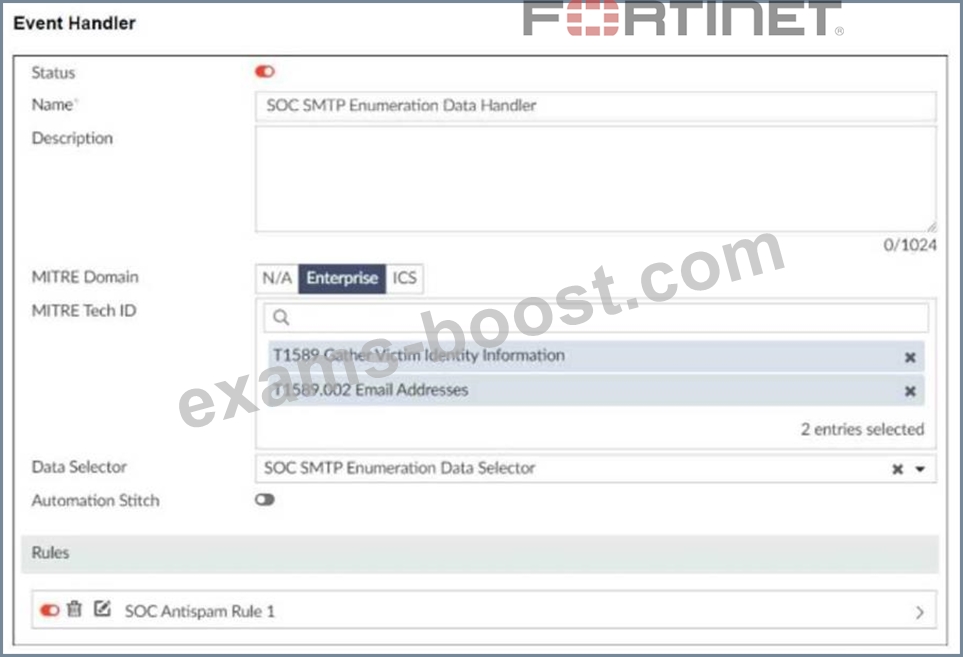
You configured a custom event handler and an associated rule to generate events whenever FortiMail detects spam emails. However, you notice that the event handler is generating events for both spam emails and clean emails.
Which change must you make in the rule so that it detects only spam emails?
- A. Disable the rule to use the filter in the data selector to create the event.
- B. In the Log Type field, select Anti-Spam Log (spam)
- C. In the Trigger an event when field, select Within a group, the log field Spam Name (snane) has 2 or more unique values.
- D. In the Log filter by Text field, type type==spam.
Answer: B
Explanation:
Understanding the Custom Event Handler Configuration:
The event handler is set up to generate events based on specific log data.
The goal is to generate events specifically for spam emails detected by FortiMail.
Analyzing the Issue:
The event handler is currently generating events for both spam emails and clean emails.
This indicates that the rule's filtering criteria are not correctly distinguishing between spam and non- spam emails.
Evaluating the Options:
Option A: Selecting the "Anti-Spam Log (spam)" in the Log Type field will ensure that only logs related to spam emails are considered. This is the most straightforward and accurate way to filter for spam emails.
Option B: Typing type==spam in the Log filter by Text field might help filter the logs, but it is not as direct and reliable as selecting the correct log type.
Option C: Disabling the rule to use the filter in the data selector to create the event does not address the issue of filtering for spam logs specifically.
Option D: Selecting "Within a group, the log field Spam Name (snane) has 2 or more unique values" is not directly relevant to filtering spam logs and could lead to incorrect filtering criteria. Conclusion:
The correct change to make in the rule is to select "Anti-Spam Log (spam)" in the Log Type field. This ensures that the event handler only generates events for spam emails.
Reference: Fortinet Documentation on Event Handlers and Log Types.
Best Practices for Configuring FortiMail Anti-Spam Settings.
NEW QUESTION # 50
Which statement best describes the MITRE ATT&CK framework?
- A. It covers tactics, techniques, and procedures, but does not provide information about mitigations.
- B. It describes attack vectors targeting network devices and servers, but not user endpoints.
- C. It provides a high-level description of common adversary activities, but lacks technical details
- D. It contains some techniques or subtechniques that fall under more than one tactic.
Answer: D
Explanation:
Understanding the MITRE ATT&CK Framework:
The MITRE ATT&CK framework is a comprehensive matrix of tactics and techniques used by adversaries to achieve their objectives.
It is widely used for understanding adversary behavior, improving defense strategies, and conducting security assessments.
Analyzing the Options:
Option A: The framework provides detailed technical descriptions of adversary activities, including specific techniques and subtechniques.
Option B: The framework includes information about mitigations and detections for each technique and subtechnique, providing comprehensive guidance.
Option C: MITRE ATT&CK covers a wide range of attack vectors, including those targeting user endpoints, network devices, and servers.
Option D: Some techniques or subtechniques do indeed fall under multiple tactics, reflecting the complex nature of adversary activities that can serve different objectives. Conclusion:
The statement that best describes the MITRE ATT&CK framework is that it contains some techniques or subtechniques that fall under more than one tactic.
Reference: MITRE ATT&CK Framework Documentation.
Security Best Practices and Threat Intelligence Reports Utilizing MITRE ATT&CK.
NEW QUESTION # 51
Which component of the Fortinet SOC solution is primarily responsible for automated threat detection and response?
- A. FortiAnalyzer
- B. FortiSIEM
- C. FortiGate
- D. FortiManager
Answer: B
NEW QUESTION # 52
Which three end user logs does FortiAnalyzer use to identify possible IOC compromised hosts? (Choose three.)
- A. IPS logs
- B. Email filter logs
- C. DNS filter logs
- D. Web filter logs
- E. Application filter logs
Answer: A,C,D
Explanation:
Overview of Indicators of Compromise (IoCs): Indicators of Compromise (IoCs) are pieces of evidence that suggest a system may have been compromised. These can include unusual network traffic patterns, the presence of known malicious files, or other suspicious activities.
FortiAnalyzer's Role: FortiAnalyzer aggregates logs from various Fortinet devices to provide comprehensive visibility and analysis of network events. It uses these logs to identify potential IoCs and compromised hosts.
Relevant Log Types:
DNS Filter Logs:
DNS requests are a common vector for malware communication. Analyzing DNS filter logs helps in identifying suspicious domain queries, which can indicate malware attempting to communicate with command and control (C2) servers.
Reference: Fortinet Documentation on DNS Filtering FortiOS DNS Filter IPS Logs:
Intrusion Prevention System (IPS) logs detect and block exploit attempts and malicious activities.
These logs are critical for identifying compromised hosts based on detected intrusion attempts or behaviors matching known attack patterns.
Reference: Fortinet IPS Overview FortiOS IPS
Web Filter Logs:
Web filtering logs monitor and control access to web content. These logs can reveal access to malicious websites, download of malware, or other web-based threats, indicating a compromised host.
Reference: Fortinet Web Filtering FortiOS Web Filter
Why Not Other Log Types:
Email Filter Logs:
While important for detecting phishing and email-based threats, they are not as directly indicative of compromised hosts as DNS, IPS, and Web filter logs. Application Filter Logs:
These logs control application usage but are less likely to directly indicate compromised hosts compared to the selected logs.
Detailed Process:
Step 1: FortiAnalyzer collects logs from FortiGate and other Fortinet devices.
Step 2: DNS filter logs are analyzed to detect unusual or malicious domain queries.
Step 3: IPS logs are reviewed for any intrusion attempts or suspicious activities.
Step 4: Web filter logs are checked for access to malicious websites or downloads.
Step 5: FortiAnalyzer correlates the information from these logs to identify potential IoCs and compromised hosts.
Reference: Fortinet Documentation: FortiOS DNS Filter, IPS, and Web Filter administration guides.
FortiAnalyzer Administration Guide: Details on log analysis and IoC identification.
By using DNS filter logs, IPS logs, and Web filter logs, FortiAnalyzer effectively identifies possible compromised hosts, providing critical insights for threat detection and response.
NEW QUESTION # 53
What is the impact of poorly configured playbook triggers in a SOC environment?
- A. Improved efficiency of threat detection
- B. Increased marketing capabilities
- C. Enhanced personal relationships among SOC staff
- D. Decreased accuracy in automated responses
Answer: D
NEW QUESTION # 54
Which three end user logs does FortiAnalyzer use to identify possible IOC compromised hosts? (Choose three.)
- A. IPS logs
- B. Email filter logs
- C. DNS filter logs
- D. Web filter logs
- E. Application filter logs
Answer: A,C,D
Explanation:
* Overview of Indicators of Compromise (IoCs): Indicators of Compromise (IoCs) are pieces of evidence that suggest a system may have been compromised. These can include unusual network traffic patterns, the presence of known malicious files, or other suspicious activities.
* FortiAnalyzer's Role: FortiAnalyzer aggregates logs from various Fortinet devices to provide comprehensive visibility and analysis of network events. It uses these logs to identify potential IoCs and compromised hosts.
* Relevant Log Types:
* DNS Filter Logs:
* DNS requests are a common vector for malware communication. Analyzing DNS filter logs helps in identifying suspicious domain queries, which can indicate malware attempting to communicate with command and control (C2) servers.
NEW QUESTION # 55
Which statement describes automation stitch integration between FortiGate and FortiAnalyzer?
- A. An event handler on FortiAnalyzer is configured to send a notification to FortiGate to trigger an automation stitch.
- B. An event handler on FortiAnalyzer executes an automation stitch when an event is created.
- C. A security profile on FortiGate triggers a violation and FortiGate sends a webhook call to FortiAnalyzer.
- D. An automation stitch is configured on FortiAnalyzer and mapped to FortiGate using the FortiOS connector.
Answer: C
Explanation:
Overview of Automation Stitches: Automation stitches in Fortinet solutions enable automated responses to specific events detected within the network. This automation helps in swiftly mitigating threats without manual intervention.
FortiGate Security Profiles:
FortiGate uses security profiles to enforce policies on network traffic. These profiles can include antivirus, web filtering, intrusion prevention, and more.
When a security profile detects a violation or a specific event, it can trigger predefined actions.
Webhook Calls:
FortiGate can be configured to send webhook calls upon detecting specific security events.
A webhook is an HTTP callback triggered by an event, sending data to a specified URL. This allows FortiGate to communicate with other systems, such as FortiAnalyzer. FortiAnalyzer Integration:
FortiAnalyzer collects logs and events from various Fortinet devices, providing centralized logging and analysis.
Upon receiving a webhook call from FortiGate, FortiAnalyzer can further analyze the event, generate reports, and take automated actions if configured to do so. Detailed Process:
Step 1: A security profile on FortiGate triggers a violation based on the defined security policies.
Step 2: FortiGate sends a webhook call to FortiAnalyzer with details of the violation.
Step 3: FortiAnalyzer receives the webhook call and logs the event.
Step 4: Depending on the configuration, FortiAnalyzer can execute an automation stitch to respond to the event, such as sending alerts, generating reports, or triggering further actions.
Reference: Fortinet Documentation: FortiOS Automation Stitches
FortiAnalyzer Administration Guide: Details on configuring event handlers and integrating with FortiGate.
FortiGate Administration Guide: Information on security profiles and webhook configurations.
By understanding the interaction between FortiGate and FortiAnalyzer through webhook calls and automation stitches, security operations can ensure a proactive and efficient response to security events.
NEW QUESTION # 56
What is a key consideration when designing a scalable FortiAnalyzer deployment?
- A. The integration with third-party tools
- B. The color scheme of the dashboard
- C. The future increase in log volume
- D. The branding of the user interface
Answer: C
NEW QUESTION # 57
How does identifying adversary behavior benefit SOC operations in terms of incident response?
- A. By reducing the importance of endpoint security
- B. By providing data for marketing strategies
- C. By increasing the time it takes to respond to incidents
- D. By allowing for a quicker isolation of affected systems
Answer: D
NEW QUESTION # 58
What is the advantage of integrating advanced analytics in the management of events and incidents in a SOC?
- A. It diminishes the importance of cybersecurity.
- B. It reduces the necessity for manual data processing.
- C. It increases the workload on SOC analysts.
- D. It focuses on marketing data analysis.
Answer: B
NEW QUESTION # 59
Refer to the exhibits.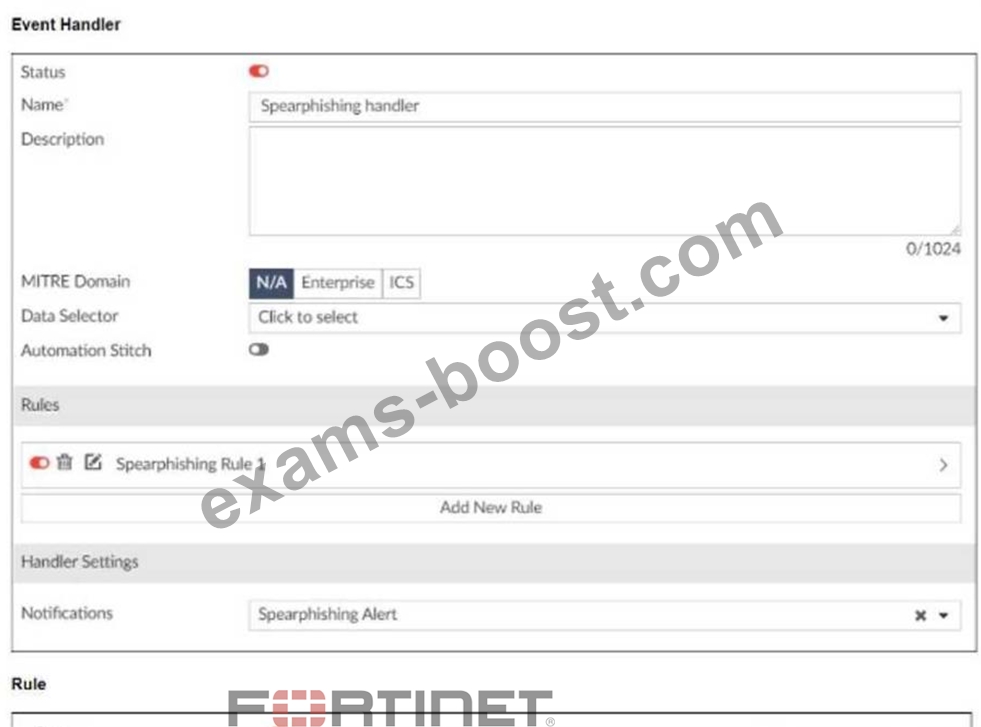
You configured a spearphishing event handler and the associated rule. However. FortiAnalyzer did not generate an event.
When you check the FortiAnalyzer log viewer, you confirm that FortiSandbox forwarded the appropriate logs, as shown in the raw log exhibit.
What configuration must you change on FortiAnalyzer in order for FortiAnalyzer to generate an event?
- A. In the Log Filter by Text field, type the value: .5 ub t ype ma Iwa re..
- B. Configure a FortiSandbox data selector and add it tothe event handler.
- C. Change trigger condition by selecting. Within a group, the log field Malware Kame (mname> has 2 or more unique values.
- D. In the Log Type field, change the selection to AntiVirus Log(malware).
Answer: B
Explanation:
Understanding the Event Handler Configuration:
The event handler is set up to detect specific security incidents, such as spearphishing, based on logs forwarded from other Fortinet products like FortiSandbox.
An event handler includes rules that define the conditions under which an event should be triggered.
Analyzing the Current Configuration:
The current event handler is named "Spearphishing handler" with a rule titled "Spearphishing Rule 1".
The log viewer shows that logs are being forwarded by FortiSandbox but no events are generated by FortiAnalyzer.
Key Components of Event Handling:
Log Type: Determines which type of logs will trigger the event handler.
Data Selector: Specifies the criteria that logs must meet to trigger an event.
Automation Stitch: Optional actions that can be triggered when an event occurs.
Notifications: Defines how alerts are communicated when an event is detected.
Issue Identification:
Since FortiSandbox logs are correctly forwarded but no event is generated, the issue likely lies in the data selector configuration or log type matching.
The data selector must be configured to include logs forwarded by FortiSandbox.
Solution:
B . Configure a FortiSandbox data selector and add it to the event handler:
By configuring a data selector specifically for FortiSandbox logs and adding it to the event handler, FortiAnalyzer can accurately identify and trigger events based on the forwarded logs. Steps to Implement the Solution:
Step 1: Go to the Event Handler settings in FortiAnalyzer.
Step 2: Add a new data selector that includes criteria matching the logs forwarded by FortiSandbox (e.g., log subtype, malware detection details).
Step 3: Link this data selector to the existing spearphishing event handler.
Step 4: Save the configuration and test to ensure events are now being generated.
Conclusion:
The correct configuration of a FortiSandbox data selector within the event handler ensures that FortiAnalyzer can generate events based on relevant logs.
Reference: Fortinet Documentation on Event Handlers and Data Selectors FortiAnalyzer Event Handlers Fortinet Knowledge Base for Configuring Data Selectors FortiAnalyzer Data Selectors By configuring a FortiSandbox data selector and adding it to the event handler, FortiAnalyzer will be able to accurately generate events based on the appropriate logs.
NEW QUESTION # 60
Refer to the exhibits.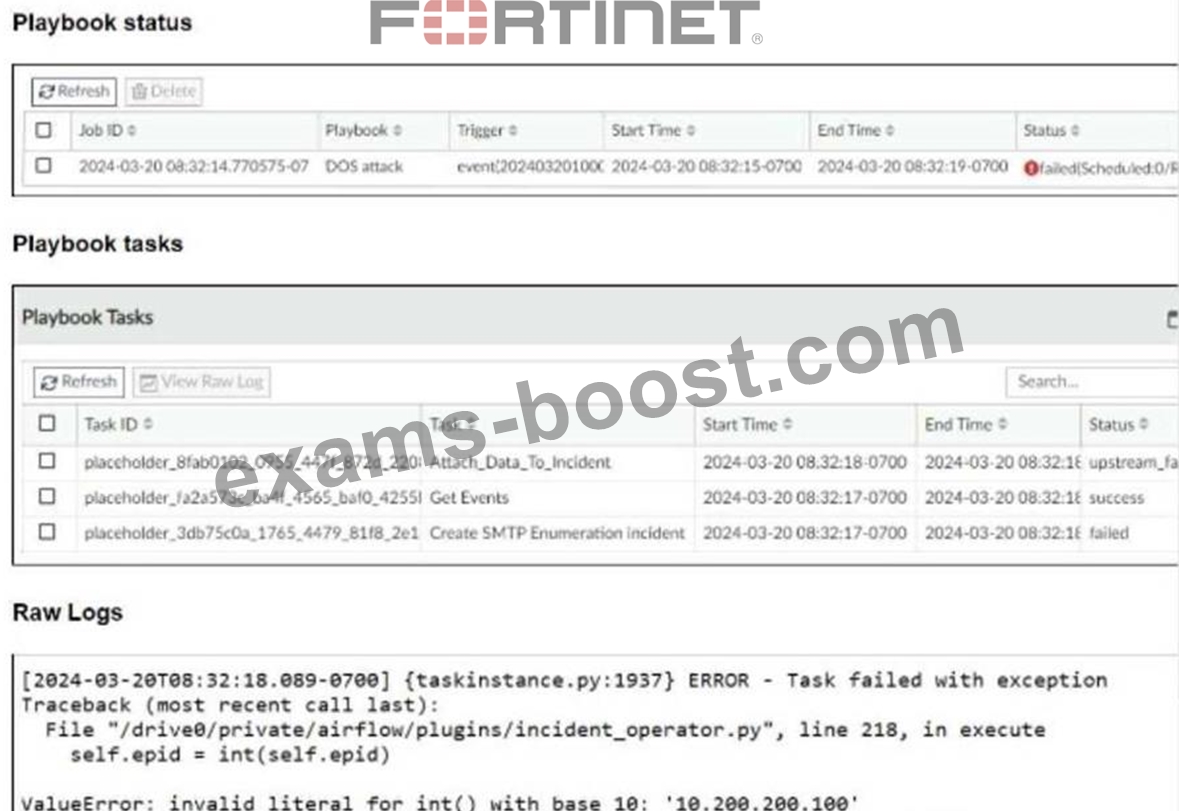
The DOS attack playbook is configured to create an incident when an event handler generates a denial-of-ser/ice (DoS) attack event.
Why did the DOS attack playbook fail to execute?
- A. The Attach_Data_To_lncident task is expecting an integer value but is receiving the incorrect datatype.
- B. The Create SMTP Enumeration incident task is expecting an integer value but is receiving the incorrect data type
- C. The Attach_Data_To_lncident task failed.
- D. The Get Events task is configured to execute in the incorrect order.
Answer: B
Explanation:
Understanding the Playbook and its Components:
The exhibit shows the status of a playbook named "DOS attack" and its associated tasks. The playbook is designed to execute a series of tasks upon detecting a DoS attack event. Analysis of Playbook Tasks:
Attach_Data_To_Incident: Task ID placeholder_8fab0102, status is "upstream_failed," meaning it did not execute properly due to a previous task's failure.
Get Events: Task ID placeholder_fa2a573c, status is "success."
Create SMTP Enumeration incident: Task ID placeholder_3db75c0a, status is "failed." Reviewing Raw Logs:
The error log shows a ValueError: invalid literal for int() with base 10: '10.200.200.100'.
This error indicates that the task attempted to convert a string (the IP address '10.200.200.100') to an integer, which is not possible.
Identifying the Source of the Error:
The error occurs in the file "incident_operator.py," specifically in the execute method.
This suggests that the task "Create SMTP Enumeration incident" is the one causing the issue because it failed to process the data type correctly.
Conclusion:
The failure of the playbook is due to the "Create SMTP Enumeration incident" task receiving a string value (an IP address) when it expects an integer value. This mismatch in data types leads to the error.
Reference: Fortinet Documentation on Playbook and Task Configuration.
Python error handling documentation for understanding ValueError.
NEW QUESTION # 61
You are managing 10 FortiAnalyzer devices in a FortiAnalyzer Fabric. In this scenario, what is a benefit of configuring a Fabric group?
- A. You can aggregate and compress logging data for the devices in the group.
- B. You can apply separate data storage policies per group.
- C. You can filter log search results based on the group.
- D. You can configure separate logging rates per group.
Answer: C
NEW QUESTION # 62
In managing events and incidents, which factors should a SOC analyst focus on to improve response times?
(Choose Three)
- A. Time spent in meetings
- B. Clarity of communication channels
- C. Speed of alert generation
- D. Efficiency of data entry processes
- E. Accuracy of event correlation
Answer: B,C,E
NEW QUESTION # 63
In the context of threat hunting, which information feeds are most beneficial?
- A. Stock market trends
- B. Cyber threat intelligence
- C. Marketing data
- D. Corporate governance updates
Answer: B
NEW QUESTION # 64
Your company is doing a security audit To pass the audit, you must take an inventory of all software and applications running on all Windows devices Which FortiAnalyzer connector must you use?
- A. ServiceNow
- B. Local Host
- C. FortiCASB
- D. FortiClient EMS
Answer: D
Explanation:
* Requirement Analysis:
* The objective is to inventory all software and applications running on all Windows devices within the organization.
* This inventory must be comprehensive and accurate to pass the security audit.
* Key Components:
* FortiClient EMS (Endpoint Management Server):
* FortiClient EMS provides centralized management of endpoint security, including software and application inventory on Windows devices.
* It allows administrators to monitor, manage, and report on all endpoints protected by FortiClient.
* Connector Options:
* FortiClient EMS:
* Best suited for managing and reporting on endpoint software and applications.
* Provides detailed inventory reports for all managed endpoints.
* Selected as it directly addresses the requirement of taking inventory of software and applications on Windows devices.
* ServiceNow:
* Primarily a service management platform.
* While it can be used for asset management, it is not specifically tailored for endpoint software inventory.
* Not selected as it does not provide direct endpoint inventory management.
* FortiCASB:
* Focuses on cloud access security and monitoring SaaS applications.
* Not applicable for managing or inventorying endpoint software.
* Not selected as it is not related to endpoint software inventory.
* Local Host:
* Refers to handling events and logs within FortiAnalyzer itself.
* Not specific enough for detailed endpoint software inventory.
* Not selected as it does not provide the required endpoint inventory capabilities.
* Implementation Steps:
* Step 1: Ensure all Windows devices are managed by FortiClient and connected to FortiClient EMS.
* Step 2: Use FortiClient EMS to collect and report on the software and applications installed on these devices.
* Step 3: Generate inventory reports from FortiClient EMS to meet the audit requirements.
References:
* Fortinet Documentation on FortiClient EMS FortiClient EMS Administration Guide By using the FortiClient EMS connector, you can effectively inventory all software and applications on Windows devices, ensuring compliance with the security audit requirements.
NEW QUESTION # 65
Which two assets are available with the outbreak alert licensed feature on FortiAnalyzer?
(Choose two.)
- A. Outbreak-specific custom playbooks
- B. Custom outbreak reports
- C. Custom event handlers from FortiGuard
- D. Custom connectors from FortiGuard
Answer: B,C
NEW QUESTION # 66
What is the primary purpose of configuring playbook triggers in SOC automation?
- A. To schedule regular maintenance windows
- B. To initiate automated responses based on specific conditions
- C. To document incident response procedures
- D. To manually control network traffic
Answer: B
NEW QUESTION # 67
Which of the following are critical when analyzing and managing events and incidents in a SOC?
(Choose Two)
- A. Periodic system downtime for maintenance
- B. Rapid identification of false positives
- C. Immediate escalation for all alerts
- D. Immediate escalation for all alerts
Answer: B,C
NEW QUESTION # 68
Refer to the exhibit.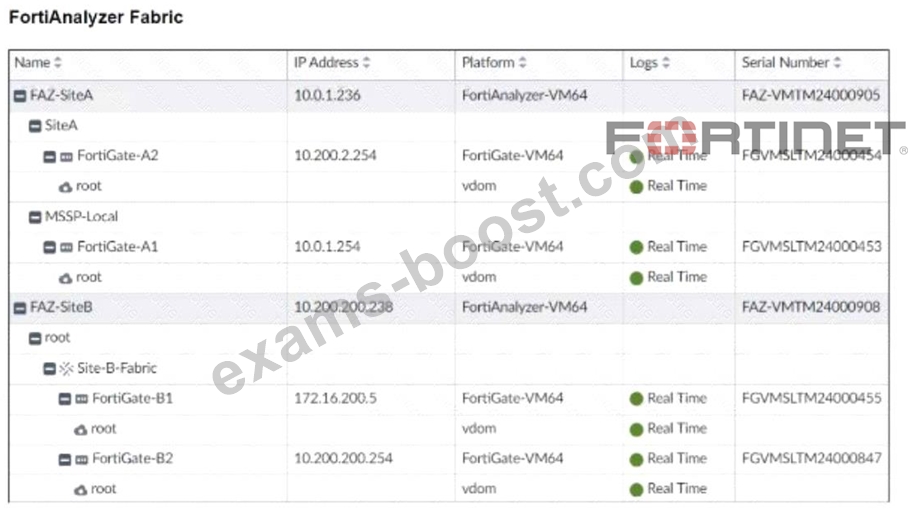
Assume that all devices in the FortiAnalyzer Fabric are shown in the image.
Which two statements about the FortiAnalyzer Fabric deployment are true? (Choose two.)
- A. FAZ-SiteA has two ADOMs enabled.
- B. All FortiGate devices are directly registered to the supervisor.
- C. There is no collector in the topology.
- D. FortiGate-B1 and FortiGate-B2 are in a Security Fabric.
Answer: A,D
Explanation:
* Understanding the FortiAnalyzer Fabric:
* The FortiAnalyzer Fabric provides centralized log collection, analysis, and reporting for connected FortiGate devices.
* Devices in a FortiAnalyzer Fabric can be organized into different Administrative Domains (ADOMs) to separate logs and management.
* Analyzing the Exhibit:
* FAZ-SiteAandFAZ-SiteBare FortiAnalyzer devices in the fabric.
* FortiGate-B1andFortiGate-B2are shown under theSite-B-Fabric, indicating they are part of the same Security Fabric.
* FAZ-SiteAhas multiple entries under it:SiteAandMSSP-Local, suggesting multiple ADOMs are enabled.
* Evaluating the Options:
* Option A:FortiGate-B1 and FortiGate-B2 are underSite-B-Fabric, indicating they are indeed part of the same Security Fabric.
* Option B:The presence of FAZ-SiteA and FAZ-SiteB as FortiAnalyzers does not preclude the existence of collectors. However, there is no explicit mention of a separate collector role in the exhibit.
* Option C:Not all FortiGate devices are directly registered to the supervisor. The exhibit shows hierarchical organization under different sites and ADOMs.
* Option D:The multiple entries underFAZ-SiteA(SiteA and MSSP-Local) indicate that FAZ-SiteA has two ADOMs enabled.
* Conclusion:
* FortiGate-B1 and FortiGate-B2 are in a Security Fabric.
* FAZ-SiteA has two ADOMs enabled.
References:
* Fortinet Documentation on FortiAnalyzer Fabric Topology and ADOM Configuration.
* Best Practices for Security Fabric Deployment with FortiAnalyzer.
NEW QUESTION # 69
......
Download Free Fortinet FCSS_SOC_AN-7.4 Real Exam Questions: https://www.exams-boost.com/FCSS_SOC_AN-7.4-valid-materials.html
Pass Your Exam With 100% Verified FCSS_SOC_AN-7.4 Exam Questions: https://drive.google.com/open?id=1OszdXdZPxzWRKngccNWx6UR-aNxcYogz