

2026 Updated 3V0-24.25 PDF for the 3V0-24.25 Tests Free Updated Today!
Fully Updated Dumps PDF - Latest 3V0-24.25 Exam Questions and Answers
NEW QUESTION # 42
A VKS Administrator is troubleshooting a stalled upgrade of the prod-cluster. The upgrade has halted during the worker node rollout.
The administrator inspects the Machine object for the node currently being deleted (worker-node-02) and finds the following event:
Events:
Type Reason Age From Message
---- ------ ---- ---- -------
Warning DrainFailed 10m machine-controller Failed to drain node: Cannot evict pod "payment- service-5d4f7c" in namespace "finance": PodDisruptionBudget "payment-pdb" is blocking eviction.
Review the PodDisruptionBudget (PDB) status:
NAME MIN AVAILABLE MAX UNAVAILABLE ALLOWED DISRUPTIONS AGE
payment-pdb 2 N/A 50d 0
The deployment payment-service currently has 2 replicas running.
What is the correct procedure to resolve this blockage and allow the upgrade to proceed? (Choose 2.)
- A. Scale up the payment-service deployment to 3 replicas.
- B. Manually delete the Machine object for worker-node-02 using kubectl delete machine --force.
- C. Delete the PodDisruptionBudget temporarily.
- D. Edit the PDB to reduce minAvailable to 1.
- E. Restart the Supervisor Control Plane to reset the drain controller.
Answer: A,D
NEW QUESTION # 43
Which two package management tools can be used to configure and install applications on VMware vSphere Kubernetes Service (VKS)? (Choose two.)
- A. Carvel
- B. Fluent Bit
- C. Multus
- D. Helm
- E. Grafana
Answer: A,D
Explanation:
VCF 9.0 positions VKS clusters as Kubernetes-native environments where platform teams install and manage
"standard packages" and add-ons. In VCF Automation's VKS overview, VMware states that a set of packages is automatically included with a VKS cluster, includingkapp-controllerandsecret-gen controller. These components are part of theCarveltoolchain used for packaging and deploying applications/configuration in a Kubernetes-friendly, declarative way.
In addition, the VCF 9.0 CLI "package" workflows explicitly supportytt overlaysduring package installation
/updates (for example, --ytt-overlay-file and --ytt-overlays), which are configuration mechanisms associated with Carvel-based packaging workflows.
Helmis the other widely used Kubernetes package manager for installing and configuring applications through charts and values, and is commonly used by DevOps teams on Kubernetes clusters such as VKS for app deployment and configuration management. By contrast, Fluent Bit is a log shipper, Multus is a CNI multiplexer, and Grafana is a visualization tool-none are package management tools.
NEW QUESTION # 44
What is the purpose of the VMware vSphere Kubernetes Service (VKS) Service Mesh?
- A. Provides service discovery across multiple clusters.
- B. Provides a centralized, global routing table to simplify and optimize traffic management.
- C. Provides dynamic application load balancing and autoscaling across multiple clusters and multiple sites.
- D. Provides an infrastructure layer that makes communication between applications possible, structured, and observable.
Answer: D
Explanation:
A service mesh is an application communication layer that standardizesservice-to-service trafficinside Kubernetes. Instead of each development team building custom logic for retries, timeouts, encryption, and telemetry, the mesh provides these capabilities consistently across workloads. This is typically done by inserting a data plane (often sidecar proxies or node-level proxies) that intercepts inbound and outbound traffic for each microservice, plus a control plane that distributes configuration and identity material.
The key outcomes align directly to optionB: communication becomespossible(reliable connectivity patterns), structured(consistent routing rules, policies, and identity), andobservable(metrics, logs, and distributed tracing for east-west traffic). A service mesh commonly adds controls such asmTLS encryption, fine-grainedtraffic policy(allow/deny, rate limits, circuit breaking), and progressive delivery patterns (canary/blue-green) without changing application code.
By contrast, service discovery (A) is usually a built-in Kubernetes function, load balancing/autoscaling across sites (C) is not the primary definition of a service mesh, and a single centralized global routing table (D) is not how meshes are typically described or implemented.
NEW QUESTION # 45
A Cloud Administrator initiates a Supervisor upgrade. The process hangs at 55% for an extended period.
The administrator checks the vCenter events and sees:
Event: Supervisor Upgrade Stalled
Detail: Waiting for Control Plane VM 'Supervisor-Control-Plane-VM-02' to power on.
Error: The operation failed due to a file lock on the datastore '[vsanDatastore]'.
Further investigation reveals that a backup job from a third-party tool is currently running on the old Control Plane VMs, holding a lock on the VM files.
What is the correct remediation to allow the upgrade to proceed? (Choose 2.)
- A. Manually delete the 'Supervisor-Control-Plane-VM-02' from disk.
- B. Migrate the Supervisor to a different datastore during the upgrade.
- C. Cancel the backup job to release the file locks.
- D. The upgrade process will automatically retry once the locks are released; no manual intervention is strictly required if the backup finishes within the timeout window, but cancelling is the immediate fix.
- E. Restart the vCenter Server service.
Answer: C,D
NEW QUESTION # 46
A Cloud Administrator is troubleshooting a failed Tanzu Kubernetes Grid (TKG) cluster provisioning.
The cluster creation task in the vSphere Client indicates a failure, but the error message is generic. The administrator decides to investigate the specific controller logs on the Supervisor.
Which specific Kubernetes object events should the administrator inspect using kubectl to find the most detailed error messages regarding the infrastructure provisioning (VM cloning, networking) of the TKG cluster nodes?
- A. kubectl describe tanzukubernetescluster
- B. kubectl get events --namespace kube-system
- C. kubectl describe virtualmachine
- D. kubectl logs deployment/wcp-auth-proxy
Answer: C
NEW QUESTION # 47
Which feature in VMware vSphere Kubernetes Service (VKS) provides vSphere storage policy integration that supports provisioning persistent volumes and their backing virtual disks?
- A. Cloud storage implementation
- B. Container Storage Interface (CSI)
- C. vSphere Cloud Native Storage (CNS)
- D. Cloud storage provider
Answer: C
Explanation:
VCF 9.0 describesCloud Native Storage (CNS) on vCenteras the component that implements "provisioning and lifecycle operations for persistent volumes." When provisioning persistent volumes, CNS "interacts with the vSphere First Class Disk functionality to create virtual disks that back the volumes," and it
"communicates with Storage Policy Based Management to guarantee a required level of service to the disks." This is exactly the storage-policy-to-backed-virtual-disk relationship the question is testing: storage policies (via policy-based management) define requirements, and CNS is the vCenter-side service that applies those requirements while creating and managing the backing storage objects.
In contrast,CSI(including Supervisor CNS-CSI and VKS pvCSI) is the Kubernetes-facing interface/driver used to request and consume storage, but it does not "provide" the vSphere storage policy system; rather, it relies on CNS/CNS-CSI and vCenter services to fulfill provisioning requests. Therefore,vSphere Cloud Native Storage (CNS)is the correct choice.
NEW QUESTION # 48
A Platform Engineer attempts to create a snapshot of a PVC named mysql-data but the VolumeSnapshot object remains in a ReadyToUse: False state.
The engineer inspects the status:
$ kubectl describe volumesnapshot mysql-snap
...
Status:
Ready To Use: false
Error: Snapshot creation failed: Error: CNS: CnsVolumeNotFound
What is the most likely cause of this error? (Choose 2.)
- A. The virtual disk (VMDK) associated with the PV was manually moved to a different datastore using Storage vMotion without updating the CNS metadata.
- B. The underlying Persistent Volume (PV) backing the PVC mysql-data has been deleted or detached from the CNS (Cloud Native Storage) perspective in vSphere.
- C. The PVC mysql-data is currently mounted by a running Pod, and the vSphere CSI driver (in certain versions/configurations) or the specific filesystem requires the volume to be quiesced or unmounted (or the FCD ID is missing/mismatched).
- D. The Namespace quota for snapshots has been exceeded.
- E. The VolumeSnapshotClass specified does not exist.
Answer: A,B
NEW QUESTION # 49
An architect is meeting with a customer to deploy a mission-critical application using the vSphere Kubernetes Service. The architect learns that the ticketing application runs at a steady state 80% of the time but has significant spikes when an event is announced. The application is unable to meet demand even though resources are available.
What will address the issue of peak demand?
- A. Install cluster autoscaling.
- B. Oversubscribe the vSphere Kubernetes environment so that adequate resources are always available.
- C. Install the Contour Supervisor Services package.
- D. Enable Foundation Load Balancer to manage the network traffic during peak demand.
Answer: A
Explanation:
The problem describes demand spikes where capacity exists, but the application cannot meet demand-this typically indicates the cluster needs toscale out(more nodes/pods) automatically when load increases. In VCF
9.0, VKS supportsCluster Autoscaleras an optional package and specifically calls out improvements: "Cluster Autoscaler supports scaling from zero or to zero... You must have the autoscaler standard package installed." This directly supports optionA(install cluster autoscaling) as the mechanism to dynamically add capacity during peak events and reduce it afterward, optimizing cost and operations while meeting bursts. A load balancer (including Foundation Load Balancer) helps distribute traffic acrossexistingendpoints, but it does not create new compute capacity when pods are pending due to insufficient nodes. Similarly, installing Contour relates to ingress (routing inbound traffic) and is not, by itself, a capacity scaling solution. Oversubscription is a risky workaround that can degrade performance and does not provide targeted, policy-driven elasticity.
Therefore, enablingcluster autoscalingis the correct way to address burst demand when underlying resources are available.
NEW QUESTION # 50
An administrator is configuring the Supervisor Service in vCenter.
Click the option an administrator uses to begin creating a vSphere Supervisor Zone.
Answer:
Explanation:
Explanation:
Hosts and Clusters
To create avSphere Zone(used as a Supervisor Management Zone and/or Workload Zone), the administrator must start from the vSphere Client inventory wherevCenterand its clusters are managed. That's why the correct starting point in the "Inventories" toolbar isHosts and Clusters-it is the entry point used to select the vCenter object and the target clusters.
VCF 9.0 documents the zone-creation workflow as:navigate to vCenter, thenSelect Configure, thenselect vSphere Zones, and finally clickAdd New vSphere Zone. After naming the zone, youselect a vSphere cluster to add to the zoneand finish the wizard.
This sequence matches the intent of the hotspot: you must first open the inventory view that exposes vCenter and clusters (Hosts and Clusters), then perform the configuration steps under vCenter to define vSphere Zones. Once created, these zones can later be selected during Supervisor deployment (for multi-zone placement) or assigned to namespaces for workload placement.
NEW QUESTION # 51
In the context of a Tanzu Kubernetes Grid (TKG) cluster upgrade within vSphere with Tanzu, what is the primary mechanism used to update the worker nodes?
- A. Rolling update: New worker node VMs are deployed with the new version image, workloads are drained from old nodes to new ones, and old nodes are deleted.
- B. Blue/Green deployment: A completely new cluster is deployed alongside the old one, and the Load Balancer VIP is switched to the new cluster.
- C. Snapshot reversion: The nodes are reverted to a pre-configured snapshot that contains the new software version.
- D. In-place upgrade: The package manager (yum/apt) inside each worker node VM is triggered to update the kubelet and container runtime binaries.
Answer: A
NEW QUESTION # 52
Drag and drop the three features into the correct order from Possible Features list on the left and place them into the Provided by Service Mesh on the right side. (Choose three.)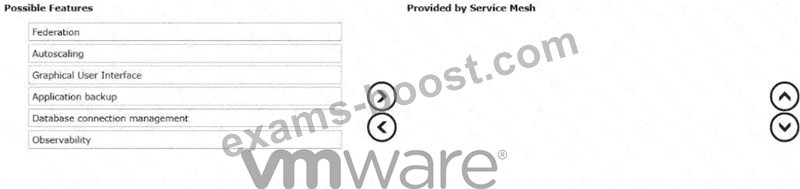
Answer:
Explanation: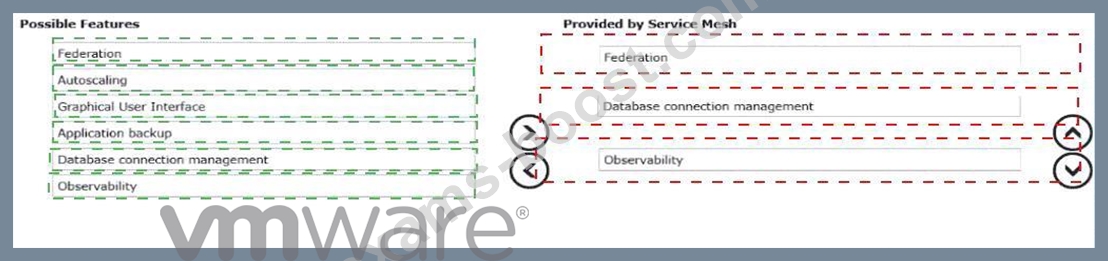
Explanation:
Provided by Service Mesh (choose three, in order):
* Federation
* Graphical User Interface
* Observability
A service mesh is an application networking layer that managesservice-to-service communicationacross Kubernetes clusters, providing consistent connectivity, policy enforcement, and visibility without requiring application code changes.Federationis a service-mesh capability because modern meshes (especially multi- cluster/enterprise implementations) can connect services across multiple clusters and environments, enabling shared identity, cross-cluster service discovery, and uniform policy application (often described as multi- cluster or federated service connectivity). AGraphical User Interfaceis commonly provided alongside the service mesh platform to centrally configure policies (traffic routing, access controls, security settings) and to visualize service topology and health.Observabilityis a core service-mesh outcome: by inserting sidecar proxies (or equivalent dataplane components) into the data path, the mesh can generate consistentmetrics, logs, and distributed tracesfor service traffic, enabling latency/error monitoring and dependency mapping.
The other options are not service-mesh features:Autoscalingis handled by Kubernetes/HPA and metrics pipelines,application backupis typically provided by backup tools (e.g., Velero-like solutions), anddatabase connection managementis handled by application frameworks or database proxies rather than the service mesh itself.
NEW QUESTION # 53
A Platform Engineer is enabling Workload Management on a vSphere Cluster to prepare it for a new development team. The environment utilizes NSX for networking.
Review the following configuration options available in the "Enable Workload Management" wizard:
[Network Stack]
1. NSX
2. VDS
[Load Balancer]
1. NSX Load Balancer
2. HAProxy
3. Avi Load Balancer
Which specific configuration combination facilitates the deployment of vSphere Pods (native pods)?
- A. Network Stack: NSX | Load Balancer: NSX Load Balancer
- B. Network Stack: VDS | Load Balancer: Avi Load Balancer
- C. Network Stack: NSX | Load Balancer: Avi Load Balancer
- D. Network Stack: VDS | Load Balancer: HAProxy
Answer: A
NEW QUESTION # 54
A Cloud Architect is designing a storage strategy for a Zonal Supervisor deployment across 3 Availability Zones (Zone-1, Zone-2, Zone-3) to support a highly available Kafka cluster.
Requirements:
1. Kafka brokers will be distributed across all 3 zones.
2. Each broker needs a persistent volume for data.
3. If a pod in Zone-1 fails and is rescheduled to Zone-1 (same zone), it must re-attach to its data.
4. If Zone-1 fails completely, the architecture does NOT require the data from Zone-1 to be accessible in Zone-2 (Kafka handles app-level replication).
5. Storage management must be automated via Kubernetes.
Which storage policy design best meets these requirements while minimizing cross-zone latency and cost? (Select all that apply.)
- A. Create three distinct vSphere Storage Policies (e.g., local-zone-1, local-zone-2, local-zone-3), each tagged to use only the local datastores within its respective zone.
- B. Use a Topology-Aware Storage Class. This can be achieved by using a single Storage Policy (e.g., zonal-storage) that is compatible with storage in all zones, and relying on the WaitForFirstConsumer volume binding mode.
- C. Use a vSAN Stretched Cluster policy that replicates data synchronously across all zones.
- D. Configure the Kafka StatefulSet to use the zonal-storage class. When a pod is scheduled to a node in Zone-1, the CSI driver (via delayed binding) will automatically provision the volume on the datastore in Zone-1 to satisfy the topology constraint.
- E. Assign all three zonal policies to the kafka-namespace.
Answer: B,D
NEW QUESTION # 55
A Platform Engineer is designing a Blue/Green Deployment model for a critical application using Contour Ingress Controller.
Goal:
* v1 of the app is live.
* v2 is deployed but receives no traffic.
* The engineer wants to shift 10% of the traffic to v2 for testing (Canary) before a full switch.
Which Contour Custom Resource Definition (CRD) should be used instead of the standard Kubernetes Ingress object to achieve this weighted traffic splitting?
- A. IngressRoute
- B. ServiceEntry
- C. VirtualService
- D. HTTPProxy
- E. NetworkPolicy
Answer: D
NEW QUESTION # 56
A Security Operations Analyst is creating a secure Workload Deployment Model for a highly regulated environment. The model requires that no Pod can run as the root user, and the filesystem must be read-only.
Which mechanism should be implemented to enforce these constraints across the entire TKG cluster?
(Select all that apply.)
- A. Configure the securityContext in the default Pod template for the deployment model with runAsNonRoot: true and readOnlyRootFilesystem: true.
- B. Implement a Pod Security Admission (PSA) policy (or Pod Security Policy in older versions) at the namespace level, setting the enforcement level to restricted.
- C. Use Tanzu Mission Control to apply a "Security" Policy (OPA/Gatekeeper) that denies any pod creation request lacking these security contexts.
- D. Disable the root user in the TKR Node OS image.
- E. Configure the underlying VM Class to be read-only at the vSphere level.
Answer: A,B,C
NEW QUESTION # 57
A Platform Engineer is designing a Supervisor architecture for a critical production environment that requires resilience against the failure of an entire Availability Zone (AZ). The environment consists of three vSphere Zones: Zone-1, Zone-2, and Zone-3.
Review the following proposed configuration for the Supervisor deployment:
# Proposed Supervisor Config
Name: Prod-Supervisor
Zones:
- Zone-1
- Zone-2
Control Plane Size: Medium
Network: vDS with NSX Advanced Load Balancer
Storage: vSAN Stretched Cluster
Why will this configuration fail to meet the requirement of tolerating a full zone failure while maintaining full control plane functionality? (Select all that apply.)
- A. vDS networking does not support multi-zone Supervisor deployments; NSX-T Data Center is a strict requirement for Zonal Supervisors.
- B. The Supervisor must be deployed in a single zone and rely on vSphere HA to restart VMs in the other zones.
- C. The vSAN Stretched Cluster provides storage resilience, but the Supervisor Control Plane VMs must be anti-affined across three distinct fault domains to ensure one remains available and quorum is held.
- D. The "Medium" Control Plane size does not support multi-zone availability; "Large" is required.
- E. A Supervisor deployed across only two zones (Zone-1 and Zone-2) cannot maintain a quorum (etcd) if one of those zones fails; a minimum of three zones is required for a Zonal Supervisor to survive a zone failure.
Answer: C,E
NEW QUESTION # 58
What is the purpose of a ReplicaSet in the VMware vSphere Kubernetes Service (VKS)?
- A. To provide a stable network identity and persistent storage for stateful applications.
- B. To expose a set of pods as a network service with a single, stable IP address.
- C. To ensure that a specified number of identical pods are running at all times.
- D. To run a single instance of a pod on every node in a cluster.
Answer: C
Explanation:
A ReplicaSet is a core Kubernetes workload controller used in VKS clusters to maintainavailability and steady-state capacityfor stateless applications. Its primary purpose is to ensure that adesired number of identical pod replicasare running continuously. If a pod is deleted, crashes, or is evicted because a node fails, the ReplicaSet detects that the current number of matching pods has dropped below the target and immediately creates replacement pods to restore the requested replica count. Conversely, if too many matching pods exist (for example, due to manual creation or a transient surge), it scales down by deleting excess pods to return to the desired state.
This behavior makes ReplicaSets foundational to reliable, self-healing application operation in Kubernetes and therefore in VKS. In practice, administrators and DevOps teams usually interact with ReplicaSets indirectly through higher-level controllers likeDeployments, which manage rolling updates and revisions while using ReplicaSets underneath to enforce the replica count for each version of an application. Options A, B, and D map to other Kubernetes objects (Service, StatefulSet, and DaemonSet respectively), not ReplicaSet.
NEW QUESTION # 59
A VI Administrator is preparing a vSphere Namespace named dev-playground for the DevOps team to deploy Virtual Machines via kubectl. The administrator has already created a Content Library named K8s-Images containing the necessary OVF templates.
Review the Namespace configuration view in the vSphere Client:
Namespace: dev-playground
[VM Service]
VM Classes: [ 2 selected ]
Content Libraries: [ 0 selected ]
What specific action must the administrator take to enable the DevOps team to resolve the image names specified in their VM YAML manifests?
- A. Add the K8s-Images Content Library to the "Content Libraries" card in the Namespace configuration.
- B. Convert the OVF templates to Docker images and push them to the embedded Harbor registry.
- C. Share the K8s-Images library globally from the vCenter Administration menu; namespace assignment is automatic.
- D. Deploy a specific "Image Registry Pod" into the namespace.
Answer: A
NEW QUESTION # 60
A VI Administrator is managing the lifecycle of VM images used by the VM Service. A new corporate standard requires that all Linux VMs deployed via kubectl must use the hardened image corp-linux- v2.ova.
The administrator has uploaded the new OVA to the Corporate-Images Content Library.
How can the administrator ensure that developers can immediately begin deploying VMs using this new image name in their YAML? (Select all that apply.)
- A. The administrator must create a "VM Image" custom resource object in Kubernetes mapping the OVA UUID to a name.
- B. The developers must change the kind in their YAML to VirtualMachineImage.
- C. The VM Service automatically syncs and discovers new images in assigned libraries; the developers can reference corp-linux-v2 in the spec.imageName field once the sync completes.
- D. The administrator must manually restart the wcp-vmop-controller pod on the Supervisor to recognize the new image.
- E. Ensure the Corporate-Images Content Library is assigned to the developers' vSphere Namespace.
Answer: C,E
NEW QUESTION # 61
......
Free 3V0-24.25 Exam Questions 3V0-24.25 Actual Free Exam Questions: https://www.exams-boost.com/3V0-24.25-valid-materials.html