

FCP_FAC_AD-6.5 100% Guarantee Download FCP_FAC_AD-6.5 Exam PDF Q&A [Dec 04, 2025]
Get FCP_FAC_AD-6.5 Actual Free Exam Q&As to Prepare for Your Fortinet Certification
NEW QUESTION # 59
An administrator wants users and devices that cannot be identified transparently, such as Android BYOD devices, to be able to register and create their own credentials.
In this case, which FortiAuthenticator user identity discovery method can the administrator use?
- A. Portal authentication
- B. SSOMA
- C. Kerberos-based authentication
- D. Syslog messaging or SAML IdP
Answer: A
Explanation:
Portal authentication allows unidentified users or devices, such as Android BYOD devices, to self-register and create credentials through a captive or guest portal on FortiAuthenticator.
NEW QUESTION # 60
What is the role of the FortiAuthenticator certificate management service?
- A. Generating local certificates for various purposes
- B. Managing user passwords
- C. Managing network load balancing
- D. Handling firewall configurations
Answer: A
NEW QUESTION # 61
You are an administrator for a large enterprise and you want to delegate the creation and management of guest users to a group of sponsors.
How would you associate the guest accounts with individual sponsors?
- A. Select the sponsor on the guest portal, during registration.
- B. As an administrator, you can assign guest groups to individual sponsors.
- C. You can automatically add guest accounts to groups associated with specific sponsors.
- D. Guest accounts are associated with the sponsor that creates the guest account.
Answer: D
NEW QUESTION # 62
Which two capabilities does FortiAuthenticator offer when acting as a self-signed or local CA?
(Choose two)
- A. Validating other CA CRLs using OSCP
- B. Importing other CA certificates and CRLs
- C. Merging local and remote CRLs using SCEP
- D. Creating, signing, and revoking of X.509 certificates
Answer: B,D
NEW QUESTION # 63
Which FSSO discovery method transparently detects logged off users without having to rely on external features such as WMI polling?
- A. FortiClient SSO mobility agent
- B. RADIUS accounting
- C. DC polling
- D. Windows AD polling
Answer: A
Explanation:
The FortiClient SSO Mobility Agent runs on the endpoint and communicates login and logoff events directly to FortiAuthenticator, allowing transparent detection of logged-off users without relying on external mechanisms like WMI polling.
NEW QUESTION # 64
You are the administrator of a large network that includes a large local user datadabase on the current Fortiauthenticatior. You want to import all the local users into a new Fortiauthenticator device.
Which method should you use to migrate the local users?
- A. Import users using RADIUS accounting updates.
- B. Import the current directory structure.
- C. Import users using a CSV file.
- D. Import users from RADUIS.
Answer: C
NEW QUESTION # 65
An administrator is integrating FortiAuthenticator with an existing RADIUS server with the intent of eventually replacing the RADIUS server with FortiAuthenticator.
How can FortiAuthenticator help facilitate this process?
- A. By importing the RADIUS user records
- B. By enabling learning mode in the RADIUS server configuration
- C. By enabling automatic REST API calls from the RADIUS server
- D. By configuring the RADIUS accounting proxy
Answer: B
NEW QUESTION # 66
You want to monitor FortiAuthenticator system information and receive FortiAuthenticator traps through SNMP.
Which two configurations must be performed after enabling SNMP access on the FortiAuthenticator interface? (Choose two.)
- A. Enable logging services.
- B. Set the thresholds to trigger SNMP traps.
- C. Upload management information base (MIB) files to SNMP server.
- D. Associate an ASN.1 mapping rule to the receiving host.
Answer: B,C
Explanation:
You must set thresholds that will trigger SNMP traps so FortiAuthenticator knows when to send alerts.
The SNMP server needs the appropriate MIB files uploaded to interpret FortiAuthenticator's SNMP data and traps correctly.
NEW QUESTION # 67
In the context of FortiAuthenticator, what is the purpose of active authentication?
- A. Encrypting network traffic
- B. Detecting hardware failures
- C. Managing firewall rules
- D. Enforcing access controls based on user identity
Answer: D
NEW QUESTION # 68
Why would you configure an OCSP responder URL in an end-entity certificate?
- A. To designate a server for certificate status checking
- B. To designate the SCEP server to use for CRL updates for that certificate
- C. To provide the CRL location for the certificate
- D. To identify the end point that a certificate has been assigned to
Answer: A
Explanation:
Configuring an OCSP responder URL in an end-entity certificate designates the server that will be queried to check the real-time revocation status of the certificate.
NEW QUESTION # 69
What is the purpose of using local authentication events for Fortinet Single Sign-On (FSSO)?
- A. To sync user accounts with third-party services
- B. To provide access only to local resources
- C. To eliminate the need for authentication altogether
- D. To track user logon events within FortiAuthenticator
Answer: D
NEW QUESTION # 70
Which certificate type is commonly used to secure communication between a web browser and a website?
- A. Server certificate
- B. Root certificate
- C. Intermediate certificate
- D. User certificate
Answer: A
NEW QUESTION # 71
What is the benefit of using remote authentication services?
- A. They reduce the need for firewalls
- B. They increase network speed
- C. They replace the need for encryption protocols
- D. They enable secure access for users outside the corporate network
Answer: D
NEW QUESTION # 72
Which two features of FortiAuthenticator are used for EAP deployment? (Choose two)
- A. MAC authentication bypass
- B. LDAP server
- C. Certificate authority
- D. RADIUS server
Answer: C,D
NEW QUESTION # 73
Refer to the exhibit.
FortiAuthenticator Topology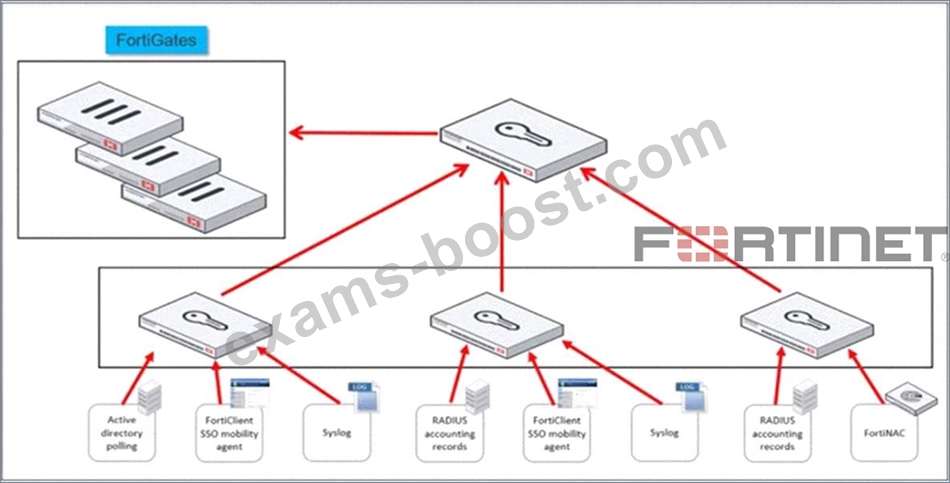
What type of FortiAuthenticator configuration is shown in this topology?
- A. Active-active HA
- B. RADIUS proxy
- C. Authentication load balancing nodes
- D. Tiered architecture
Answer: D
Explanation:
The diagram shows a tiered architecture where multiple FortiAuthenticator devices collect authentication data from various sources and forward it to an upper-tier FortiAuthenticator, which consolidates and provides SSO information to FortiGate devices.
NEW QUESTION # 74
When configuring two-factor authentication (2FA) in FortiAuthenticator, which of the following factors can be used together?
- A. Something a user is and something a user does
- B. Two biometric factors
- C. Something a user has and something a user does
- D. Something a user knows and something a user has
Answer: D
NEW QUESTION # 75
What are tokens commonly used for in authentication systems?
- A. Sending text messages
- B. Storing biometric data
- C. Generating random security codes
- D. Displaying the current time
Answer: C
NEW QUESTION # 76
What can third-party logon events be used for in Fortinet Single Sign-On (FSSO)?
- A. Creating virtual networks
- B. Generating weather forecasts
- C. Automatically updating software
- D. Tracking user logon events from other systems
Answer: D
NEW QUESTION # 77
A device that is 802.1X non-compliant must be connected to the network.
Which authentication method can you use to authenticate the device with FortiAuthenticator?
- A. EAP-TTLS
- B. MAC-based authentication
- C. Machine-based authentication
- D. EAP-TLS
Answer: B
NEW QUESTION # 78
In a PKI infrastructure, what is the purpose of the root certificate?
- A. It is a backup certificate for emergency situations
- B. It is used for encrypting sensitive user data
- C. It is the highest-level certificate that signs other certificates
- D. It is the certificate of the end user in a communication
Answer: C
NEW QUESTION # 79
Why would you configure an OCSP responder URL in an end-entity certificate?
- A. To designate a server for certificate status checking
- B. To designate the SCEP server to use for CRL updates for that certificate
- C. To provide the CRL location for the certificate
- D. To identify the end point that a certificate has been assigned to
Answer: A
NEW QUESTION # 80
You are a network administrator with a large wireless environment. FortiAuthenticator acts as the RADIUS server for your wireless controllers. You want specific wireless controllers to authenticate users against specific realms.
How would you satisfy this requirement?
- A. Enable Adaptive Authentication
- B. RADUIS policy
- C. Define RADIUS clients
- D. Create Access point groups
Answer: B
NEW QUESTION # 81
What is the primary purpose of a digital certificate in PKI?
- A. To store personal information of the certificate holder
- B. To provide access to encrypted websites only
- C. To encrypt all network traffic in a network environment
- D. To verify the identity of the certificate holder and enable secure communication
Answer: D
NEW QUESTION # 82
......
FCP_FAC_AD-6.5 Questions Truly Valid For Your Fortinet Exam: https://www.exams-boost.com/FCP_FAC_AD-6.5-valid-materials.html
Fortinet Actual Free Exam Questions And Answers: https://drive.google.com/open?id=16jPRnXbJ96RFYqoXvfbQjnQsQySsL2LM